
Featured image for Why is wooden furniture no longer made of real wood? A Manufacturer’s Guide
Why is wooden furniture no longer made of real wood? A Manufacturer’s Guide
Not long ago, a Polish retailer showed me a “solid oak” wardrobe sample that looked perfect—until I checked the edge and found MDF beneath the veneer. It’s a scene I’ve repeated across Germany, France, and the Nordics for the last decade: buyers surprised by what’s actually inside their so-called wooden furniture.
The industry-wide shift from solid wood to engineered panels in mass-market furniture is driven by supply limitations, strict forestry regulations, and the need for cost control at scale. Engineered materials such as MDF, particleboard, and plywood maximize raw wood utilization by using wood fibers, chips, and fast-growing plantation timber, bonded with resins. These panels enable automated production, flat-pack formats, and consistent quality.
Let me tell you, this shift wasn't a sudden decision; it was a slow, practical inevitability driven by the demands of mass retail. When I started in this business 15 years ago, we were still sourcing solid pine for basic bedroom sets. Today, if a buyer asks me for 1,000 wardrobes under €200 ex-works, I know immediately we’re talking MDF or particleboard. Why? Because I can guarantee the supply chain, the lead time, and the price—something solid wood simply can't offer at that scale.
Why Use Engineered Panels Instead of Solid Wood?
Engineered wood panels like MDF, particleboard, and plywood have largely replaced solid hardwood in mass-market furniture due to lower material costs, reliable global supply, and manufacturing efficiency. Solid woods are expensive, tightly regulated, and slower-growing, whereas engineered panels support automated production, flat-pack shipping1, and allow for affordable pricing in large-scale retail channels.
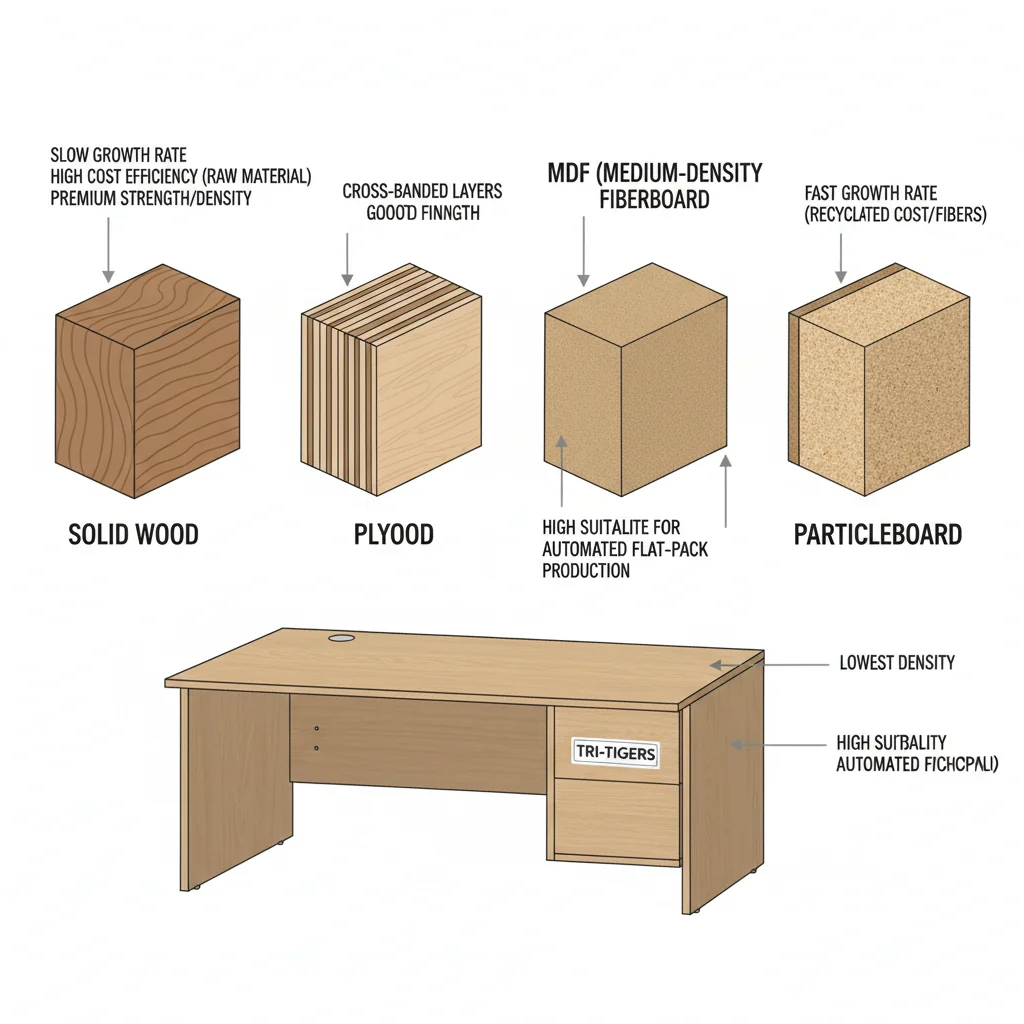
Most people don’t realize that the shift from solid wood to engineered panels—MDF, particleboard, and plywood—wasn’t just about saving money. It’s about making furniture production scalable and consistent. When I worked with a German importer last year, their buyers wanted 18mm E1-rated MDF2 shelves, not oak, because the supply chain is predictable and lead times stay under 40 days, even for 1,200-piece 40HQ orders. That’s nearly impossible with solid wood due to raw material fluctuations and longer seasoning times.
Here’s why, in my experience, engineered panels dominate mass-market furniture:
- Lower Material Cost: Engineered boards3 use wood fibers and chips from fast-growing trees. That keeps the price 30–50% below solid wood, which is critical for large retail chains.
- Reliable Global Supply: Mills in China, Poland, and Vietnam can maintain steady output year-round. I’ve seen hardwood shortages add months to orders for UK customers, but panels rarely face that issue.
- Efficient Manufacturing: Flat, uniform panels allow for automated CNC cutting and drilling, so factories can run high-speed lines. Solid wood needs hand selection and extra processing, which slows everything down.
- Optimized Shipping: Most MDF and particleboard cabinets are flat-pack. That means 300–350 units per 40HQ container, compared to under 150 for pre-assembled solid wood pieces. I’ve personally optimized loading plans that cut shipping costs by 40% just by switching to flat-pack.
- Regulatory Compliance: E1 and CARB P2 panel grades meet European and US formaldehyde limits. Solid wood is often subject to stricter forestry and import controls, which adds complexity and risk to large orders.
To be honest, if you see a three-door wardrobe at €120 ex-works, it’s almost always engineered core. I always suggest clarifying the core material and edge banding spec before placing volume orders. The biggest mistake I see is assuming “wood veneer” means the core is solid.
E1-rated MDF panels are preferred over solid oak for large orders because their moisture content is standardized around 6-8%, ensuring dimensional stability in furniture productionTrue
Engineered panels like E1-rated MDF have controlled moisture levels, reducing warping and shrinkage variability common in solid wood, which can fluctuate between 8-15%, complicating mass production and lead times.
Solid wood furniture production is faster than engineered panel assembly because natural wood requires less processing and finishing timeFalse
Solid wood processing involves variable drying, planing, and quality grading that extend lead times, whereas engineered panels come pre-finished and dimensionally consistent, enabling scalable production with shorter turnaround times.
Key takeaway: Furniture manufacturing shifted to engineered wood panels for cost, supply, and process efficiency. Engineered materials allow for mass production and lower prices, while solid wood is rarer, more expensive, and mainly used in premium segments. Buyers should expect engineered cores in most affordable large furniture pieces.
How Do Solid and Engineered Wood Differ?
Solid wood furniture uses natural lumber planks, with each component showing continuous grain and natural wood movement. Engineered wood, such as MDF, particleboard, and plywood, is manufactured by bonding wood fibers, chips, or plies into sheets, then finished with veneer or laminate. Engineered panels offer greater dimensional stability, while solid wood offers higher strength and authenticity.
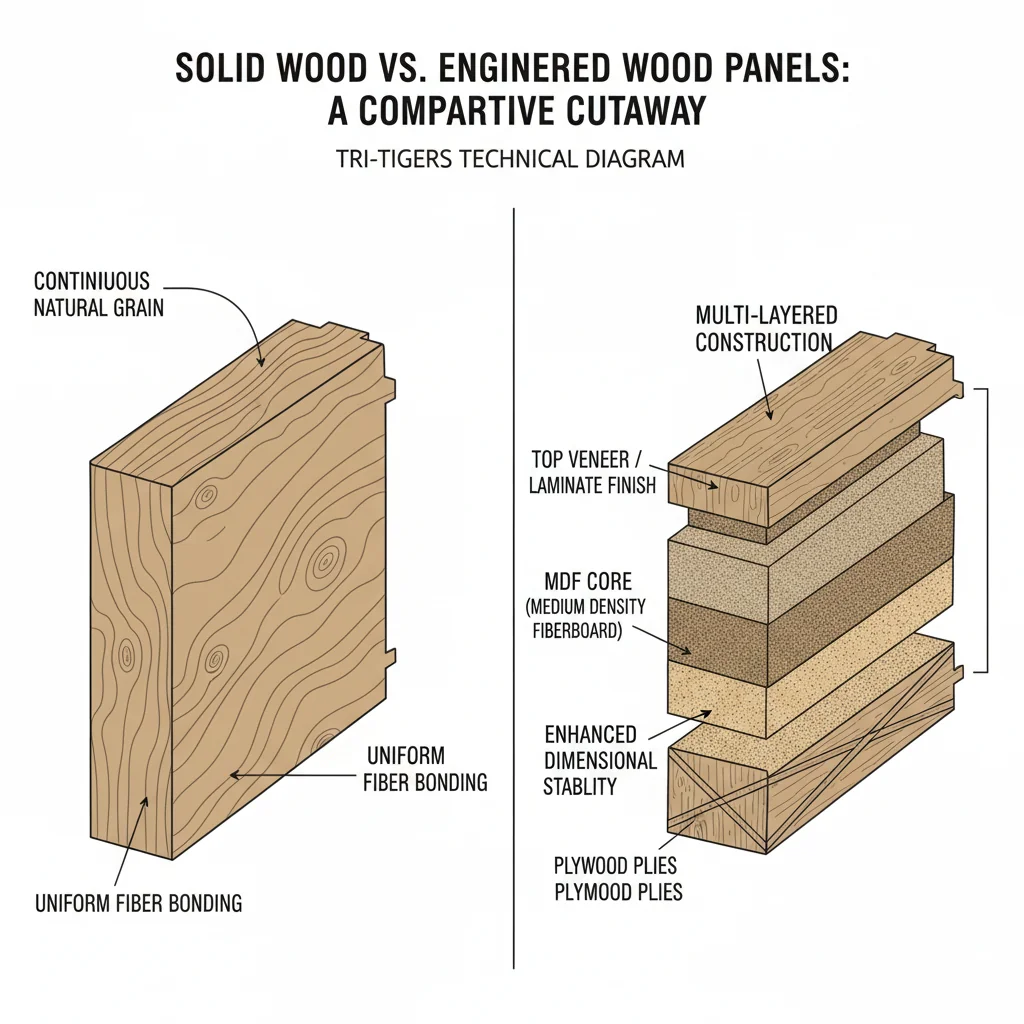
Here’s what matters most when deciding between solid and engineered wood: you need to match the material to the function. Solid wood—think oak or beech planks—offers real strength and a unique grain, but it’s sensitive to climate. In Germany, I’ve seen solid oak doors swell by 4mm in a humid summer, then shrink and crack in winter. That movement is natural but can ruin tight-fitting panels or cause joints to open. Engineered panels like MDF or particleboard solve that—they’re dimensionally stable, so your 18mm board stays 18mm year-round, even if the humidity jumps from 45% to 65%.
A Polish importer recently asked if MDF could replace solid pine for cabinet sides. For large, flat surfaces, I said yes—E1-rated 16mm MDF with melamine finish is perfect for kitchen carcasses. It resists warping and lets you produce clean, modern lines. But for high-stress parts (like legs or structural frames), I always suggest solid wood or at least 18mm plywood. From my experience, screw holding is a weak spot for MDF and particleboard—over-tighten, and you risk splitting or crumbling, especially with flat-pack assembly.
Keep in mind: a 40HQ container fits around 1,200 flat-pack cabinets in MDF, versus about 900 in solid wood—so engineered panels boost your shipping efficiency. I suggest specifying E1 or E0 emissions, 1mm PVC edge banding, and moisture-resistant grades for kitchens or bathrooms. Before committing, request both material samples and a full assembly test. The right choice comes down to use case, climate, and your buyers’ expectations.
Engineered wood panels like MDF or particleboard typically exhibit less than 0.5% dimensional change across humidity variations, compared to up to 2% in solid wood planksTrue
Engineered wood is manufactured by bonding wood fibers or particles under heat and pressure with adhesives, creating a stable composite that resists swelling and shrinking caused by moisture, unlike solid wood which expands and contracts along its grain with humidity changes.
Solid wood furniture is generally more resistant to cracking and joint failures than engineered wood due to its natural grain structureFalse
Solid wood is more prone to cracking and joint separation because its natural grain moves with humidity and temperature changes, whereas engineered wood panels have consistent stability that reduces the risk of cracking and joint failures.
Key takeaway: Understanding the structural and material differences between solid and engineered wood guides manufacturers and buyers in selecting the right material for each furniture application. Engineered panels excel in stability for large surfaces, while solid wood and quality plywood are preferred for high-stress, visible, or structural components.
How Durable Is Engineered Wood Furniture?
Engineered wood furniture typically lasts 5–10 years under normal home use, making it suitable for rentals or temporary setups. Panels may sag under heavy loads or fail when exposed to moisture, with limited repair options. In contrast, solid wood furniture often endures over 20 years, allows refinishing, and can withstand repeated repairs.
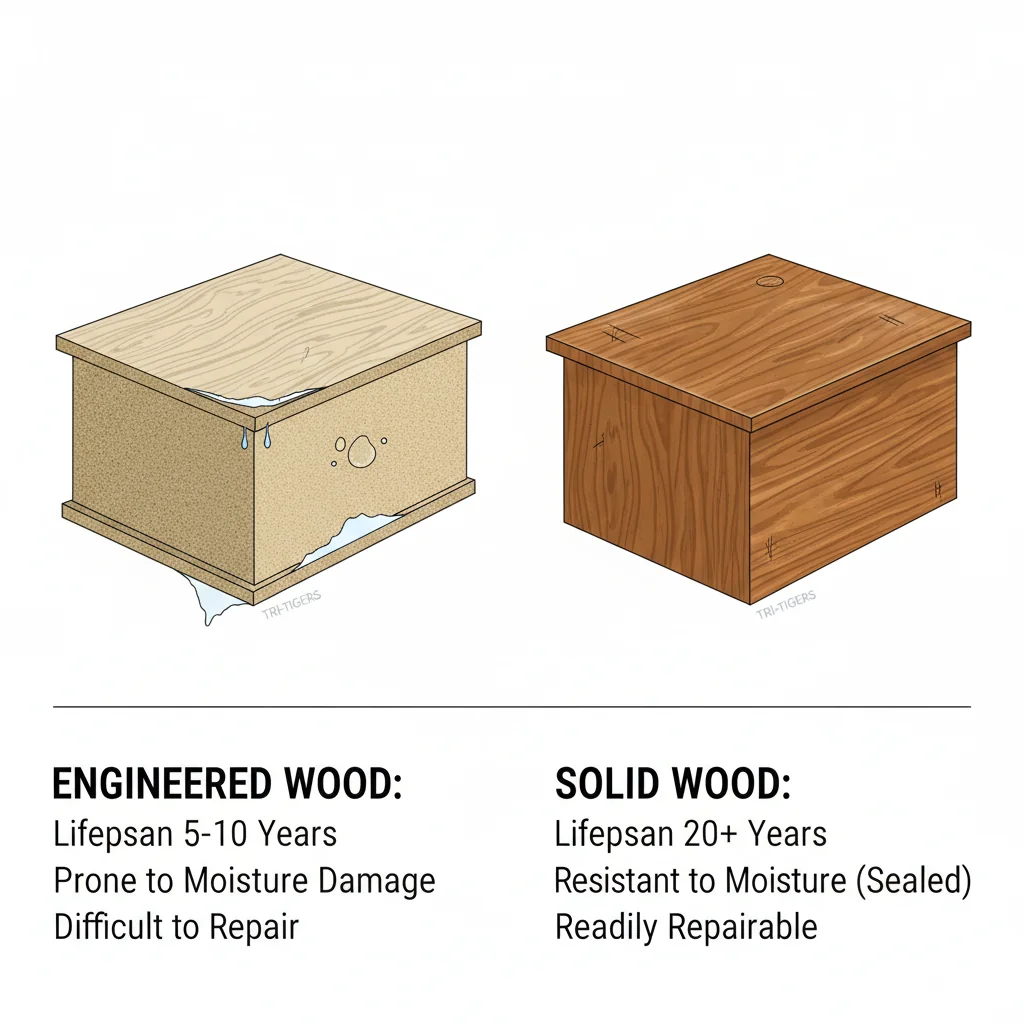
Let me share something important about engineered wood furniture durability, especially for buyers planning projects in Germany or the UK. Engineered panels—like MDF and particleboard—are designed for cost efficiency and quick production. In a typical flat-pack sideboard made from 16mm melamine-faced particleboard, you can expect a solid 5–10 years of everyday use. That’s enough for student apartments or short-term rentals. But I’ve seen cases where a Polish retailer had to replace 40% of their lowboard stock within six years due to moisture swelling and sagging shelves. Once the core absorbs water—say, if a drink spills and isn’t wiped quickly—the board can blow out, and repairs rarely hold.
From my experience, panel thickness and edge banding make a real difference. An 18mm E1-rated MDF shelf with 1mm PVC edge banding will hold more weight and resist chipping better than thinner, budget options with 0.4mm melamine edges. Still, even the best panels can’t be refinished or re-glued the way solid wood can. If a corner splits or a screw pulls loose, most buyers opt to replace rather than repair.
Economically, you’ll often pay 30–50% less upfront for engineered wood. A 40HQ container fits around 1,200 flat-pack desks, compared to 600 solid wood pieces. For high-wear items like dining tables or beds, I suggest considering solid wood or at least a solid frame. For light-use or fashion-driven pieces, engineered boards are perfectly practical. Just plan for eventual replacement and check that panel specs match your intended use.
Melamine-faced particleboard with a thickness of 16mm typically provides 5–10 years of durability under everyday use, making it suitable primarily for short-term rentals or student housingTrue
The combination of melamine facing and 16mm particleboard offers a balance of cost and durability, but the engineered wood core is prone to wear and moisture damage over time, limiting lifespan to around a decade in typical usage scenarios.
Engineered wood furniture made from particleboard is generally more resistant to moisture and structural deformation than solid hardwood furnitureFalse
Particleboard and MDF are more susceptible to moisture absorption and swelling compared to solid hardwood, which has natural grain and density that provide better resistance to water damage and structural changes over time.
Key takeaway: Engineered wood furniture offers short- to mid-term durability at a lower upfront cost, but often requires replacement within a decade, especially under heavy or moist conditions. For high-wear or long-term applications, solid wood provides superior lifespan, value, and repairability.
How Do Engineered Woods Impact Health, Environment?
Engineered wood furniture uses adhesives, often urea-formaldehyde-based, which can release volatile organic compounds like formaldehyde—a respiratory irritant. Modern emission standards such as CARB Phase 2 and TSCA Title VI minimize risks. Environmentally, engineered panels optimize wood use and reduce waste, while reclaimed and FSC-certified solid wood offer sustainable alternatives prized in eco-conscious markets.
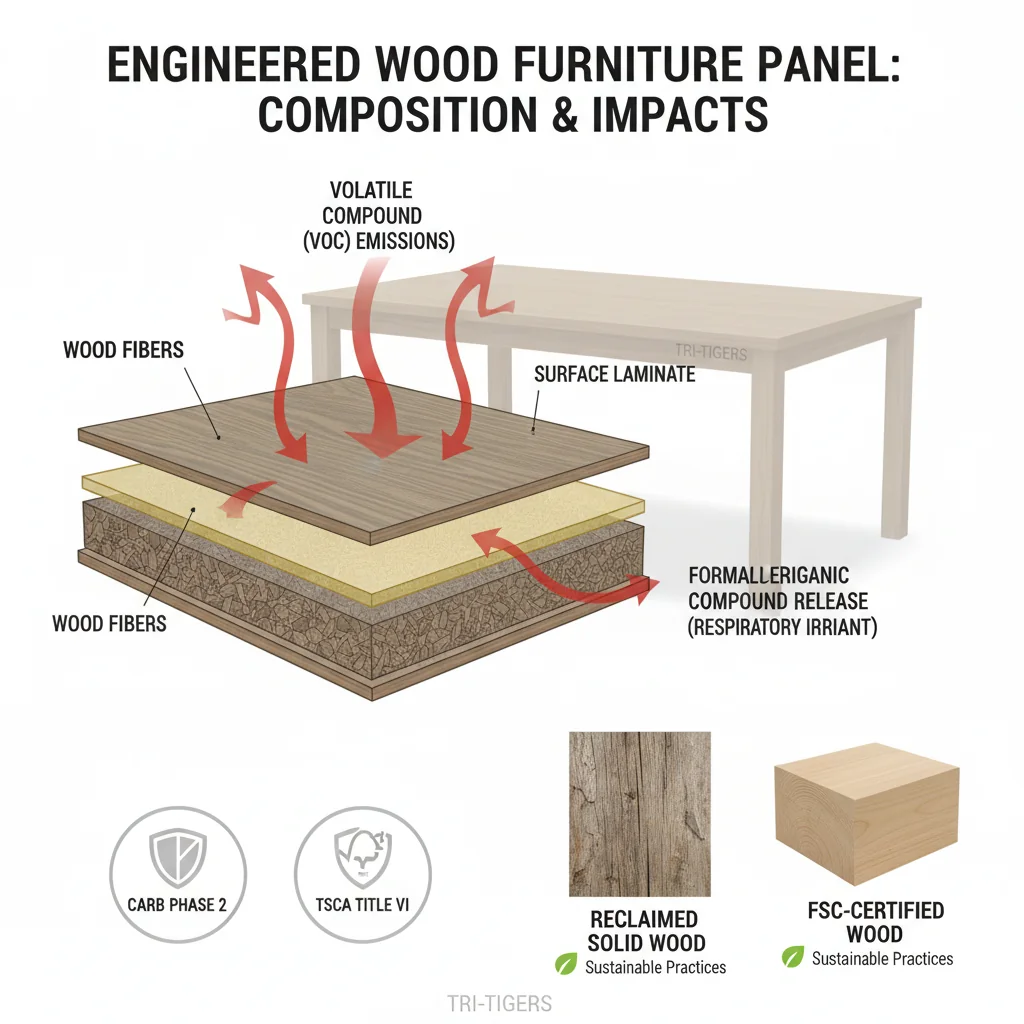
The biggest mistake I see is buyers overlooking emission ratings when sourcing engineered wood furniture—especially for bedrooms and nurseries. Formaldehyde emissions are still a real concern. I worked with a retailer in Germany last year who switched from standard E1 MDF to E0-rated boards4 for their nursery line. The result? Customer complaints about “new furniture smell” dropped by more than half. E1 boards (≤0.1 ppm formaldehyde) are accepted across Europe, but if you’re targeting sensitive spaces or premium buyers, E0 (≤0.05 ppm) or CARB Phase 2 is worth the extra cost—usually about 8–12% higher per cubic meter.
There’s also the environmental angle. Engineered panels let us use wood chips, sawdust, and plantation timber efficiently. For example, a standard 40HQ container fits around 1,000 flat-pack wardrobes made from 18mm particleboard—if you used solid wood, you’d need triple the timber, and the cost would skyrocket. The flip side: cheap particleboard can use low-grade adhesives with higher VOCs unless certified. I always stress that you get what you pay for in terms of adhesive quality.
From my experience, eco-conscious buyers in the UK and Netherlands are asking for FSC-certified or reclaimed wood options. Reclaimed oak beams, for example, now appear in high-end hotel fit-outs or boutique retail. Lead times for reclaimed lines are longer—up to 75 days versus the usual 45—but the sustainability story is a real sales driver.
I always suggest confirming board certification (E1/E0, CARB P2, or FSC) and airing out new products for a week before use. It’s a simple step that can make a big difference in air quality.
Switching from standard E1 MDF to E0-rated boards can reduce formaldehyde emissions from ≤0.1 ppm to ≤0.03 ppm, significantly decreasing indoor air pollutants in sensitive environmentsTrue
E0-rated boards have stricter emission limits than E1, reducing formaldehyde release to a third or less. This leads to fewer complaints about odors and improved air quality, especially important in nurseries and bedrooms.
All engineered wood products labeled as E0 are completely free of formaldehyde emissions and pose no health risksFalse
E0 rating indicates very low formaldehyde emissions (≤0.03 ppm), but not zero. Trace amounts can still be present, and other volatile organic compounds (VOCs) may also affect indoor air quality, so engineered woods are not completely emission-free.
Key takeaway: Engineered woods offer efficient resource use but may emit low levels of VOCs. Choosing boards with low-emission certifications or opting for FSC-certified solid wood or reclaimed pieces reduces health and environmental impacts, especially in sensitive spaces like bedrooms or nurseries. Airing out new furniture further limits potential exposure.
How to Identify Real Wood Furniture?
Genuine wood furniture can be distinguished by examining construction details and material labels. Terms like “solid wood frame” may conceal MDF or particleboard cores beneath veneers. Inspect for features such as continuous wood grain, dovetail joints5, and dense weight, and scrutinize product specifications for clarity on both core and surface materials before purchase.
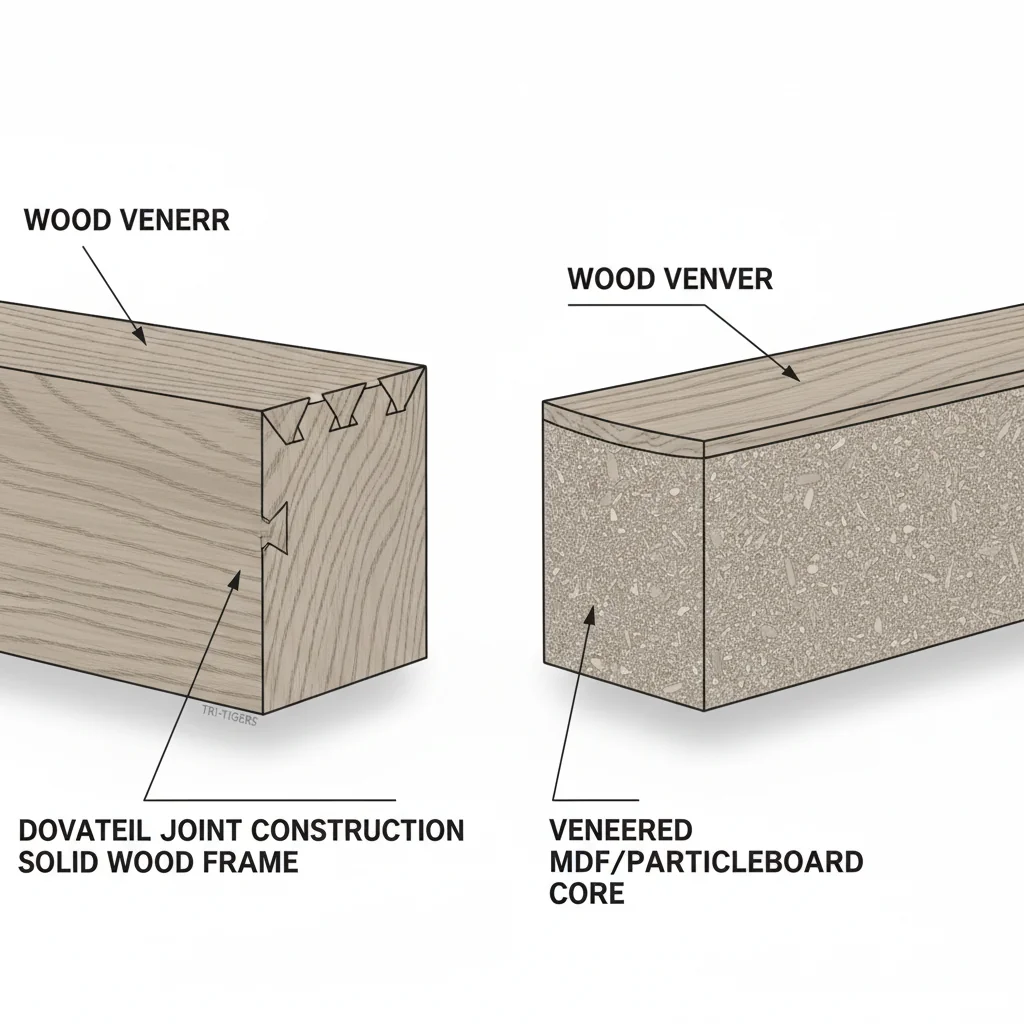
Last month, a buyer in Germany contacted me after receiving “solid wood” wardrobes that felt unusually light. The invoice said “solid wood frame,” but when we checked the panels, the core was MDF—only the rails and legs were real wood. This isn’t rare. Labels like “wood construction” or “solid wood frame” often hide MDF or particleboard under a thin wood veneer. From my experience, true solid wood furniture carries a different weight—literally. A solid oak table, for example, feels dense and heavy compared to a veneered MDF version of the same size.
When inspecting in person, I suggest looking at drawer sides and backs. Solid wood usually shows continuous grain and dovetail joints. MDF or particleboard edges look fuzzy or uniform, and flat-pack items often reveal a laminated edge banding strip. In Poland, a retailer once asked me why their 18mm “wood” shelves sagged after six months—the core was low-density particleboard, not the birch plywood specified. The lesson? Always cut a sample to check the core density.
Don’t just trust the main product photo or headline. Always check the detailed specifications. Ask directly: “What is the core material—solid wood, MDF, particleboard, or plywood?” and “What is the surface—veneer, laminate, or solid?” For online orders, I recommend requesting written confirmation of both the core and surface before placing a bulk order. If you’re aiming for premium or heirloom quality, this step is worth the extra time. It will help you avoid disappointment—and unexpected surprises—after delivery.
True solid wood furniture typically weighs 20-30% more than equivalent-sized pieces made with MDF cores, due to the higher density of natural hardwoods like oak or mapleTrue
Natural hardwoods such as oak have densities around 700 kg/m³, whereas MDF averages around 600 kg/m³ or less, making genuine solid wood noticeably heavier than furniture constructed with engineered wood cores.
Most modern wooden furniture avoids solid wood because it is structurally weaker than MDF and particleboard, leading to shorter product lifespansFalse
Solid wood is generally stronger and more durable than MDF or particleboard. The shift away from solid wood is primarily due to cost, resource availability, and manufacturing efficiency, not because of inferior structural integrity.
Key takeaway: Furniture labeled as 'wood' may often contain engineered cores like MDF or particleboard, hidden beneath veneers. Always confirm both the core and surface materials, check for construction details, and demand written specifications to ensure true wood content—especially when paying for premium or heirloom-quality pieces.
When Is Engineered Wood the Better Choice?
Engineered wood, including MDF and particleboard, excels where flat, smooth surfaces are needed, such as painted cabinetry or modern closets. It resists warping better than solid wood in climate-controlled interiors and is cost-effective for large furniture. However, it is unsuitable for damp locations and heavy-duty shelving without additional reinforcement.
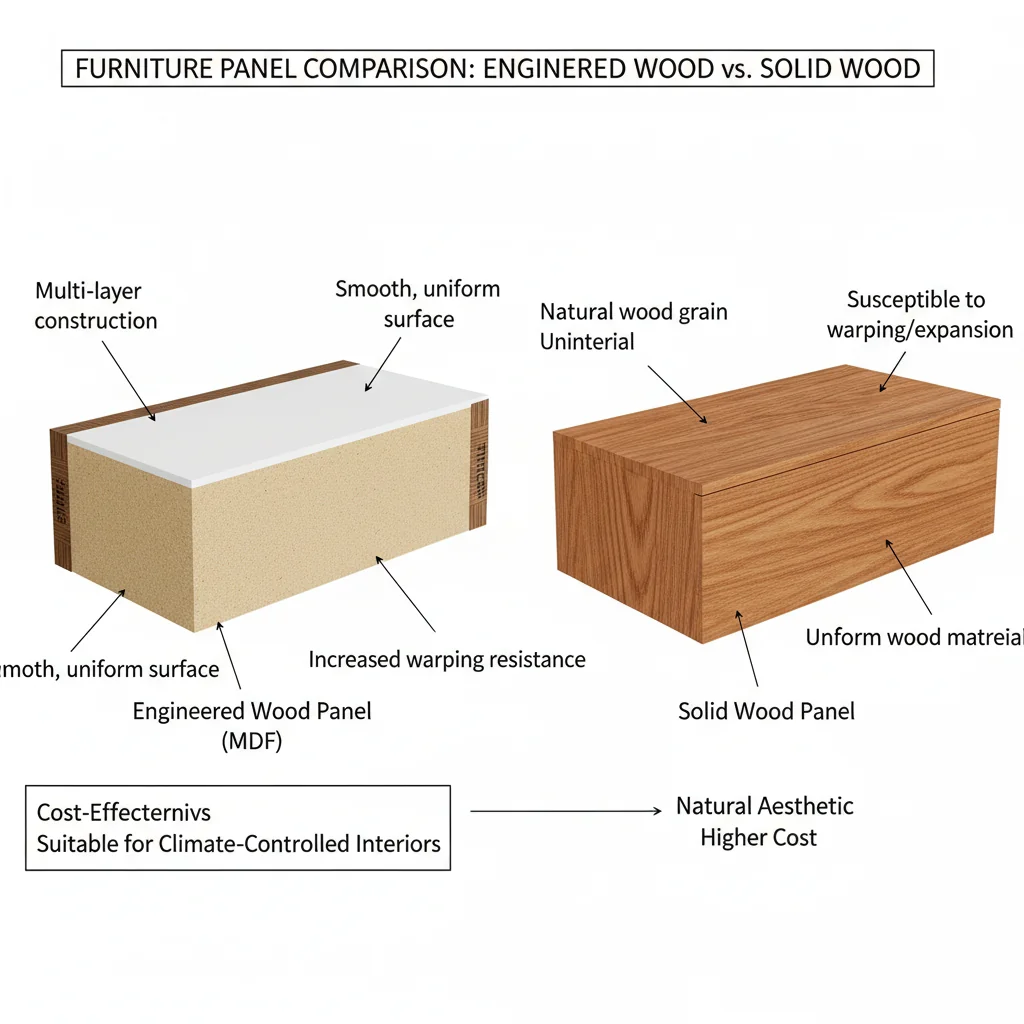
To be honest, the spec that actually matters is how the material performs in real-world use—not just on paper. Engineered wood like MDF and particleboard really shines for modern furniture with clean lines and painted or melamine finishes. I’ve seen this firsthand with a German importer who needed over 1,000 flat-pack wardrobes in white. Solid wood would have doubled the cost and led to color inconsistencies, but E1-rated 18mm MDF6 delivered flawless surfaces and reliable quality, all within a 40HQ container. That’s around 320 wardrobes shipped per load, with lead times holding steady at 35–40 days FOB.
Here’s what matters most when you’re choosing for high-turnover or project-based interiors—think student housing in France or rentals in the UK. Engineered panels resist warping and twisting far better than solid wood, especially in climate-controlled spaces. For budget-driven projects, particleboard with melamine7 is a proven workhorse. I always tell buyers: Don’t overload long shelves—particleboard needs extra support beyond 80cm spans, or sagging becomes a real issue.
From my experience, mixing materials is smart. For example, use plywood for load-bearing parts (like bed frames or table legs) and MDF for visible panels. Always check for E1 or even E0 certification—buyers in Poland are asking for low-formaldehyde panels more than ever. One last tip: Ask for 1mm PVC edge banding on visible edges. It hides seams and protects against moisture better than thin melamine strips. I suggest requesting a full panel sample before committing to volume orders—finish, flatness, and edge quality make all the difference.
E1-rated 18mm MDF panels provide more consistent color and surface smoothness than solid wood, making them ideal for high-volume, painted flat-pack furniture productionTrue
E1-rated MDF is engineered for uniform density and minimal grain, which ensures a flawless finish and consistent color when painted, unlike solid wood that varies naturally in grain and color, complicating large-scale production.
Solid wood furniture is generally more cost-effective than engineered wood like MDF for high-volume flat-pack manufacturingFalse
Solid wood typically costs at least twice as much as engineered wood panels like MDF in large production runs due to material costs, machining complexity, and higher waste from natural defects, making engineered wood the more economical choice.
Key takeaway: Engineered wood is not inherently inferior to solid wood. Its stability, affordability, and finish quality make it optimal for specific interior furniture applications—particularly in budget-sensitive, low-moisture, and high-turnover environments. Always consider the use case and select high-quality materials with appropriate certifications.
Is Real Wood Furniture Still Available?
Solid wood furniture has not vanished, but is now concentrated in premium, design-driven, and sustainability-focused segments. Major 2026 forecasts highlight reclaimed timber, handcrafted pieces, and vintage-inspired styles. Mass-market furniture typically features engineered boards, while solid hardwoods are found through specialty stores, artisanal makers, and higher-end collections, reflecting a shift in availability and consumer priorities.
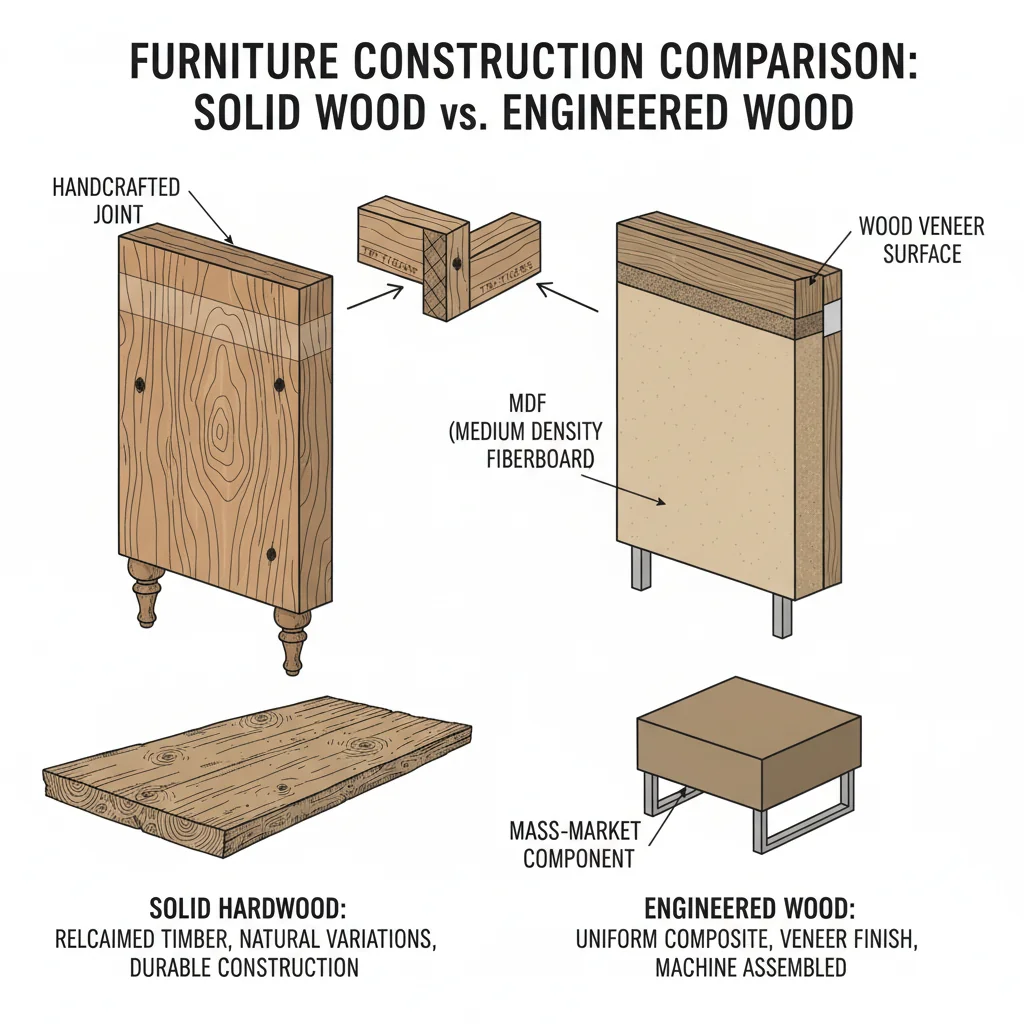
Last quarter, a UK wholesaler called me looking for solid oak dining tables. They were frustrated—most mass-market catalogs listed only MDF or particleboard cores with oak veneer. This isn’t a fluke. Over the past five years, I’ve seen true solid wood furniture shift almost entirely into premium or specialty channels. Mass-market retailers rarely offer “solid [species] throughout” anymore, especially for larger items like wardrobes or beds. The reason is simple: cost and consistency. Engineered boards like MDF and particleboard offer predictable quality, save 20-40% on raw material costs, and allow for easier CNC machining—critical for large-scale flat-pack production.
But real wood hasn’t vanished. In Germany, several boutique importers still buy reclaimed pine shelving and walnut tables, paying 30-50% more than for veneered alternatives. Lead times also stretch longer—custom solid wood pieces often require 45-60 days, compared to 30 days for standard melamine or painted MDF. I’ve visited workshops in Poland crafting solid beech benches where each batch is unique, with visible grain and color variation. Buyers in these segments want longevity and repairability. They ask about FSC certification and expect clarity on finish type—oil, lacquer, or wax.
If you’re serious about sourcing real wood, focus on smaller makers and higher-end lines. Always check for clear labeling—“solid oak” or “solid ash,” not just “oak finish.” Be ready for higher MOQs or per-piece pricing, but you’re paying for durability and the ability to refinish or repair. I suggest always requesting wood samples and finish swatches before finalizing your order.
Solid wood furniture has largely shifted to premium markets because engineered wood offers more dimensional stability and uniformity, reducing warping and defects common in large solid wood piecesTrue
Engineered wood products like MDF and plywood are manufactured to strict tolerances, ensuring consistent thickness and reducing natural wood issues such as knots and grain variation, which are costly to manage at scale in mass-market furniture.
Mass-market furniture manufacturers avoid using real wood primarily because engineered wood is significantly lighter, making transportation costs negligible compared to solid woodFalse
While engineered wood can be lighter in some applications, the main drivers for using it over solid wood are cost efficiency and consistency, not just weight. Transport costs are only one factor and often secondary to manufacturing and material expenses.
Key takeaway: Real wood furniture persists in premium and artisanal markets, often emphasizing sustainability and craftsmanship. Engineered wood dominates mass production, while solid wood appears in higher-end, specialty, or custom offerings. Consumers seeking longevity and repairability should look for products explicitly labeled as solid wood and expect higher price points.
Conclusion
We’ve looked at why most affordable furniture today relies on engineered panels instead of solid wood, and what that shift means for buyers. In my experience, the importers who avoid surprises are the ones who look beyond the surface—testing a sample isn’t enough if you don’t check that bulk production matches what was promised. “Sample hero, bulk zero” is still a risk, especially if you’re new to a supplier. If you’re unsure which panel type or finish best suits your market, or want to understand packing optimization before your first order, feel free to reach out. I’m always happy to share practical tips from real projects across Europe. Every buyer’s situation is different—choose what actually works for your business model.
References
-
Comprehensive insights on how flat-pack shipping reduces costs, supports automation, and enables scalable furniture production. ↩
-
In-depth explanation of E1 formaldehyde emission standards and why it ensures safer, more reliable MDF for large-scale furniture production. ↩
-
Details cost savings, quality consistency, and CNC machining advantages that make engineered boards preferred for large-scale manufacturing.
-
In-depth insights on E0 boards’ ultra-low formaldehyde levels, benefits for sensitive spaces, and comparison with E1 and CARB Phase 2 standards. ↩
-
Expert explanation on how dovetail joints indicate craftsmanship and solid wood construction versus cheaper alternatives. ↩
-
In-depth look at E1-rated MDF standards, thickness benefits, and why it ensures quality and safety in mass-produced furniture. ↩
-
Expert insights on durability, cost-effectiveness, and reinforcement needs of melamine-coated particleboard in interiors. ↩
Published: 2026-01-19