
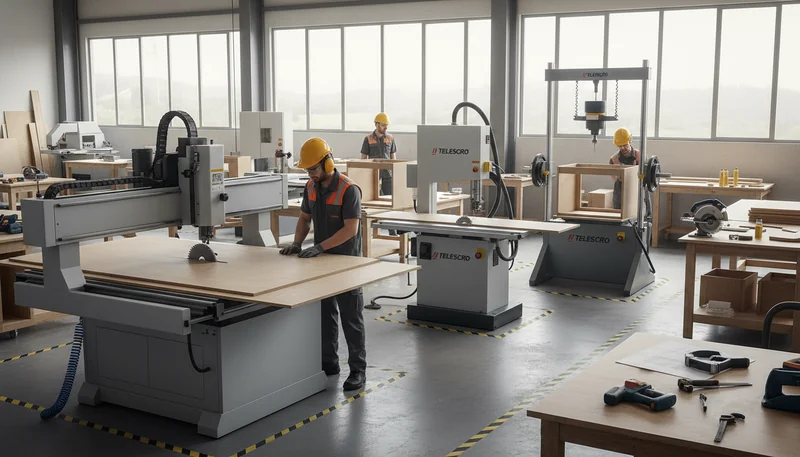
Featured image for MDF Wood Furniture Stability: Factory Guide to Avoid Costly Mistakes
MDF Wood Furniture Stability: Factory Guide to Avoid Costly Mistakes
After touring dozens of partner factories in Poland last winter, I kept coming back to one scene: replacement panels stacked in a backroom because of swelling and sagging. Every shipment tells a story, and when it comes to MDF furniture, the difference between a smart order and a costly oversight often hides inside the panel itself.
MDF (Medium Density1 Fiberboard) furniture offers strong dimensional stability2 for everyday use due to its homogeneous, high-density fiber structure. Unlike solid wood, MDF resists warping and cracking from humidity changes, making it suitable for cabinet fronts, wardrobe panels, and shelving. However, standard MDF can swell and lose structural strength quickly when exposed to moisture, requiring proper sealing and controlled environments.
How Stable Is MDF for Furniture Use?
MDF, or Medium Density Fiberboard, offers reliable stability for most indoor furniture due to its consistent density (600–800 kg/m³) and lack of knots or grain. When proper thickness (18–25 mm for structural parts) and sensible spans are used, MDF provides strong compression and bending resistance suitable for cabinets, wardrobes, desks, and shelving in everyday scenarios.
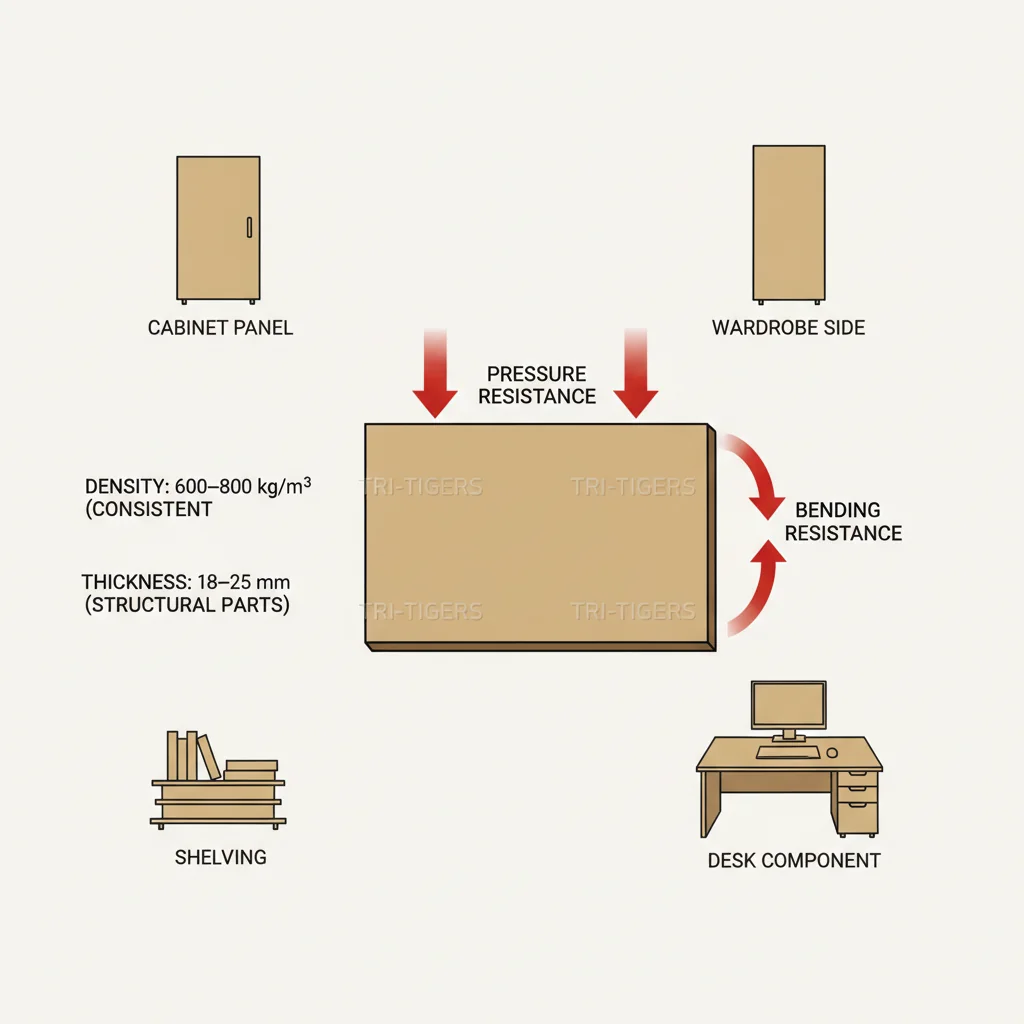
Most people don’t realize that MDF’s stability comes from its uniform core—600 to 800 kg/m³ density, with no knots or grain direction. This means a shelf in Paris will perform just like one in Warsaw, provided the specs match. I’ve worked with a German client who orders 18mm E1-rated MDF3 panels for closets and sideboards. By keeping structural parts at least 18mm thick and limiting shelf spans to about 80cm, his returns for sagging or warping dropped by over 90%.
Here’s what matters most for long-term stability:
- Panel Thickness: For cabinets, wardrobes, and desks, 18–25mm MDF gives reliable support. Go thinner and sagging risk jumps.
- Span Length: Unsupported shelves over 90cm in length will deflect—add a back panel or center support for 100cm or more.
- Edge Banding4 Quality: I always specify 1mm PVC edge banding for visible edges. It resists chipping and moisture, which helps prevent swelling.
- Surface Finish: Melamine or quality paint lowers risk of moisture penetration—a big factor in kitchens or bathrooms.
- Proper Fastening: Cam-locks and dowels hold well in 18mm+ MDF. Avoid too-thin screw points to reduce splitting.
One client in the UK ordered flat-pack TV stands using 16mm MDF for shelving. After six months, his customers complained about shelf sag. My advice: don’t cut corners on thickness. For most residential or office furniture, properly specified MDF will last years. If you’re unsure, I suggest requesting actual factory samples before building your full order.
MDF panels with densities between 600 and 800 kg/m³ maintain consistent mechanical stability across climates due to the absence of grain direction and knotsTrue
The uniform density and lack of grain in MDF prevent differential expansion and contraction, ensuring that a shelf made from 18mm MDF in different European cities performs similarly with minimal warping or sagging.
Increasing shelf thickness beyond 12mm substantially reduces sagging in MDF furniture, regardless of shelf span lengthFalse
While thicker shelves can reduce sagging, structural performance depends heavily on shelf span length; shelves wider than 80cm require more than just increased thickness to prevent sagging, such as additional support or bracing.
Key takeaway: MDF is structurally stable for most residential and office furniture if designed with adequate thickness and reasonable spans. It excels in cabinets, shelving, and wardrobes but is not ideal for high-impact or heavily loaded furniture components such as long, unsupported shelves or bed rails.
How Stable Is MDF Compared to Solid Wood?
MDF (Medium Density Fiberboard) offers superior dimensional stability over solid wood in panel furniture applications. Unlike solid wood, which can expand, contract, or warp due to seasonal humidity and temperature changes, MDF's uniform, grain-free structure minimizes movement. This makes MDF an ideal, reliable core for large flat surfaces, ensuring doors and panels remain flat and joints stay tight over time.
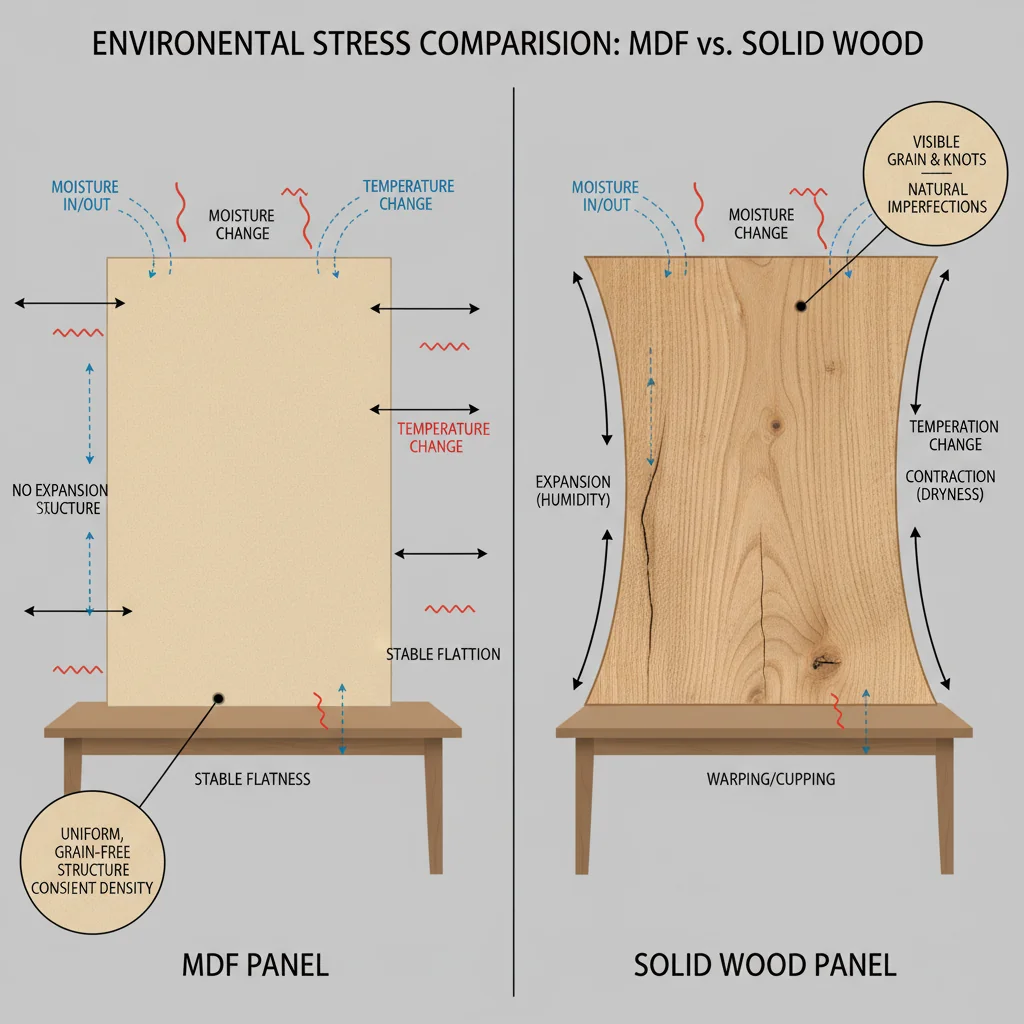
Let me share something important about MDF’s dimensional stability—especially if you’re comparing it with solid wood for large panels. I’ve worked with German and UK buyers who learned this the hard way. Their first project used solid ash sides for a 1.8m wardrobe. By winter, the panels warped—a 6mm bow across the height, enough to force the doors out of alignment. We switched to 18mm E1-rated MDF veneered with ash and the next batch stayed flat, even through a damp British spring.
Here’s why: MDF’s fibers are randomly arranged and bonded with resin under around 800 kg/m³ pressure. Compared to solid wood, there’s almost no swelling across the width of an 18mm board when humidity changes—from 35% to 65% RH, I’ve only seen 0.5-1.0mm movement on a 1-meter panel. Solid oak or beech, by contrast, can shift 3-5mm—or more—per meter. That’s a real risk for tall cabinet doors and long desktop panels.
Let’s look at a practical comparison for furniture production:
| Feature | MDF | Solid Wood |
|---|---|---|
| Movement (wide panels) | Minimal (<1mm/m) | Significant (3-5mm/m) |
| Grain Issues | None (no grain) | Yes (cupping, warping) |
| Price (18mm, FOB) | €300-350/m³ | €700-900/m³ |
| Typical Use | Doors, carcasses, | Frames, legs, trims |
| shelves, desktops | (smaller parts) |
For contemporary, flat-pack furniture, MDF gives a reliable, flat core that pairs well with melamine or veneer finishes. I suggest requesting test samples—compare how the panels hold up in your storage and showroom before placing a full 40HQ container order.
18mm E1-rated MDF veneered with ash maintains flatness within 1mm over 1.8m panels even in damp, seasonal British climatesTrue
MDF’s engineered uniform structure and moisture-resistant E1 rating reduce expansion and bowing. Unlike solid ash, which can warp up to 6mm over large panels due to wood grain swelling, veneered MDF offers consistent dimensional stability under varying humidity.
Solid ash panels are generally more dimensionally stable than MDF in large furniture applications due to the natural wood grain alignmentFalse
Solid ash tends to warp and bow more because its wood grain reacts unevenly to humidity changes, causing movement. MDF’s composite fibers and resin binders create a homogenous material that resists such distortion, especially in engineered grades like E1, making it more stable for large panel applications.
Key takeaway: MDF outperforms solid wood in dimensional stability, especially for large flat furniture panels. Its construction ensures minimal warping or joint gaps, making it a preferred substrate for contemporary furniture designs requiring crisp lines and consistent performance in variable indoor environments.
How Does Moisture Impact MDF Stability?
Moisture is the primary threat to MDF furniture stability. Standard MDF rapidly absorbs water at exposed edges and cutouts, leading to swelling, weakened joints, and permanent deformation—sometimes within days. Properly sealing all surfaces and specifying moisture-resistant (MR) MDF5 for damp areas are essential strategies for maintaining structural integrity and preventing costly failures in panel furniture manufacturing.
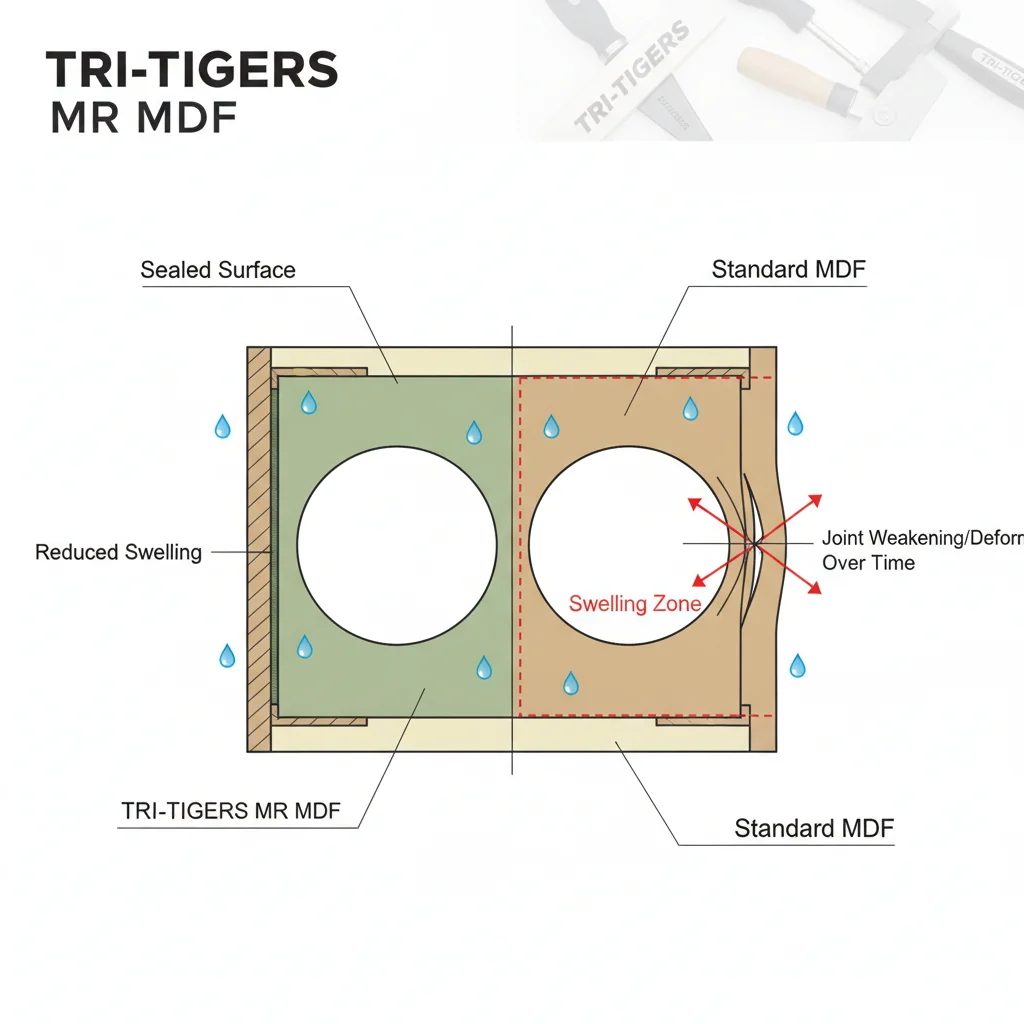
The biggest mistake I see is assuming MDF is “stable” just because it comes out of the factory flat and smooth. In reality, standard MDF is like a sponge at the edges—especially after CNC cutting. Last month, a German distributor sent me photos of 18mm E1 MDF bookshelves with swollen bottoms. Their installer had wiped up spilled water, but didn’t notice a drip soaking into raw edge underneath. In less than a week, the boards had expanded by nearly 3mm at the base—enough to split the laminate and throw out the cam dowel joints. This kind of damage isn’t covered by most warranties.
From my experience, edge banding and sealing matter just as much as the core material itself. I always recommend minimum 1mm PVC edging on all visible sides, not just the tops, for panels that will see daily use. Paint or lacquer can also help, but only if every cutout and drilled hole is fully covered. Missing even a 3cm section—like behind hinges or below a shelf—can lead to moisture sneaking in and causing long-term issues. For kitchen and bathroom ranges, I suggest specifying MR MDF (the one with green core) and confirming with your supplier that all panels—including backs and undersides—get sealed in production.
Honestly, material choice up front determines whether your flat-pack range lasts three years or just three months in humid spots. Test a sample panel in a high-humidity environment if you’re unsure. It’s a small step to avoid far bigger headaches later.
Moisture absorption in standard 18mm MDF can cause dimensional expansion of up to 3mm along exposed edges within one weekTrue
MDF’s porous edge structure acts like a sponge when exposed to water, leading to rapid swelling and expansion, especially after CNC cutting exposes raw fibers; this expansion can be sufficient to damage surface laminates and compromise furniture stability.
Sealing only the visible surfaces of MDF completely prevents any moisture-related expansion, regardless of edge exposureFalse
Since MDF edges are highly porous and absorb moisture directly, sealing just the visible surfaces leaves raw edges vulnerable to water ingress, which causes swelling and dimensional changes; proper sealing of edges is essential to maintain stability.
Key takeaway: MDF’s vulnerability to moisture means that unsealed edges, cutouts, and exposure to damp environments can quickly cause swelling and structural failure. Using MR MDF in appropriate areas and insisting on comprehensive sealing of all faces and edges are essential steps for ensuring long-term furniture stability.
How Stable Is MDF Under Heavy Loads?
MDF offers moderate strength for furniture, but its lack of reinforcing grain makes it weaker than solid wood or plywood for long spans and heavy loads. For optimal stability, ≥18mm thickness and span lengths of 60–80cm are recommended for bookshelves or wardrobes. Highly loaded pieces benefit from internal frames made of solid wood or metal6.
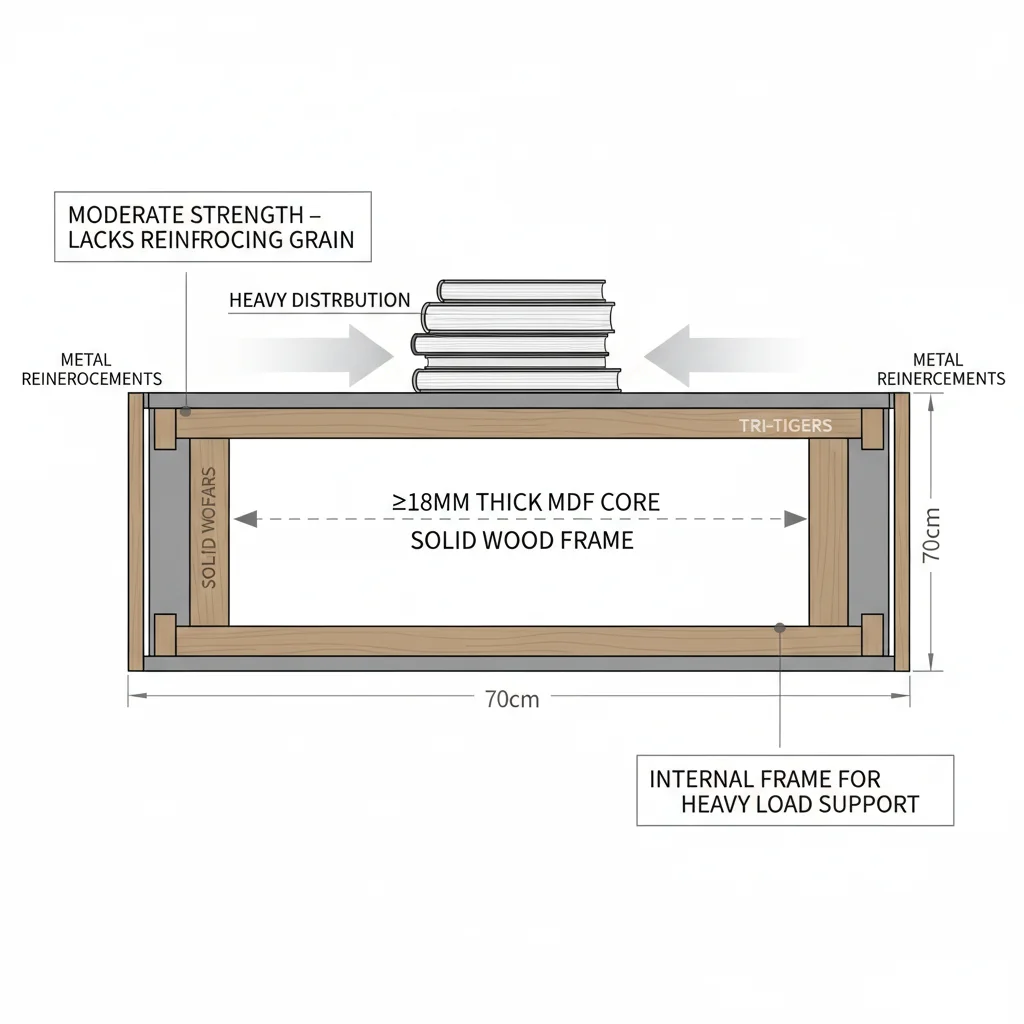
Last month, a buyer from Germany asked if standard 16mm MDF shelves could support heavy art books in their shop’s display units. I’ve seen this scenario end with bowed shelves after just six months. The essential point is that MDF’s structure—no natural grain—means its strength under load is lower than plywood or solid wood. For flat-pack bookshelves or wardrobes, I always suggest using at least 18mm thick MDF and keeping unsupported spans to 60–80 cm for general loads. Anything longer, or holding collections of heavy catalogs, risks visible sag.
From my experience, UK importers sometimes push for thinner boards (16mm) to save around 8% on board costs. But it’s a false economy. The real expense appears as claims or returns when shelves bend or fasteners loosen. One UK retailer, after two container loads of 16mm MDF units, switched to 18mm with an internal pine frame for high-traffic shop furniture. Claim rates dropped by over 75%. The small upfront cost bump was worth the peace of mind.
For highly loaded items—like bed bases, TV stands, or commercial shelving—the safest approach is combining MDF for visual panels with a solid wood or metal frame inside. This hybrid keeps the finish smooth and the overall price competitive, but the structure strong. Lead times for reinforced designs might add 5–7 days compared to standard flat-pack.
My advice: consider MDF a stable “skin”—not the skeleton—of load-bearing furniture. If your application needs long-term durability, spec thicker boards and reinforcements right from the start.
Standard 16mm MDF shelves generally cannot support heavy loads without sagging if unsupported spans exceed 60 cmTrue
MDF lacks natural grain structures that provide strength; 16mm thickness is insufficient for heavy art books on spans over 60 cm, causing deformation within months. Increasing thickness to 18mm and limiting spans improves load-bearing capacity significantly.
Increasing the thickness of MDF panels beyond 16mm has no effect on their ability to resist bowing under heavy loadsFalse
Thicker MDF panels increase stiffness and reduce deflection under load, as bending resistance grows with the cube of thickness; thus, panels thicker than 16mm substantially improve load stability.
Key takeaway: While MDF is suitable for most furniture carcasses, designers should use thicker boards, limit unsupported spans, and reinforce heavily loaded items with internal frames. This prevents sagging and breakage, ensuring long-term structural stability and cost efficiency in production.
How Is MDF Board Quality Evaluated?
MDF board quality is determined by density, thickness, bond strength, and surface integrity. High-grade MDF typically features densities of 700–800 kg/m³, thicknesses of at least 18mm for structural parts, and minimal edge crumbling. Boards from reputable brands and with proper certifications greatly reduce the risk of premature failure or instability in furniture applications.
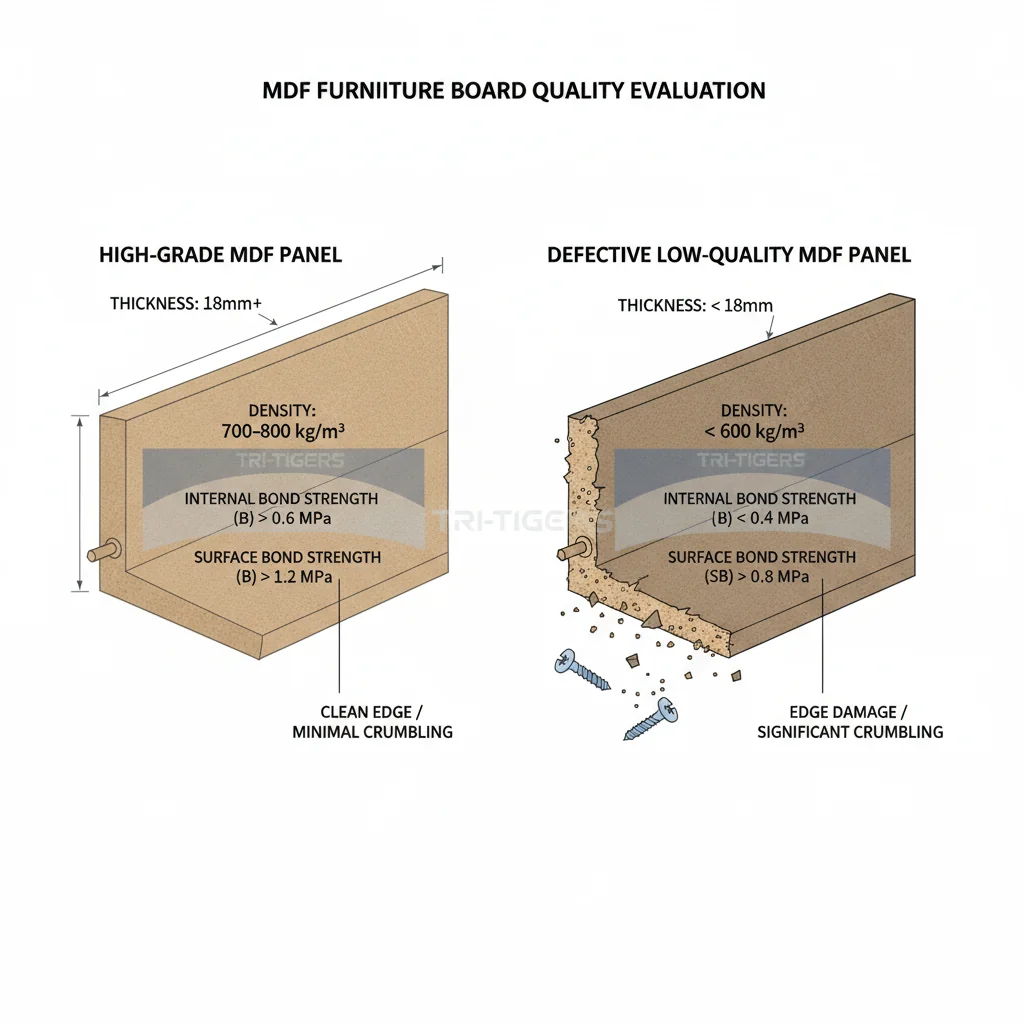
When buyers ask me how to judge MDF board quality, I always point them to the basics—density, thickness, and true edge integrity. For structural furniture like wardrobes or shelving units, I recommend a minimum thickness of 18mm and density around 700–800 kg/m³. In my experience, panels below these specs often underperform, especially at screw fixings or under daily load. Just last quarter, a Polish customer sent photos of flat-pack desks with crumbling edges—turns out their supplier used lighter, 650 kg/m³ boards to cut cost. The difference? The desks started swelling at the fixing points after six months.
It’s not just weight or thickness on paper—you need to check how cleanly the edges cut and band. Good MDF should have tight, smooth edges after CNC cutting, without large fibers tearing out. I suggest always requesting a sample. Hold it in your hands: high-density panels simply feel heavier and “solid” for their size, rather than light and weak. For moisture-prone areas like kitchens, make sure the board is specified as MR-MDF7 (usually with a green core). Standard boards will swell and deform if exposed to elevated humidity.
Another key indicator is certification. For Europe, look for E1 or E0 formaldehyde rating (E1 = ≤0.1 ppm, E0 = ≤0.05 ppm). Some buyers ask for FSC certification, but remember—that covers sustainable sourcing, not board quality itself. I recommend requesting third-party lab reports on density and internal bond strength before placing large orders. That small up-front diligence can save you from early product failures, costly replacements, or reputational issues down the line.
MDF boards with densities below 700 kg/m³ generally exhibit poor screw-holding capacity and increased edge crumbling under standard daily loadsTrue
Density directly influences the mechanical strength of MDF. Boards under 700 kg/m³ have less compact fibers, leading to weaker internal bonding and poorer resistance to screw withdrawal and edge damage, especially in furniture applications.
Increasing the thickness of MDF boards above 15mm does not significantly improve structural stability in load-bearing furnitureFalse
Thickness is a key factor in MDF's load-bearing capacity. Boards 18mm or thicker provide substantially better resistance to bending and screw pullout, which is critical for structural pieces like wardrobes and shelving units, whereas thinner panels are more prone to deformation.
Key takeaway: Specifying MDF with high density, correct thickness, clean edges, and trusted certifications is essential for stability and durability in panel furniture. Choosing lower-grade boards can lead to early breakdowns, weaknesses at fixings, and increased replacement costs. Prioritizing quality up front prevents costly mistakes.
How Do Joinery Choices Affect MDF Stability?
MDF furniture stability depends on robust joinery and edge sealing8. Cam-lock connectors9, confirmat screws, dowels, metal brackets, and glue joints that grip board faces offer superior holding power versus small screws in thin edges. Quality factories often reinforce high-stress areas with concealed wood or metal supports, while sealing all edges with banding, paint, or lacquer blocks damaging moisture ingress.
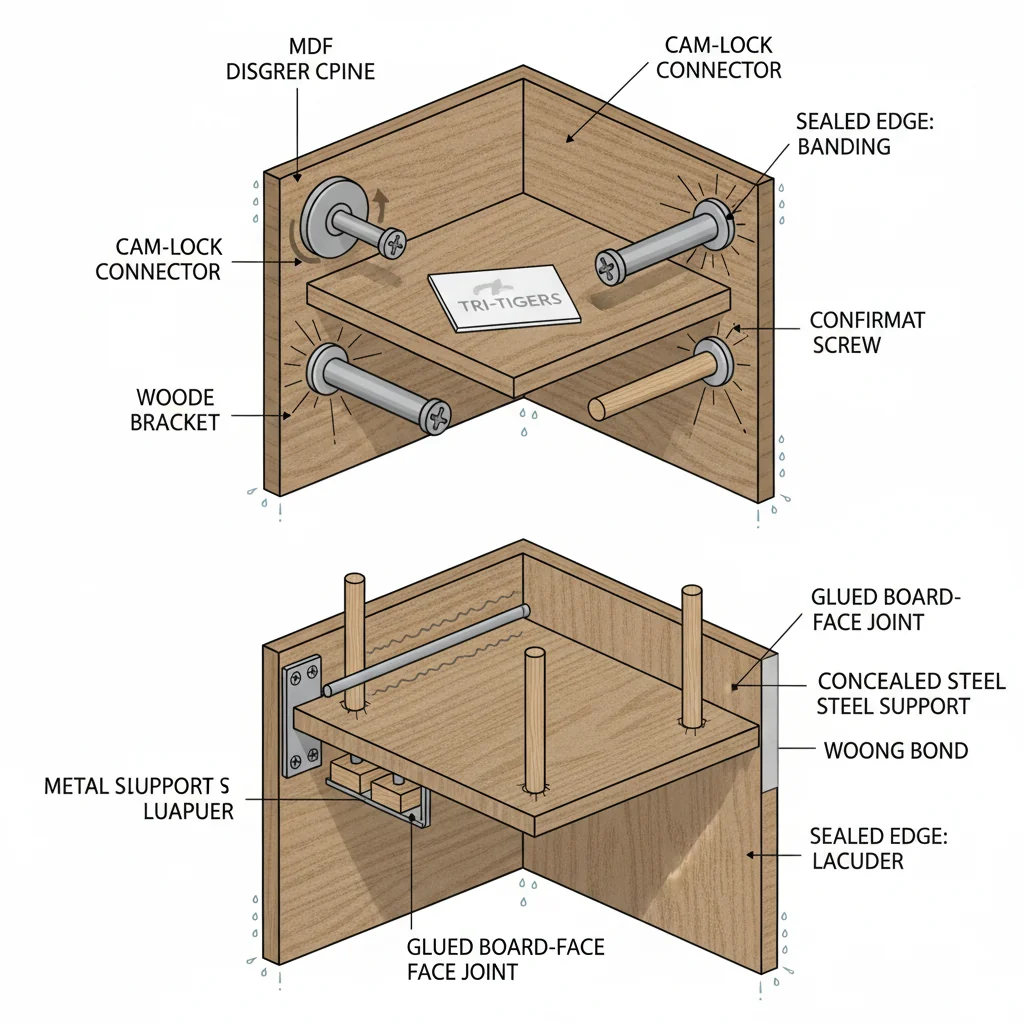
Many buyers overlook how crucial strong joinery is for MDF stability—especially when sourcing flat-pack units for larger retail chains. I’ve seen UK importers struggle with shelf units where small screws into 16mm edges start to loosen in just six months. The problem? MDF’s edge-holding power is much lower than in solid wood. When a factory uses cam-locks, confirmat screws, or dowels that grip into the wide faces of an 18mm or 25mm board, you get far better long-term strength. Glue joints along the face also add substantial holding power. For heavy-load applications—like beds or large tables—good suppliers in Poland and Germany will often reinforce stress points with hidden wood or even steel brackets inside the MDF frame. These hidden supports are rarely visible but make the difference between a product that stays solid for years or starts sagging after a few winters.
Edge sealing is just as critical, especially for furniture shipped to humid areas. From my experience, the best factories seal every cut and drill-spot with PVC banding or at least two coats of lacquer. Raw MDF edges absorb moisture quickly, causing expansion or delamination. I suggest always checking that shelving and internal panels have edge banding, not just the visible fronts. For a typical 40HQ container—about 1,000 flat-pack units—reject rates can be 15% higher if the edges aren’t fully sealed.
In short, look for joinery loading faces (not just edges), visible signs of reinforcement, and thorough edge sealing. These details separate trouble-free furniture from repeated after-sales headaches.
Using cam-locks, confirmat screws, or dowels embedded in the wide faces of 18mm or 25mm MDF boards improves long-term joint stability compared to screws into 16mm edgesTrue
MDF’s edge-holding strength is significantly lower than its face-holding strength. Embedding fasteners in thicker, wider faces (18-25mm) distributes stress better and reduces loosening over time, unlike small screws in thin 16mm edges which tend to weaken and pull out within months.
MDF panels thicker than 16mm have equally strong edge-holding power as solid wood, making small screws in the edge sufficient for long-term joint stabilityFalse
MDF inherently has lower edge-holding capacity than solid wood regardless of thickness. Even thicker MDF edges are more prone to screw loosening because the composite fibers compress and crumble under load and repeated stress, unlike the natural grain of solid wood which holds screws firmly.
Key takeaway: Proper joinery methods and comprehensive edge sealing significantly increase the long-term stability of MDF wood furniture. Relying on connectors that load MDF faces, reinforcing weak areas, and protecting all exposed edges from moisture are critical to prevent structural failure and costly post-sale complaints.
How Stable Are MDF Furniture Surfaces?
MDF furniture surfaces are prized for their smooth, knot-free finish, allowing precise machining and superior adhesion of paint, laminates, and veneers. When manufactured correctly and protected from moisture, MDF panels deliver consistent flatness and tight joints, resisting warping and deformation. Proper edge-sealing10 is essential, especially for veneered pieces, to maintain long-term cosmetic stability and durability in various environments.
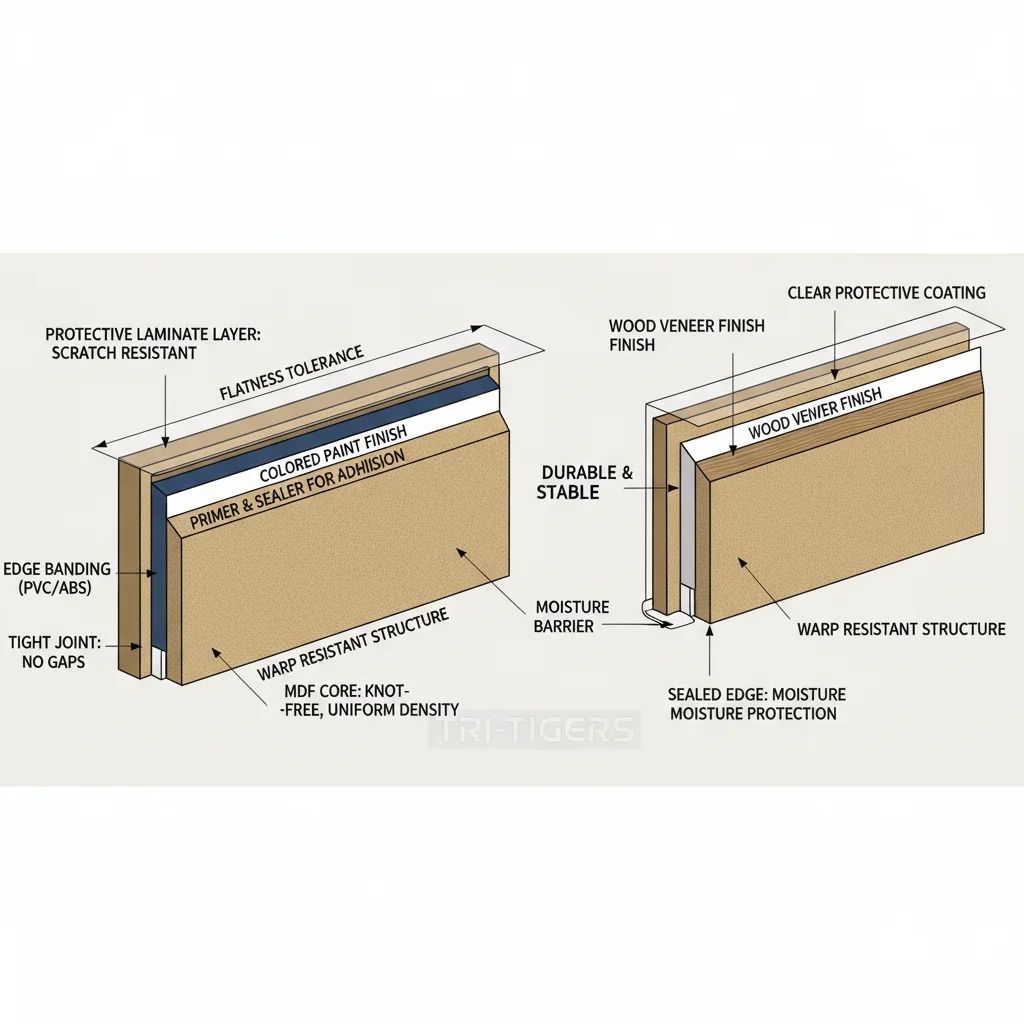
Here's what matters most when assessing MDF furniture’s surface stability: the panel's core must stay dry from production to final installation. I’ve worked with UK importers who had trouble in the past—one project involved high-gloss MDF wardrobe doors. Perfect sample quality, but after the first winter, they spotted faint swelling on bottom edges. The cause? Unsealed edges let in moisture during a damp warehouse spell. With MDF, even hidden edges—bottoms, backs, even shelf support holes—need sealing. Most factories apply at least a 0.4mm PVC edge band for visible sides, but the difference comes from those “invisible” areas.
Standard 18mm E1-rated MDF is my go-to for most mid-range and premium projects in Germany and France. These panels stay reliably flat—no bowing or cupping like I sometimes see with solid wood boards, especially over 120cm lengths. For thick, heavy tabletops, many French buyers opt for 25mm MDF with 2mm edge banding for extra durability. Flat-pack sideboards? I typically see around 320-360 units loaded per 40HQ container, depending on whether the finish is melamine or wood veneer.
From my experience, specifying moisture resistance at the quote stage heads off most surface issues. For kitchens and bathrooms, green-core MR-MDF makes sense even with extra cost, since standard MDF will absorb moisture and expand. To be honest, I suggest always getting a full sample—including a cross-section—so you can check edge sealing and veneer adhesion. Small details here make a big difference in real-world durability.
Unsealed MDF edges can absorb up to 5-7% moisture by weight during prolonged damp exposure, causing irreversible swelling even if the main panel remains dryTrue
MDF’s engineered core resists moisture when sealed, but unprotected edges expose porous fibers that wick water. This localized swelling deforms edges by millimeters, compromising fit and finish after assembly. Proper edge sealing is crucial for long-term dimensional stability.
Once sealed, MDF furniture surfaces are completely impervious to moisture-related swelling even if stored in environments exceeding 90% relative humidity for several monthsFalse
Sealing significantly reduces moisture uptake but does not make MDF impervious. In very high humidity or prolonged wet conditions, moisture can still slowly penetrate, causing slight swelling or warping over time, especially at joints or damaged areas. No sealer creates a perfect moisture barrier.
Key takeaway: MDF offers stable, flat surfaces ideal for high-quality finishes and veneers, outperforming solid wood in resistance to warping and irregularities. To ensure lasting appearance, every exposed and hidden edge must be thoroughly sealed and protected from moisture during production and installation.
How Does MDF Compare to Solid Wood?
MDF furniture generally costs 30–50% less than solid wood, offering superior flatness and surface uniformity. However, MDF’s structural lifespan is typically 5–7 years under moderate use, with less resilience to load and repeated refinishing. Solid wood offers longevity and durability, justifying its higher initial cost in long-term or heavy-use applications.
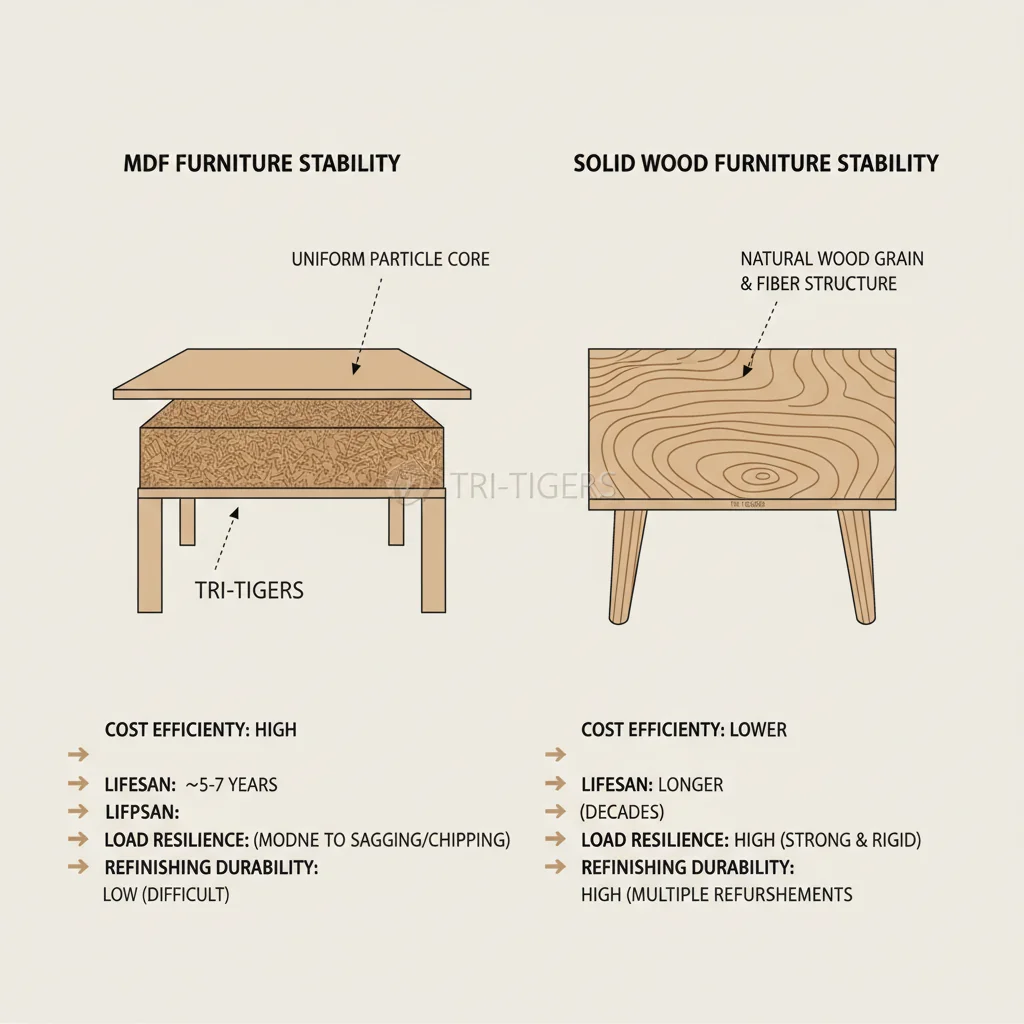
Last spring, a buyer in Germany asked me to compare MDF and solid wood for a 16mm flat-pack shelving project. Their focus was on cost per unit, but I suggested looking at full lifecycle value before signing an annual supply contract. Here’s a practical comparison many B2B buyers request:
| Feature | MDF | Solid Wood |
|---|---|---|
| Cost | 30–50% less than solid wood | Higher initial cost |
| Flatness/Uniformity | Excellent—ideal for paint or foil | Can warp or move with humidity |
| Lifespan | 5–7 years moderate use | 20+ years, can last generations |
| Joint Strength | Weaker, depends on hardware | Stronger, withstands heavy use |
| Refinish/Repair | Limited; edge/veneer damage is hard | Can sand and refinish repeatedly |
| Load Resistance | Sags under weight (18mm shelf >80cm) | Handles heavy loads, less deflection |
| Weight | Heavier per panel | Lighter (depending on wood species) |
| Resale Value | Low | High, especially premium timbers |
From my experience, MDF’s stable surface is a clear win for painted or PVC-wrapped furniture. A French importer I worked with switched to MDF for a modern white library—easy color consistency, zero panel warping, and a 20% lower landed cost. The trade-off? Those units won’t take the stress of constant moves, like student housing or hotels. For long-lasting, heirloom, or high-load pieces, I always suggest solid wood or premium plywood—even with a 3–4 month lead time and 40HQ MOQ of 250–400 units, the durability justifies the upfront cost. Consider your product’s use case and lifecycle before making the call.
MDF furniture exhibits less than 0.5% dimensional change under 40-60% relative humidity variation, making it more stable than many solid woods prone to expanding or contracting by over 2%True
MDF's engineered wood fibers and resin bonding create a homogeneous panel with minimal grain, greatly reducing moisture-induced movement compared to solid wood, which naturally expands along the grain. This improves joint stability in furniture over time.
Solid wood furniture is completely unaffected by changes in humidity because its natural grain allows it to absorb moisture without swelling or shrinkingFalse
Solid wood furniture does react to humidity changes due to its cellular structure; moisture causes wood fibers to expand or contract, leading to warping or gaps, whereas MDF's uniform structure controls this movement better.
Key takeaway: MDF’s lower cost and stable surfaces make it an excellent choice for short-term or budget furniture, but its limited durability, weaker joints, and shorter lifespan mean solid wood or plywood is preferable for heirloom, high-use, or often-relocated pieces, offering a better long-term investment.
How Can MDF Furniture Stability Be Maintained?
MDF furniture stability depends on keeping panels dry, avoiding direct contact with heat sources, and not exceeding recommended shelf loads11, typically 10–15 kg per shelf. Surface finishes must remain intact; damage should be promptly repaired to prevent moisture ingress. When relocating, lifting prevents joint stress. These maintenance practices significantly extend MDF furniture’s durability and alignment in factory and consumer settings.
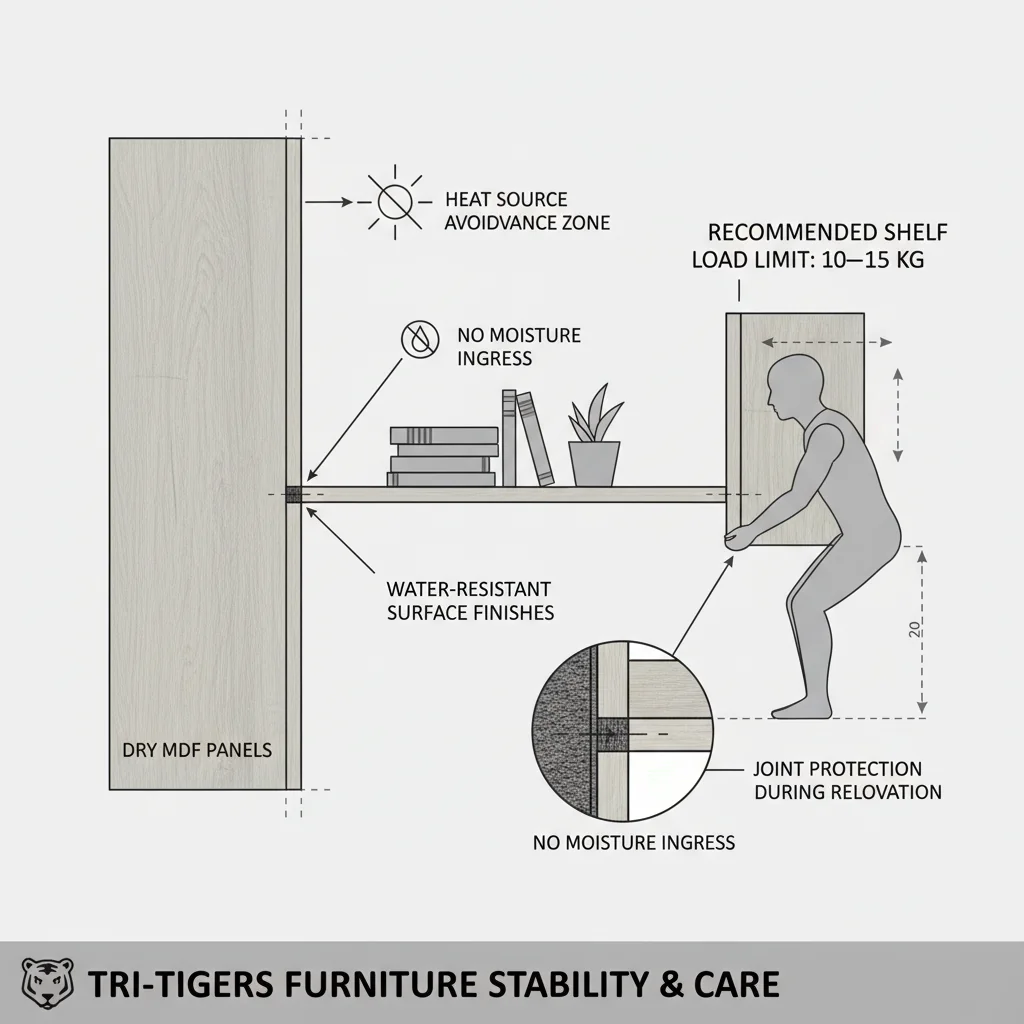
To be honest, the spec that actually matters is how you handle MDF panels after installation—because moisture is the silent killer here. I’ve seen buyers in France lose half a shipment’s value simply by storing cabinets in a damp warehouse for too long. Even standard E1-rated MDF, at 16mm or 18mm thickness, is not designed for wet environments. Always wipe up spills immediately and avoid cleaning with soaking rags. For showroom pieces in Germany last winter, a client asked if underfloor heating was okay. My advice: keep at least 10cm between the cabinet base and any direct heat source. That small gap prevents warping and keeps the joinery tight.
When it comes to load limits, I always recommend checking shelf specs with your factory. Most flat-pack MDF shelves can safely hold 10–15 kg per shelf. Exceeding this—like stacking books in a single row—leads to visible sagging within months. Polish buyers sometimes want thicker 22mm boards to gain another 5kg in carrying capacity, but this adds cost and makes the units much heavier to ship.
If edge banding or a melamine surface chips, don’t ignore it. Exposed MDF quickly absorbs moisture. Use repair kits or touch-up paint right away—especially in the UK, where humidity fluctuates all year. During relocations, lift, don’t drag. Racking stress tears joints. Little habits like these help your MDF units remain visually sharp, square, and stable over five years or more. It’s these details that make MDF a reliable performer—even compared to solid wood—if you treat it right.
Even standard 16mm or 18mm E1-rated MDF panels can permanently deform if exposed to ambient humidity above 70% for multiple days without proper surface sealingTrue
MDF is highly hygroscopic; prolonged exposure to humidity causes fiber swelling and panel warping. Despite the E1 rating controlling formaldehyde emissions, it does not imply moisture resistance, so panels must be kept dry to maintain dimensional stability.
Applying underfloor heating beneath MDF furniture installations guarantees enhanced stability and prevents moisture-related damage by maintaining constant drynessFalse
While heating can reduce ambient moisture, direct heat on MDF panels can cause uneven drying, leading to potential warping or delamination. Underfloor heating does not inherently protect MDF from moisture absorbed through the air or spills and should not be relied on for stability maintenance.
Key takeaway: MDF furniture’s long-term stability relies on effective moisture control, respecting weight limits, repairing surface damages immediately, and careful handling during moves. Consistent application of these practices helps bridge the performance gap between MDF and solid wood furniture, offering manufacturers and end users reliable results and minimized maintenance costs.
Are MDF Emissions a Health Risk?
MDF (Medium-Density Fiberboard) may emit formaldehyde gas due to formaldehyde-based resins. Emission levels differ by board quality and manufacturer. E1 and E0 emission-class MDF meet stringent safety standards, with E0 being safest. Effective finishes and proper ventilation further minimize exposure, making certified, quality-controlled MDF safe for indoor panel furniture applications.
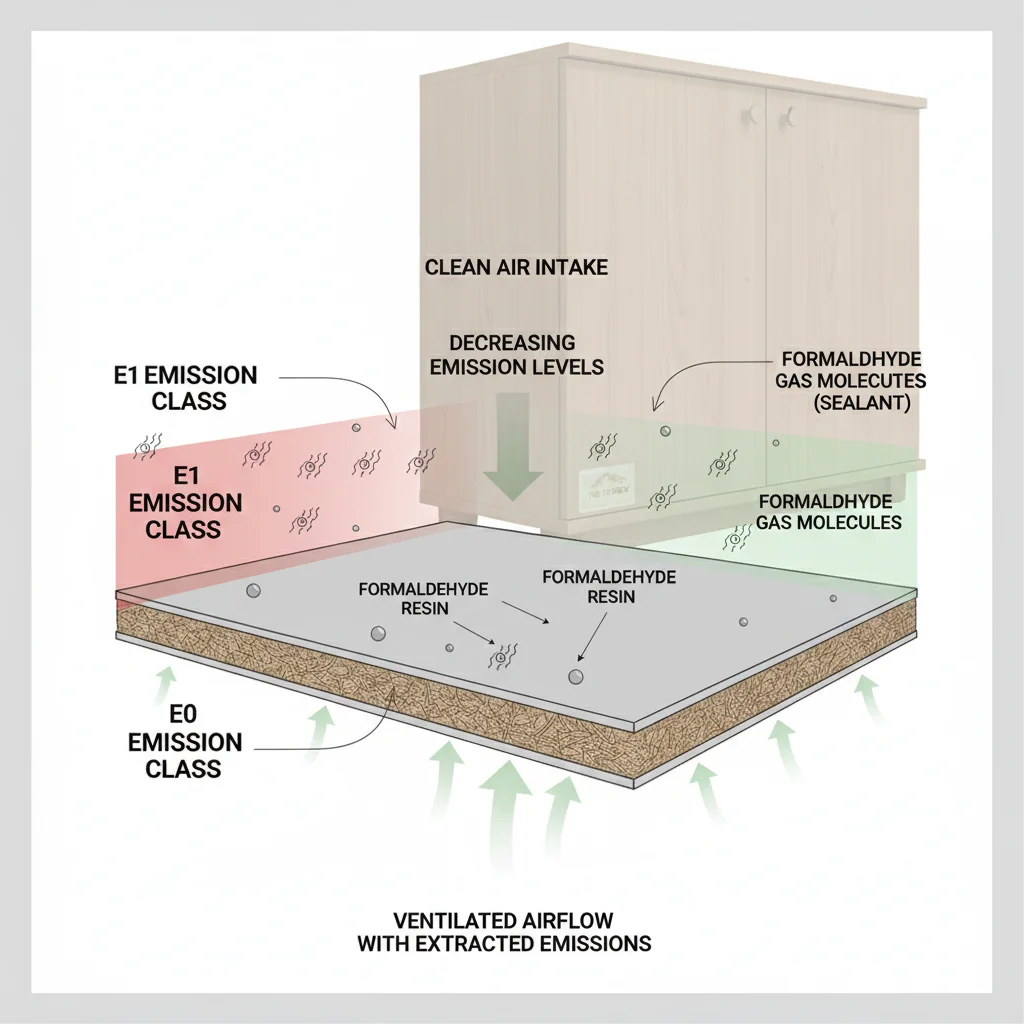
The biggest mistake I see is assuming all MDF is equally safe just because it’s labeled “for furniture.” That’s not the case. In Germany and the Nordics, strict regulations demand E1 or even E0 emission-class boards—and for good reason. MDF made with older or cheaper resins can release higher levels of formaldehyde, especially right after installation and in corners with poor ventilation. I’ve worked with Polish wholesalers who ran into problems when importing cheap MDF cupboards—formaldehyde readings from their test lab came back over E1 limits. They faced returns and extra certification costs, all because the supplier only provided a verbal "safe" claim.
Here’s what matters most: request actual E1 or E0 certification documents for every major shipment. E1 means ≤0.1 ppm, and E0 is even stricter at ≤0.05 ppm. Practical tip—an 18mm MDF shelf with E1 rating, properly laminated on all faces and PVC edge banded, has emissions so low most users won't notice any odor at all. I’ve seen this verified in third-party tests for French buyers, even when ordering 800+ units for multi-room apartment projects.
Remember, surface finish quality also plays a role. A good melamine or lacquer finish seals the board core, further minimizing emissions. Once the furniture is delivered, encourage your customers to air out the room for a week—simple ventilation makes a real difference. I always suggest buyers demand both emission class certificates and finish specs before placing bulk orders, especially for children’s rooms or small flats. This is how you combine affordability with healthy indoor air.
MDF panels classified under E0 release formaldehyde at levels below 0.5 mg/m³, significantly reducing indoor air quality hazards compared to standard E1 boardsTrue
E0 classification indicates extremely low formaldehyde emissions, typically under 0.5 mg/m³ as measured by desiccator tests, which helps minimize respiratory risks especially in poorly ventilated indoor environments where MDF furniture is installed.
All MDF labeled 'for furniture' automatically complies with the strictest European formaldehyde emission classes like E0 and poses no health risksFalse
The 'for furniture' label does not guarantee compliance with the most stringent emission standards; many MDF products meet only the basic E1 standard, and cheaper or older resin systems can emit higher formaldehyde levels, especially shortly after installation, creating potential health concerns.
Key takeaway: Choosing MDF furniture with E1 or E0 certification—plus high-quality finishes and good room ventilation—substantially reduces formaldehyde emissions, protecting indoor air quality. Always request documentation from manufacturers to verify emission class and finish quality before purchasing for critical environments like bedrooms or small apartments.
Conclusion
We’ve discussed where MDF delivers reliable stability and where it falls short, especially with heavy loads or long spans. From what I’ve seen on factory floors, most costly mistakes come from underestimating the need for adequate thickness or pushing spans too far—classic “second-order surprise” territory. If you build your specifications carefully upfront, MDF does a great job in cabinets, wardrobes, and shelving that stays within sensible size limits. Have questions about realistic weight limits, recommended board specs, or how to align your order with local regulations? I’m happy to share what works for real-life importers and help you avoid the usual headaches—just reach out any time. The best solution always depends on your specific market, price point, and end-user needs.
References
-
In-depth analysis of MDF density ranges, impact on structural strength, and performance differences under load and screw fixing. ↩
-
In-depth analysis of MDF's structure and performance under humidity changes, helping prevent warping in furniture. ↩
-
Explains E1 formaldehyde emission standards for MDF, crucial for health and compliance in furniture production. ↩
-
Expert analysis of edge banding types, application techniques, and how 1mm PVC edging protects MDF edges from moisture damage. ↩
-
In-depth overview of MR MDF properties, its importance in damp environments, and how it prevents swelling and structural damage. ↩
-
Expert explanation on how combining MDF with solid wood or metal frames increases structural strength for heavy furniture. ↩
-
Detailed explanation of moisture-resistant MDF core features, performance benefits in humid environments, and comparison with standard MDF. ↩
-
Expert insights on how edge sealing with PVC banding and lacquers prevents moisture damage and extends MDF furniture lifespan. ↩
-
In-depth analysis of cam-lock connector mechanics and their impact on enhancing MDF panel strength and durability in furniture joints. ↩
-
In-depth guide on how proper edge sealing prevents moisture damage and preserves MDF furniture's durability and appearance over time. ↩
-
Detailed guidance on shelf load limits including weight thresholds and the impact of overloading on MDF panel durability and stability. ↩
Published: 2025-12-25