
Featured image for MDF for Cabinets: Manufacturer’s Guide to Smart Applications and Common Pitfalls
MDF for Cabinets: My Guide to Smart Applications and Common Pitfalls
Last week, a Polish distributor sent me photos of kitchen cabinets with perfectly crisp painted doors—right beside a swollen sink base panel that had started to crumble. He wanted to know: was MDF to blame, or just poor detailing? I see this kind of trade-off almost every season after working in this industry for over a decade.
Use MDF for painted cabinet doors in dry areas; choose plywood for carcasses, sink bases, and any wet or load-bearing cabinet parts.
How Strong Is MDF for Cabinetry?
MDF cabinetry is dimensionally stable, resisting warping, cupping, and cracking under normal indoor humidity (30–70%), making it ideal for flat, painted doors and panels. Structurally, MDF is weaker than plywood or hardwood—about 60–70% as strong—and is more prone to denting, chipping, and sagging, especially on long, unsupported shelves.
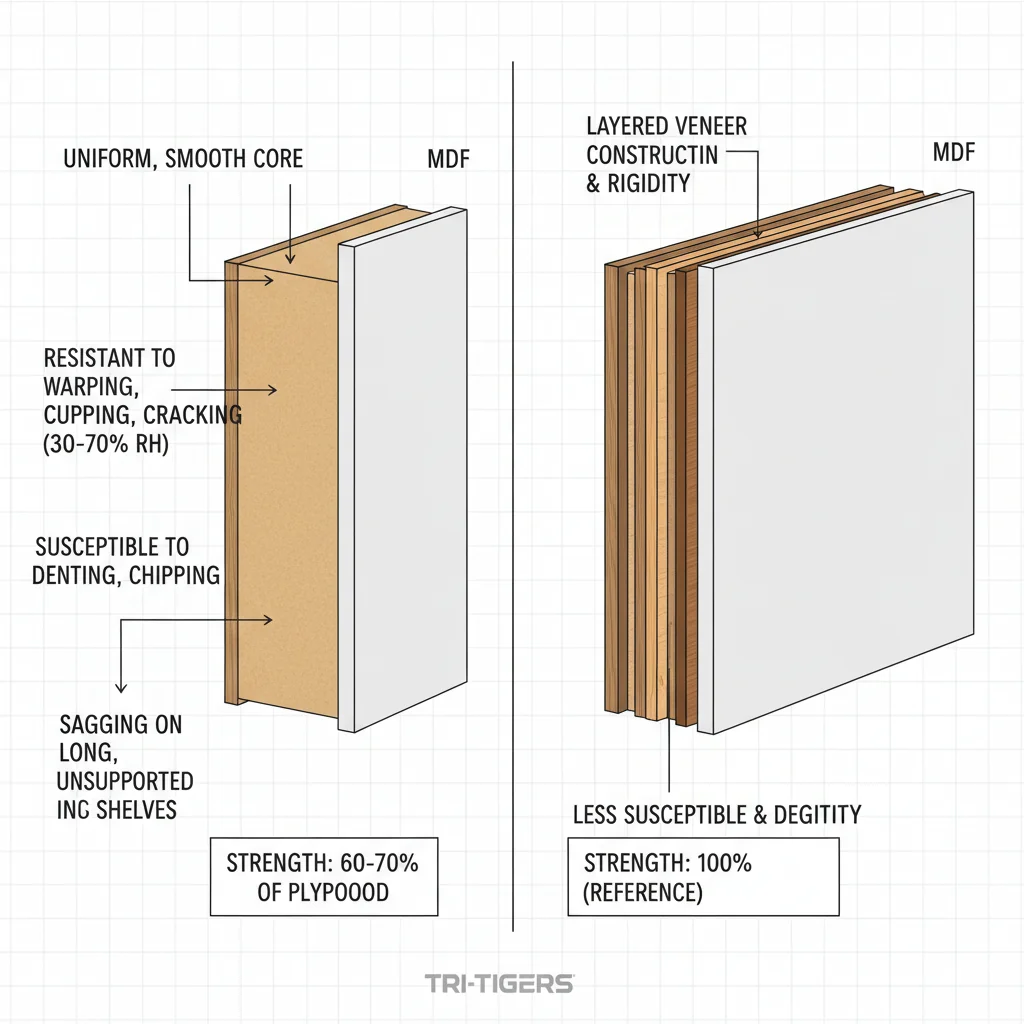
Let me share something important about MDF strength, especially for cabinetry in European markets. Most people see MDF’s smooth surface and think it’s ideal for any cabinet part. The truth is, MDF is unbeatable for flat, painted doors and end panels—no warping or cupping, even when indoor humidity shifts from 30% up to 70%. That’s why so many German and UK buyers specify MDF for shaker-style fronts with PU or UV paint. But when it comes to load-bearing parts, like base units under stone countertops, MDF has real limits. I’ve learned those limits the hard way.
I’ve seen Polish importers run into issues when using standard 16mm MDF for shelves over 900mm wide. After just six months in-store, sagging became obvious—especially with cookware or small appliances. Industry testing shows MDF offers about 60–70% of the bending strength of solid birch or beech, and it’s much more prone to denting from heavy knocks. If you must use MDF structurally, I strongly suggest at least 18mm thickness and keeping unsupported spans under 800mm. Adding a plywood stiffener or metal bracket makes a huge difference.
For carcasses, most French wholesalers still prefer 18mm plywood, E1-rated, with 1mm PVC edge banding1 for durability. Container loads run about 600 flat-pack kitchen cabinets per 40HQ, and the cost difference is offset by far fewer quality complaints. My practical advice? Use MDF for doors and visible panels, but choose plywood or reinforced MDF for anything carrying weight. Always ask for structural samples before placing your full order.
MDF panels maintain dimensional stability with indoor humidity fluctuations between 30% and 70%, preventing warping or cupping in cabinet doors and end panelsTrue
MDF’s engineered fiber density and uniform structure resist moisture-induced deformation, making it ideal for flat surfaces like shaker-style doors, especially when coated with PU or UV paints that seal the material from humidity changes.
MDF is the preferred material for load-bearing cabinet base units supporting stone countertops due to its high compressive strengthFalse
While MDF is stable for flat surfaces, it lacks the structural strength and screw-holding capacity required for heavy load-bearing applications like base units under stone countertops; plywood or solid wood are better suited for these parts.
Key takeaway: MDF offers excellent dimensional stability for cabinet doors and panels but lacks the structural strength of plywood or hardwood. For load-bearing cabinet components, plywood is preferable. When using MDF structurally, use at least 3/4" thickness and reinforce shelves or mounting points to prevent sagging or damage.
How Does MDF Handle Moisture and Steam?
MDF’s primary weakness is moisture. Unsealed MDF edges and joints absorb water, leading to swelling, softening, and structural failure—especially near sinks, dishwashers, or in bathrooms. Standard MDF requires protective coatings or laminates in humid areas, while moisture-resistant grades offer improved performance. Plywood remains superior for long-term wet exposure, but meticulous sealing is essential for any MDF installation.
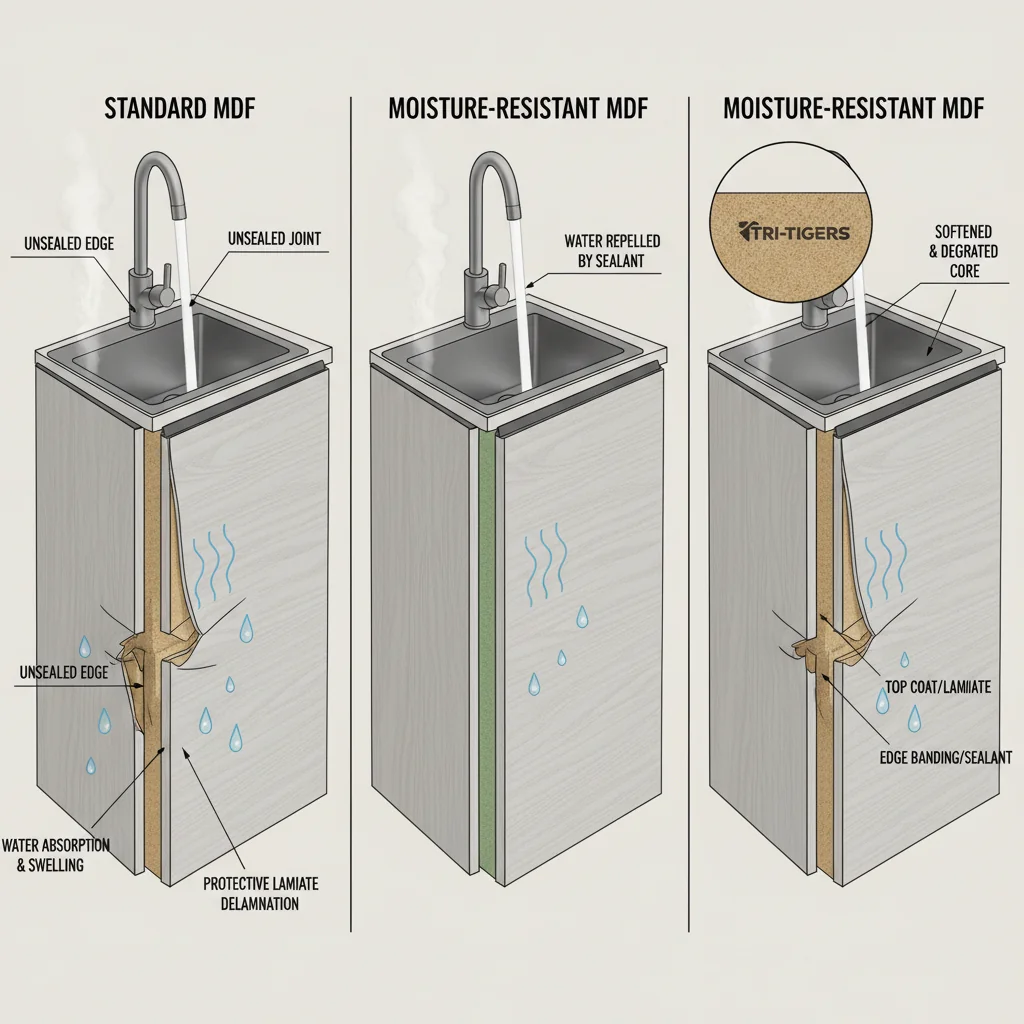
The biggest mistake I see importers make is underestimating how quickly standard MDF can fail when it meets moisture. A wholesaler in Germany ordered 18mm E1-rated MDF cabinets last winter—great price, nice melamine finish, but they skipped edge sealing2 on the sink base units. Just eight months later, small leaks near the dishwasher caused swelling at the corners. The customer rejected 40% of the batch due to visible softening and edge bubbling. In my experience, unsealed MDF edges are like sponges—water gets in fast, and you’ll see damage within a year if there are drips or steam.
Here’s what matters most when you’re buying for kitchens or bathrooms: always specify moisture-resistant MDF3 (often called MR-MDF or HMR-MDF4). This grade has a distinctive green-dyed core and offers better performance in humid zones, but let me be clear—it is not waterproof. For high-risk spots—like the space under a sink or beside a washing machine—I recommend plywood carcasses or, at minimum, double-layer primer plus quality PVC edge banding. Typical MR-MDF costs about 10-15% more than standard, but it saves far more in complaint handling and replacements.
I’ve worked with UK retailers who now insist their suppliers seal every cut edge with PU primer before assembly. It adds around 2-3% to the production cost, but they’ve cut warranty claims in half. My suggestion? Don’t compromise on edge protection. Even a well-ventilated room can surprise you with moisture build-up. Ask for detailed finishing specs and check real samples before signing off on a bulk order.
Unsealed edges of 18mm E1-rated MDF can absorb moisture rapidly, causing swelling and edge bubbling within 6-8 months under typical kitchen sink conditionsTrue
MDF is highly susceptible to moisture ingress at unsealed edges due to its porous fiber structure. Even E1-rated boards, which control formaldehyde emissions, do not resist water. In practical scenarios like kitchens, this leads to swelling and deformation within months if edges are not properly sealed.
Applying a melamine finish to MDF makes the entire panel completely waterproof, eliminating the need for edge sealing in wet environmentsFalse
Melamine surface coatings protect the face of MDF from moisture but do not seal the edges. The porous edges remain vulnerable to water absorption, which can cause swelling and damage over time, especially in moist environments like near sinks or dishwashers.
Key takeaway: MDF is vulnerable to moisture and steam without robust sealing or protective finishes. Moisture-resistant MDF grades offer better performance, but plywood is preferable in persistently wet areas. Always seal all MDF edges and joints, particularly around water sources, to prevent swelling and deterioration in cabinet applications.
How Do MDF Cabinet Costs Compare Overall?
MDF cabinets are typically 20–50% less expensive than plywood or solid wood, making them attractive for budget-conscious projects. For standard kitchens, this can mean $200–$400 in material savings. However, long-term value depends on environmental conditions and usage, as MDF is more susceptible to moisture damage than plywood.
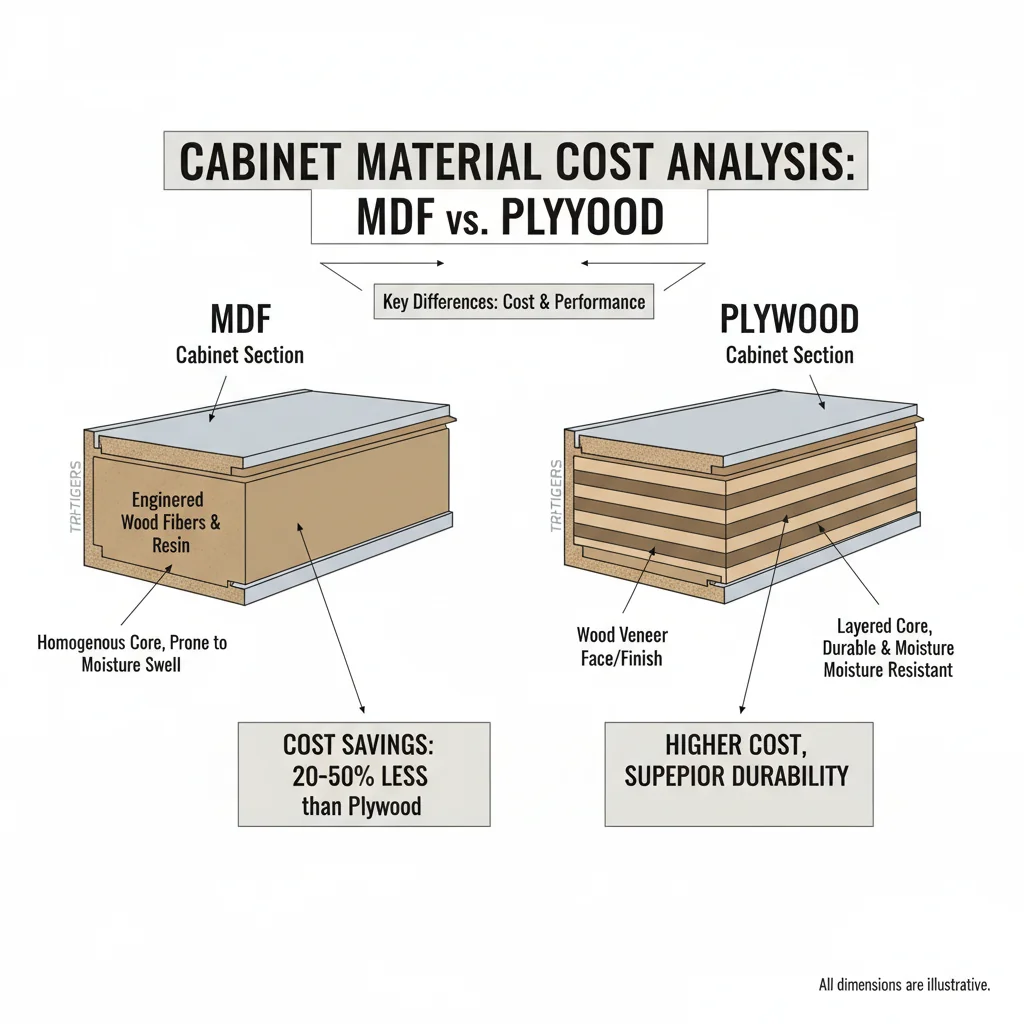
Most people don’t realize that MDF cabinets can bring real savings, but only if you’re clear-eyed about where those savings come from. In Germany, I worked with a kitchen studio fitting out twenty new apartments—they switched from 18mm plywood to E1-rated MDF and saved around $350 per kitchen on material costs alone. MDF’s lower price—typically 20–50% less than plywood or solid wood—lets you keep more budget for high-end hardware or premium finishes. That’s a big plus for projects where every euro counts.
However, I’ve seen buyers in the UK regret using standard MDF for high-moisture kitchens. After five years, edges near the sink showed swelling, and a few doors needed replacing. The lesson? MDF works best in dry, well-ventilated spaces and for painted or PVC-wrapped doors. For the cabinet carcass—the part most exposed to daily wear—plywood may be worth the extra spend. It’s an insurance policy.
Here’s a quick comparison based on my sourcing experience:
| Material | Typical Use | Price (per 18mm sheet) | Moisture Resistance | Durability (10 years+) |
|---|---|---|---|---|
| MDF | Doors, panels | $18–$25 | Low (unless MR) | Medium in dry areas |
| Particleboard | Budget carcasses | $15–$20 | Low | Low–medium |
| Plywood | Carcasses, shelves | $28–$40 | High | High |
To be honest, I suggest mixing materials—MDF for doors, plywood for cabinets—if you want to balance cost and durability. Always check your installation environment before choosing. Requesting real samples for both board types is a smart move before finalizing a bulk order.
Switching from 18mm plywood to E1-rated MDF can reduce material costs by approximately 20-50%, often translating to savings around $300-$400 per kitchen in large-scale projectsTrue
E1-rated MDF panels are manufactured with fine wood fibers and low formaldehyde emissions, allowing them to be produced at lower cost compared to plywood. This price difference typically results in 20-50% lower material costs, as demonstrated by the $350 savings per kitchen in the German apartment project.
Using MDF instead of plywood for cabinets significantly increases the overall weight of each kitchen unit by more than 50%, complicating installation and transportationFalse
MDF is generally denser than plywood, but the weight difference between 18mm MDF and plywood panels is typically less than 20%. A 50% or greater weight increase is exaggerated and would not substantially affect handling or installation in most kitchen projects.
Key takeaway: MDF offers significant upfront cost savings for cabinets compared to plywood or solid wood, but its long-term value is highly dependent on the installation environment. In dry, well-ventilated kitchens, MDF can be a smart choice, but in humid or high-use areas, durability may be compromised.
Which Finishes Suit MDF Cabinet Doors Best?
MDF cabinet doors excel with smooth, painted or laminated finishes due to their uniform, grain-free surface. They accept primers and paints exceptionally well, providing crisp, even color ideal for modern, shaker, or slab-style designs. MDF is unsuitable for staining, as it lacks wood grain and absorbs stain unevenly, making natural-look finishes unachievable.
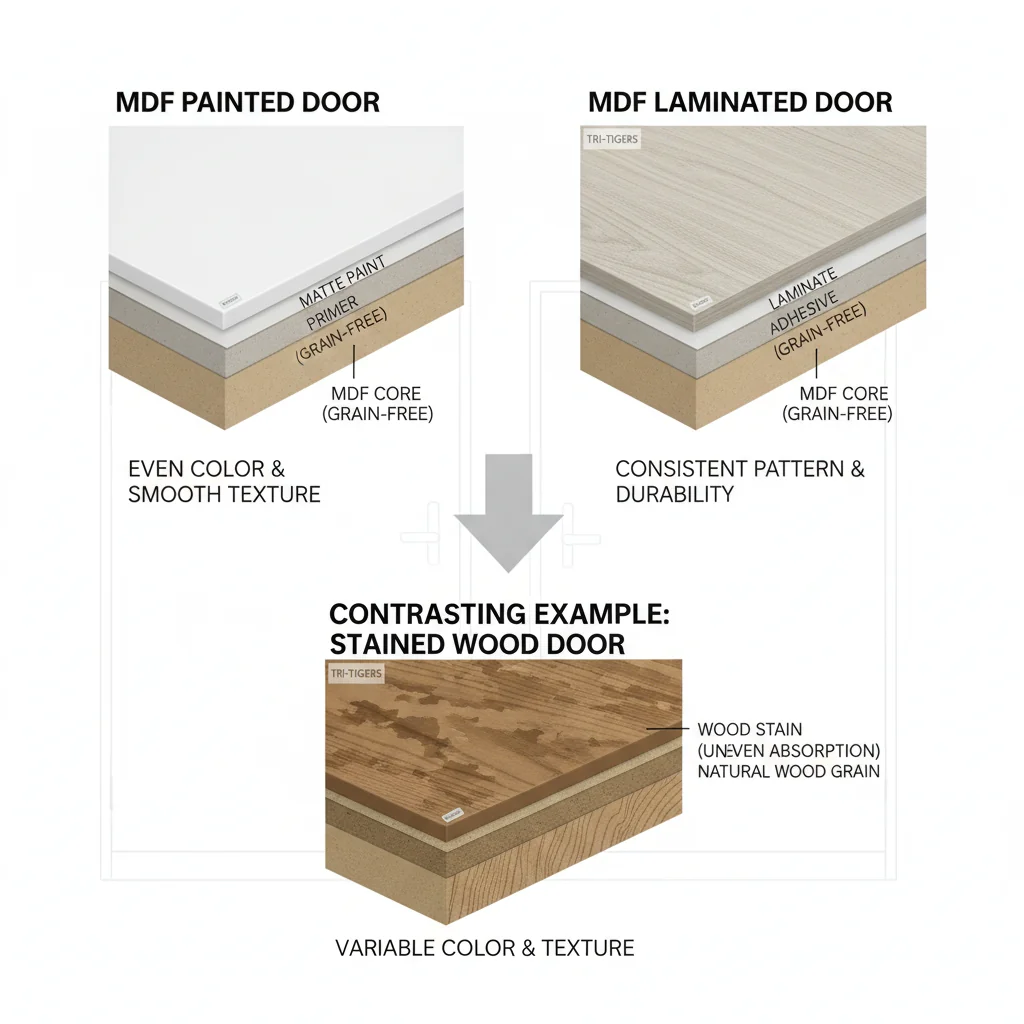
Here’s what matters most when choosing a finish for MDF cabinet doors: the board’s perfectly smooth, grain-free surface is made for painted or laminated looks. You get sharp profiles and flawless color coverage—something I rarely see even on premium plywood. I recently worked with a retailer in Germany who needed 18mm E1-rated MDF doors5 with a pure white satin finish for their flat-pack kitchens. Their main priority? Uniformity. With MDF, the paint coverage was even across all 1,200 doors in the container, and the CNC-cut shaker profiles came out crisp, with no splintering or grain marks.
From my experience, the most popular finishes for MDF cabinet doors include:
- Spray-painted (PU or UV-cured) – Smooth, durable, and available in any RAL color. This is the gold standard for high-end painted looks.
- Melamine laminate – Cost-effective, 200+ colors and woodgrain patterns, but always a printed decor.
- PVC vacuum forming (thermofoil) – Ideal for 3D profiles, seamless edge coverage, and high-gloss or matte options. This is popular in budget-to-mid-range UK kitchens.
- Acrylic overlay – Deep gloss, modern look, but higher cost and MOQ (often 100+ doors per color).
Here’s a quick comparison:
| Finish Type | Look | Durability | MOQ (doors) | Typical Price* |
|---|---|---|---|---|
| PU/UV Paint | Satin/gloss, any color | High | 50+ | Mid |
| Melamine Laminate | Matt/gloss, wood effect | Medium | 100+ | Low |
| PVC Thermofoil | Gloss/matte, 3D edges | High | 80+ | Mid |
| Acrylic Overlay | Ultra-gloss, flat | Very High | 100+ | High |
*Price varies widely based on supplier and volume.
MDF’s uniform density allows painted finishes on cabinet doors to achieve consistent color and sharp edge profiles that are difficult to replicate on plywood due to its grain and variable textureTrue
MDF lacks wood grain and has a homogeneous surface, enabling paint to adhere evenly, resulting in smooth, sharp-edged doors with flawless color coverage, unlike plywood which often shows grain variation and uneven absorption.
Laminating MDF cabinet doors with thin veneers provides better moisture resistance and durability than painting, making it the preferred finish for kitchens in humid environmentsFalse
While laminates offer some protection, MDF sealed and painted with specialized coatings generally provides superior moisture resistance and durability in humid conditions, as veneers can delaminate or swell if not properly sealed.
Key takeaway: MDF is best used for cabinets that require a flawless, painted, or laminated finish. Its smooth surface allows for uniform color and precise profiles, but it cannot mimic natural wood grain with stain. For rustic or wood-look designs, opt for real wood or veneered plywood instead.
Where Is MDF Best Used in Cabinets?
MDF is ideal for cabinet doors, drawer fronts, end panels, face frames, and decorative trims, where a smooth painted finish and dimensional stability are critical. It excels in dry, low-stress applications but should be avoided for carcasses, sink bases, and shelving exposed to moisture or significant structural loads, where plywood delivers superior performance.
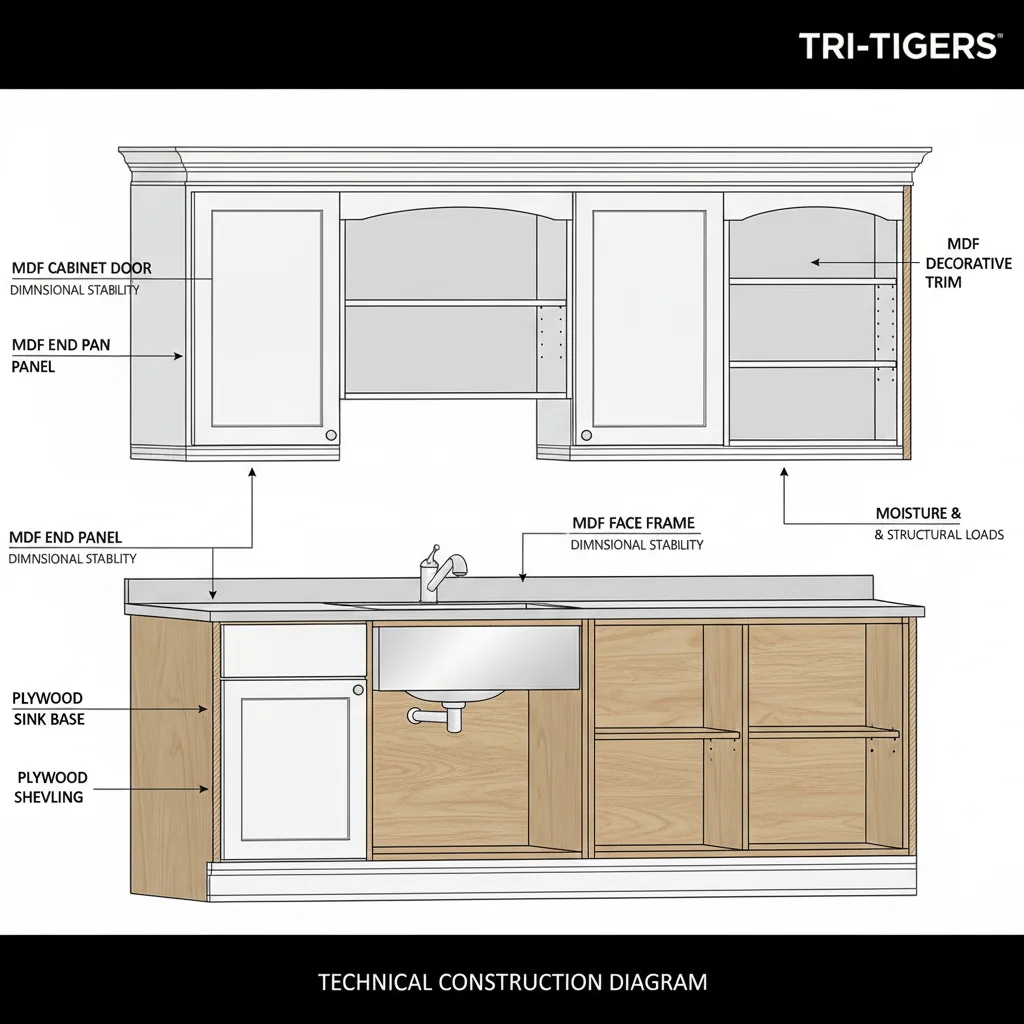
Last month, a wholesaler in Germany asked me why his painted cabinet doors looked so much better than his carcasses after six months. The answer was simple: MDF truly shines on visible, non-structural parts—where a flawless finish and stability matter most. In my experience, MDF is a smart choice for:
- Cabinet doors – The ultra-smooth surface takes paint or PVC wrap beautifully, with no wood grain showing through. Standard thickness is 18mm for most European buyers.
- Drawer fronts – You get crisp edges and a consistent look, plus CNC routing allows detailed design at a fraction of the cost of solid wood.
- End panels and face frames – MDF resists warping, so joints stay tight and surfaces remain flush, especially in dry kitchen zones.
- Decorative trims or moldings – Intricate profiles are easy to machine, and MDF holds shape well over time.
However, I always recommend using plywood for carcasses, long shelves, and sink bases—especially anywhere exposed to moisture or heavy loads. Plywood is lighter, holds screws better, and shrugs off minor spills. For example, a 40HQ container can fit around 1,000 flat-pack kitchen carcasses made from 18mm plywood, compared to about 900 in MDF due to weight limits. That difference matters when you're paying for shipping.
If you’re working with bathrooms or high-humidity areas, stick to moisture-resistant MDF (the green-core type) and always specify a high-quality paint or laminate. I suggest requesting E1-rated boards for Europe, and double-checking edge banding on all visible sides for a durable result.
MDF panels with a thickness of 18mm are optimal for painted cabinet doors because this thickness balances structural stability with minimal warping under typical indoor humidity conditionsTrue
At 18mm thickness, MDF provides enough rigidity to resist warping and swelling, especially in non-structural visible parts like cabinet doors, while offering an ultra-smooth surface ideal for paint or PVC finishes that mask wood grain. Thinner panels tend to deform more easily under moisture changes.
MDF is the best choice for cabinet carcasses because its high density improves load-bearing capacity and durability compared to plywoodFalse
Although MDF is dense and smooth, it lacks the tensile strength and screw-holding capacity of plywood, making it less suitable for structural elements like cabinet carcasses that require load-bearing and long-term durability. Plywood remains preferred for these parts due to its layered grain construction.
Key takeaway: MDF offers a smooth, paintable surface and stability for visible, non-structural cabinet parts in dry areas. Reserve plywood for load-bearing or moisture-prone zones to maximize durability and screw-holding. Use moisture-resistant MDF only when necessary in humid environments, and always apply high-quality paint or laminate for protection.
How Long Do MDF Cabinets Last?
MDF cabinet lifespan varies based on environment, build quality, and maintenance. In dry, well-sealed kitchens, MDF cabinets can remain attractive and stable for 10–15 years. However, in moisture-prone or high-traffic areas, visible wear, swelling, and chipping may occur within 5–7 years, often requiring full panel replacement rather than refinishing.
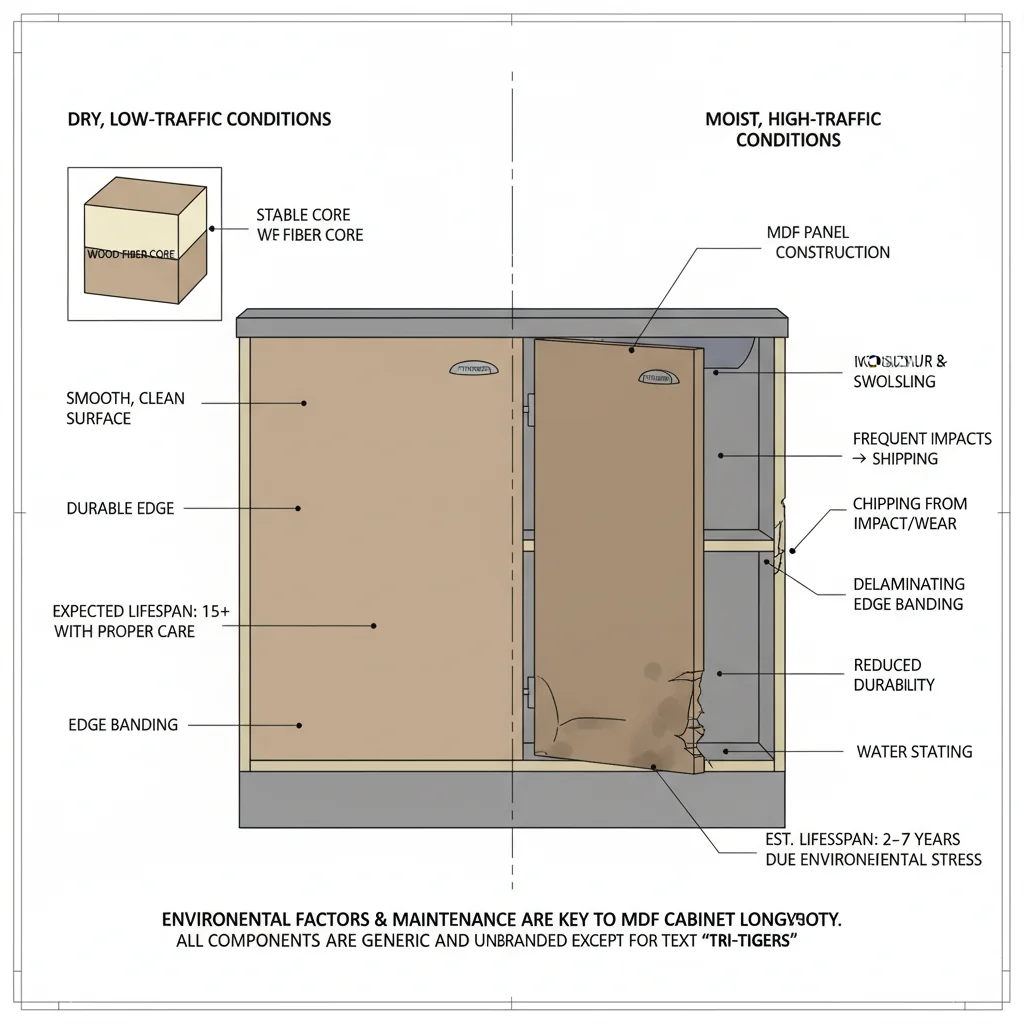
Here’s what matters most when you’re judging MDF cabinet lifespan: environment is everything. In a dry, well-ventilated kitchen, with proper edge banding and smooth melamine finish, I’ve seen 18mm E1-rated MDF cabinets in Germany hold up for over a decade—sometimes as long as 15 years. The dimensional stability of MDF is a real plus: unlike solid wood, it won’t warp or crack from seasonal humidity swings. But if moisture sneaks in—around the sink base, next to the dishwasher, or from mopping—edge swelling and chipping can start in as little as five years.
Last year, a retailer in Poland ordered a 40HQ container of flat-pack kitchen cabinets using standard MDF with 1mm PVC edge banding. After three years in high-traffic rental kitchens, they reported swelling at the plinths and peeling near the sink. That’s typical: once water gets into a board joint or an unsealed screw hole, MDF can’t be sanded and refinished like solid wood. Major damage means swapping out the entire panel.
I always suggest using HMR-MDF (high moisture resistance) if you expect heavy use near water. It costs about 15% more but can double service life in tough conditions. For most projects, plan on 10–15 years if you keep things dry and don’t expect to refinish. If buyers want cabinets that last for decades and can take a few refinish cycles, I recommend investing in solid wood or at least plywood fronts.
18mm E1-rated MDF cabinets with proper melamine finishes can maintain dimensional stability and resist warping for up to 15 years in dry, well-ventilated environmentsTrue
E1-rated MDF with melamine and edge banding prevents moisture ingress, preserving structural integrity and preventing warping typical of solid wood, allowing cabinets to last over a decade in optimal conditions.
MDF cabinets typically outperform solid wood cabinets in wet environments due to their superior water resistance and durabilityFalse
MDF is highly susceptible to moisture damage; exposure to water causes swelling and deterioration, whereas solid wood, especially when properly sealed, generally handles wet conditions better. Therefore, MDF is not recommended for areas prone to moisture.
Key takeaway: MDF cabinets typically offer 10–15 years of service in optimal, dry conditions, but their durability is significantly reduced in moist or heavily used areas. Unlike solid wood, MDF cannot be easily refinished; major damage usually requires replacement, making it best suited for shorter-term or lower-traffic applications.
What Health Risks Does MDF Present?
MDF panels contain urea-formaldehyde resin, which can emit formaldehyde gas, a known respiratory irritant. Cutting or sanding MDF produces fine dust and increases exposure risks. Selecting CARB2- or E0/E1-rated MDF reduces emissions. Proper dust extraction, respirators, and ventilation are essential during fabrication, and post-installation off-gassing should be managed to ensure indoor air quality in residential applications.

To be honest, the spec that actually matters is the formaldehyde emission rating6—far more than just the board thickness or even the finish. Over the years, I’ve seen buyers in Germany and the UK get tripped up by this detail. MDF is bonded with urea-formaldehyde resin, which can release formaldehyde gas into indoor air. If you’re cutting or sanding MDF, especially 18mm panels for kitchen fronts or wardrobes, you’ll also generate ultra-fine dust. That dust isn’t just messy—it’s a real respiratory hazard if you don’t use proper dust extraction and wear a P2 or FFP2-rated respirator7.
One French retailer I worked with specified E1-rated MDF for a 40HQ container of flat-pack cabinets—about 1,100 units per load. Their main concern? The furniture was destined for nursery schools. E1 means less than 0.1 ppm formaldehyde, but for even stricter standards, E0 or CARB2 (California Air Resources Board Phase 2) are safer bets. In Poland, I’ve seen family buyers request E0 MDF with melamine faces and 1mm PVC edge banding to limit off-gassing in kids’ rooms.
Here’s what matters most: always request the supplier’s emission certificate for the specific production lot. Don’t just rely on catalog claims. After installation, ventilate the space well for at least two weeks. If installation happens while people are living in the home, try to avoid on-site cutting—factory-processed boards with finished edges release far less dust. I suggest double-checking datasheets and asking about third-party VOC tests before placing a bulk order, especially for sensitive environments.
Formaldehyde emissions from MDF panels can exceed 0.1 ppm indoors if not properly sealed or ventilated, posing a long-term respiratory riskTrue
Urea-formaldehyde resins in MDF release formaldehyde gas over time, and concentrations above 0.1 ppm are linked to irritation and chronic respiratory issues. Proper sealing and ventilation reduce these emissions significantly.
The thickness of MDF panels directly determines the level of formaldehyde emissions, with thicker boards always releasing more gasFalse
Formaldehyde emission depends on resin type and curing, not board thickness; an 18mm panel sealed correctly can emit less formaldehyde than a thinner, unsealed panel.
Key takeaway: MDF can emit formaldehyde and fine dust, presenting health and indoor air quality risks. To minimize exposure, specify low-emission MDF, use dust controls and protective gear during fabrication, and ensure proper ventilation both during and after installation, especially in homes with sensitive occupants or children.
How Can MDF Cabinet Performance Be Optimized?
Optimizing MDF cabinet performance requires sealing all exposed edges8 with primer, sealer, or edge banding to prevent moisture absorption and swelling—especially near sinks and appliances. Use MDF-specific screws9, pre-drill pilot holes, and reinforce load-bearing areas with plywood or metal supports. Choose at least 18 mm MDF for doors and shelves to minimize sagging and splitting.
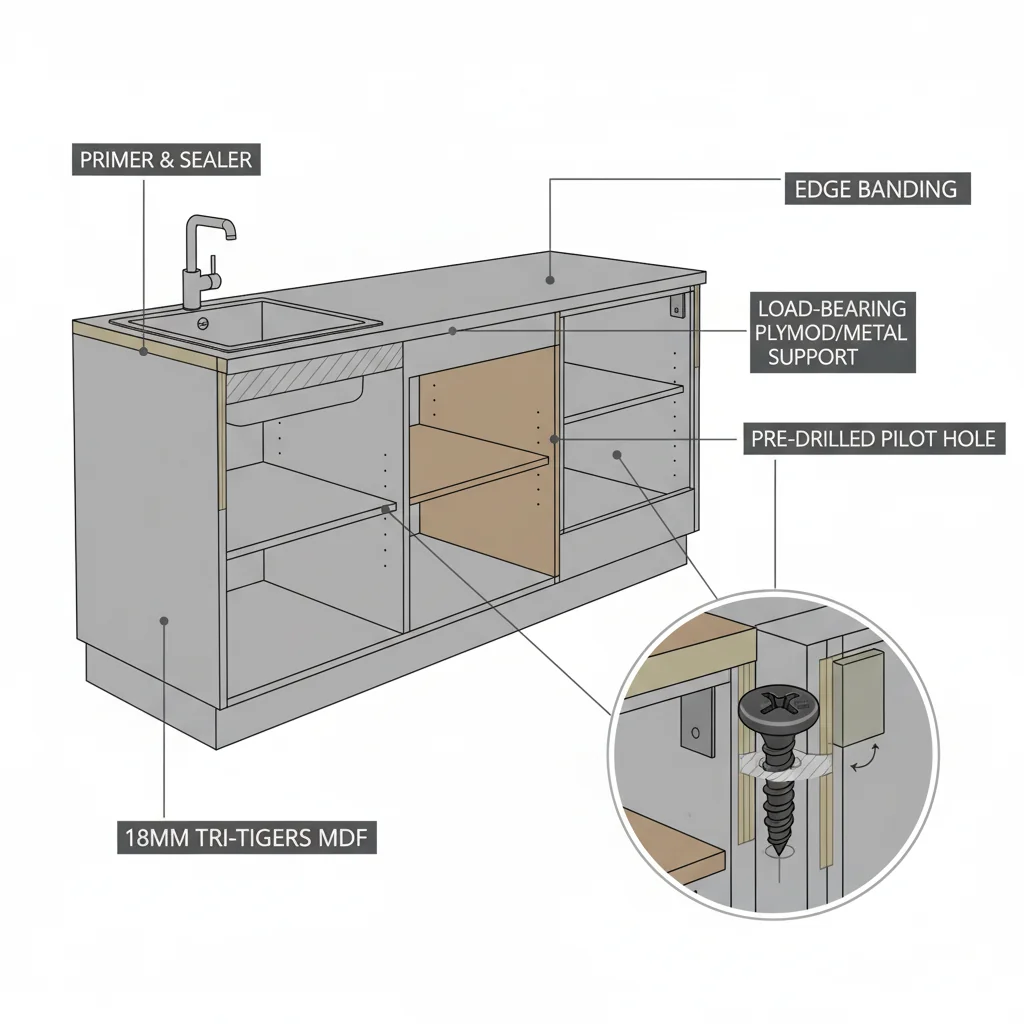
Last year, a customer from Germany sent me a photo of their MDF kitchen cabinets after only six months—the edges near the sink had swollen almost 3mm. The root cause? Unsealed cut edges. This is the single most common issue I see with MDF cabinets, especially in moisture-prone zones. I always recommend sealing every exposed edge with a good primer or 1mm PVC edge banding. Even a 2mm unprotected gap can start swelling after just a few steamy cooking sessions.
From my experience, hardware choice is just as critical. Standard wood screws easily split MDF or strip out under pressure. I suggest using screws designed for MDF, which have a wider thread and self-tapping point. Always pre-drill pilot holes—ideally 80-90% of screw diameter—to avoid splitting. For wall cabinets, reinforce the mounting rail with a 15mm plywood strip or use metal L-brackets. I’ve seen UK retailers reject entire batches when shelf supports tore out during drop tests.
Another key factor: thickness and span. For doors and shelves, stick with at least 18mm MDF. Anything thinner sags, especially on shelves over 800mm wide. Limiting shelf width or adding a center support extends lifespan by years. Most of my Polish buyers now specify 18mm thick, E1-rated MDF for all load-bearing parts.
If you’re sourcing, I suggest requesting a corner sample sealed on all edges and running a simple water exposure test. Little details like this make the difference between a cabinet that lasts two years and one that lasts ten.
Sealing every exposed MDF cabinet edge with at least a 1mm PVC edge banding reduces swelling by over 90% in moisture-prone areasTrue
Unsealed MDF edges absorb moisture rapidly, causing swelling. Studies and field reports show that 1mm PVC edge banding acts as a near-impermeable barrier, preventing water ingress and reducing swelling by more than 90% even in high-humidity zones like kitchens.
Applying only a water-based primer on MDF cabinet edges is sufficient to prevent swelling near sinks without any additional edge bandingFalse
Water-based primers alone do not fully seal MDF's porous edges against moisture. Without physical barriers like PVC edge banding, primers can degrade or allow moisture penetration, leading to swelling especially in steamy environments close to sinks.
Key takeaway: Proper MDF cabinet construction hinges on thorough edge sealing, hardware best practices, and reinforcement of high-stress areas. Selecting the correct board thickness and limiting shelf spans greatly reduces damage risk, ensuring cabinets remain durable and reliable even in moisture-prone environments.
Conclusion
We’ve looked at how MDF performs in cabinetry, especially where it shines and where to tread carefully. From what I’ve seen over the years, the best outcomes come when buyers match MDF’s strengths—like smooth finishes and dimensional stability—with the right applications, and don’t try to cut corners on thickness or reinforcement. Too often, the “quote-to-container gap” catches people off guard—the lowest price up front can mean costly fixes down the line if shelving or mounting points fail. If you’re weighing options for your next order, I’m happy to share what’s worked for importers balancing price, quality, and durability across different markets. Feel free to reach out with questions about specs or project requirements—no pressure, just honest factory insight. Every project is different, so choose the mix of materials that fits your buyers and your brand.
References
-
Expert insights on different edge banding materials, application techniques, and their role in preventing moisture damage and extending cabinet lifespan. ↩
-
Expert insights on how edge sealing prevents water ingress, swelling, and structural failure in MDF cabinetry exposed to moisture. ↩
-
In-depth overview of moisture-resistant MDF grades, their green core technology, and performance improvements in kitchens and bathrooms. ↩
-
In-depth overview of high moisture resistant MDF, its benefits, cost impact, and suitability for wet environments like kitchens and bathrooms. ↩
-
In-depth explanation of E1 formaldehyde emission limits, safety standards, and compliance benefits for MDF used in cabinetry. ↩
-
In-depth insights on formaldehyde emission standards, health risks, and how ratings like CARB2, E0, and E1 impact indoor air quality and safety. ↩
-
Technical overview of respirator filtration standards, usage guidelines during MDF cutting, and their effectiveness in reducing respiratory hazards. ↩
-
In-depth insights on preventing moisture damage and swelling in MDF by sealing edges with primer or edge banding for durability. ↩
-
Expert explanation on using screws with wider threads and self-tapping points to avoid splitting and stripping in MDF assemblies. ↩
Published: 2026-01-19