
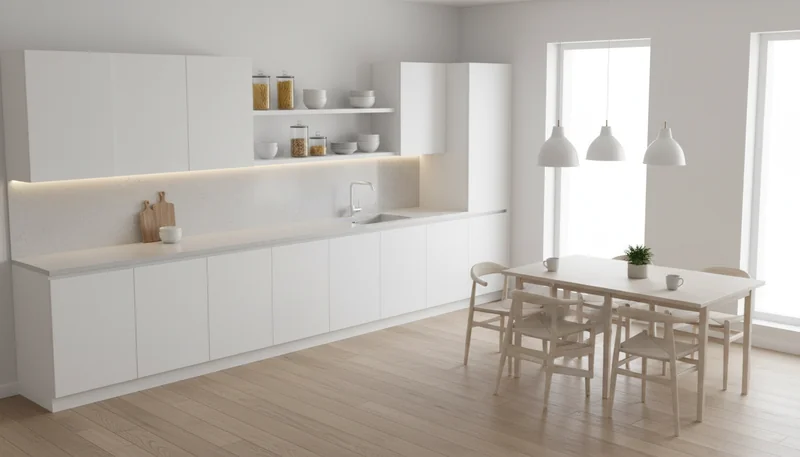
Featured image for Is MDF Board Good for Kitchen Cabinets? Manufacturer’s Sourcing Guide to Avoid Common Mistakes
Is MDF Board Good for Kitchen Cabinets? Manufacturer’s Sourcing Guide to Avoid Common Mistakes
Not long ago, a Polish contractor sent me photos of kitchen cabinets that had started to warp and swell just two years after installation. All the panels looked perfect at delivery—but one splash-prone corner near the dishwasher told a very different story. It’s a classic case I see across Europe: MDF can look flawless, yet behave unpredictably behind closed doors.
MDF (Medium-Density Fiberboard) is manufactured by compressing fine wood fibers with resin under high heat and pressure, resulting in a dense, uniform panel ideal for painted finishes. The absence of natural grain enables precise machining and a smooth surface, but also means lower screw-holding strength1 and poor resistance to moisture compared with plywood or solid wood.
Is MDF Board Suitable for Kitchen Cabinets?
MDF board, engineered from fine wood fibers and resin, offers a smooth, uniform surface ideal for painted kitchen cabinet doors and panels. However, it is less robust than plywood when exposed to moisture or heavy fastener loads. MDF’s lower screw-holding strength and poor moisture resistance limit its use as a structural cabinet material in kitchens.
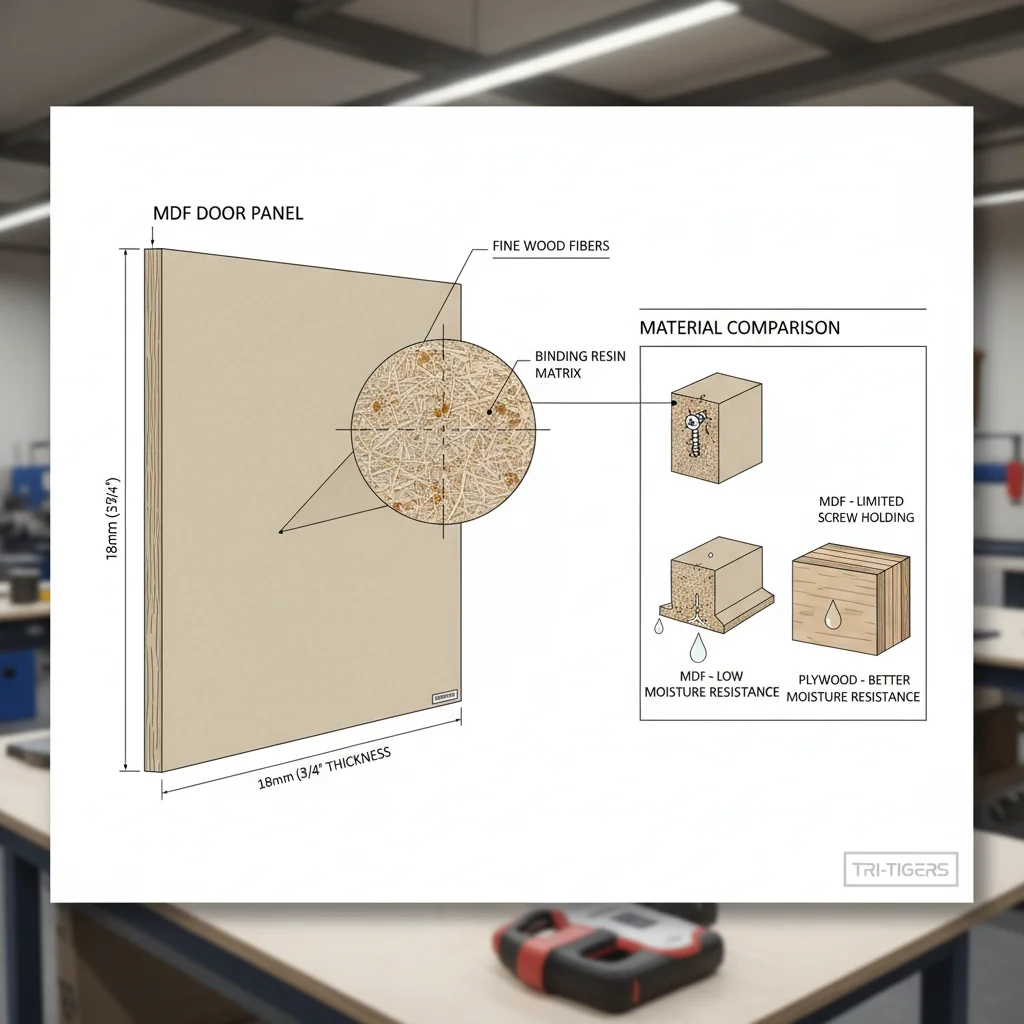
Let me share something important about MDF in kitchens—most people expect it to perform like plywood, but that’s not really the case. MDF is engineered from fine wood fibers mixed with resin and compressed under heat, which gives it a dense, uniform structure. This means you get super smooth surfaces—ideal for spray painting or PVC vacuum forming. For painted cabinet doors, especially those requiring intricate CNC profiles, it’s hard to beat. In Germany and the UK, I’ve shipped thousands of flat-pack kitchen door sets made from 18mm E1-rated MDF because the finish is flawless, and there’s no visible grain or knots to worry about.
But here’s the catch: MDF simply doesn’t handle moisture well. I’ve seen Polish wholesalers frustrated after installing MDF carcasses too close to sinks or dishwashers—edges start swelling, even with good PVC edge banding2. Standard MDF absorbs water quickly, and even moisture-resistant grades (HMR-MDF3) only buy you a bit more time. The screw-holding strength is another issue; MDF can strip out if you overtighten cam-locks or hinges, especially on wall cabinets holding heavy dinnerware.
For structure, plywood or high-density particleboard is just safer. For example, a 40HQ container will fit around 1,000 full-size kitchen cabinet carcasses in 18mm particleboard, but only about 900 in MDF due to its weight. My advice? Specify MDF for doors and visible panels—never for base or wall unit frames in demanding kitchens. Always request E1 or E0 certification and check edge sealing before confirming your order.
MDF’s uniform density makes it ideal for CNC routing intricate cabinet door profiles without causing tear-out common in plywoodTrue
MDF is composed of fine wood fibers and resin compressed evenly, resulting in a consistent density that allows precise CNC cutting with minimal chipping or splintering, unlike plywood which has grain variations that can cause tear-out during detailed profiling.
MDF is naturally water-resistant and therefore requires no additional sealing or finishing for use in kitchen cabinetsFalse
Standard MDF absorbs moisture easily due to its fiber composition, leading to swelling and degradation unless properly sealed or coated; water-resistant variants exist but are not inherent to general MDF boards used in cabinetry.
Key takeaway: MDF excels for painted kitchen cabinet panels due to its smooth finish but is not optimal for structural cabinet components exposed to moisture or heavy fastening. Manufacturers should specify MDF primarily for decorative surfaces, not for base or wall cabinet carcasses in demanding kitchen environments.
How Does MDF React to Kitchen Moisture?
MDF’s primary vulnerability in kitchen environments is moisture absorption. Its fiber-based core readily swells and softens if exposed to water—particularly through unsealed or damaged edges. While standard MDF manages normal humidity, kitchen conditions often involve splashes, spills, steam, and leaks, making MDF susceptible to swelling and crumbling unless rigorously sealed or replaced with moisture-resistant variants.
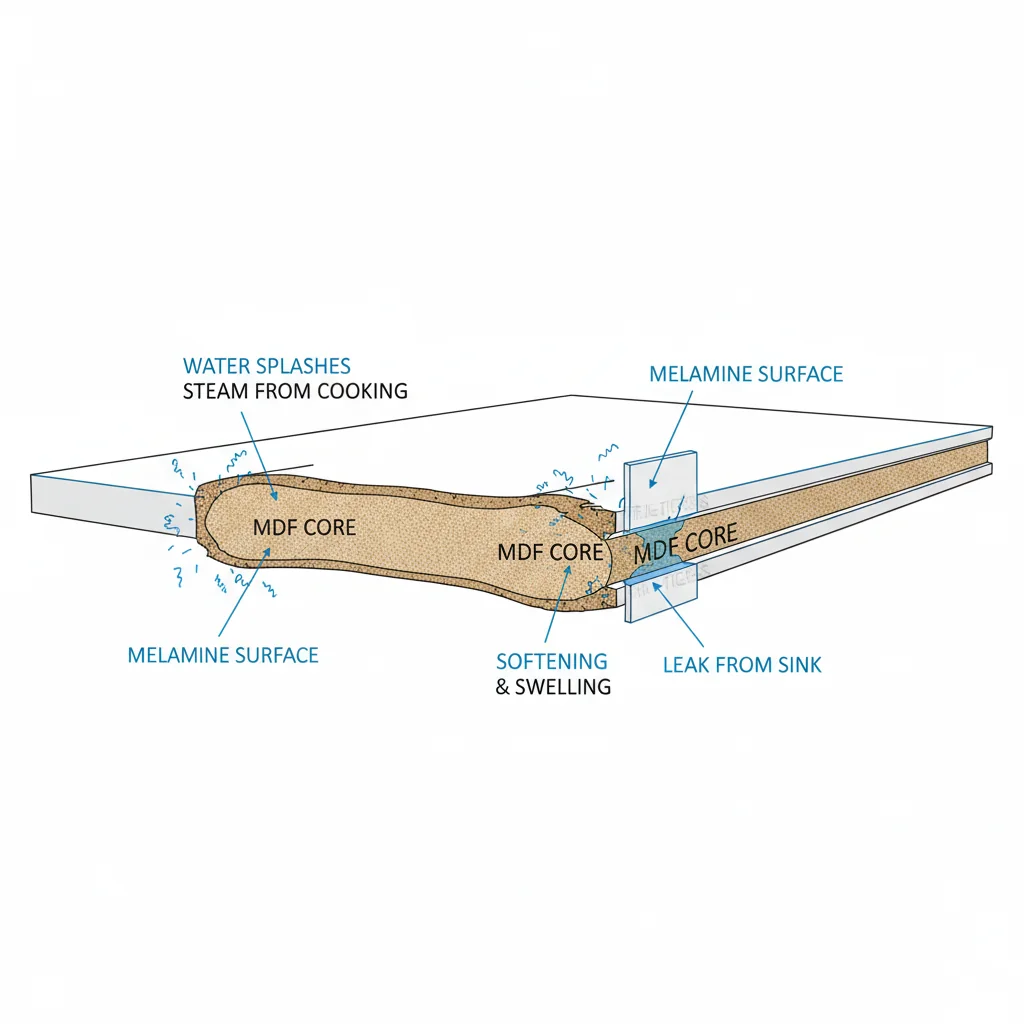
The biggest mistake I see is assuming MDF handles kitchen moisture just like it does in living rooms or bedrooms. In reality, kitchens are a different beast—think constant steam from kettles, splashes from the sink, even the odd dishwasher leak. I had a UK customer order 18mm E1-rated MDF cabinet doors last winter. They looked great in the showroom, but after six months, the sink base panels had swollen by nearly 4mm at the bottom. The culprit? A tiny gap in the edge banding let water seep in. Once moisture gets into the fiber core, swelling and softening happen fast—especially with standard MDF.
Here’s what matters most when specifying MDF for kitchens: check if it’s moisture-resistant (MR-MDF4, often with a green core). MR-MDF performs better, but don’t be misled—it’s moisture resistant, not waterproof. Even MR-MDF will absorb water at the edges if left unsealed. For high-risk zones like under-sink cabinets, toe kicks, or around dishwashers, I always suggest using proper PVC edge banding (at least 1mm thick) and requesting extra sealing on cut edges. Some German importers specify a two-layer PU lacquer on exposed edges—it adds about 5% to the panel cost, but extends service life.
From my experience, a 40HQ container typically fits around 1,200 flat-pack cabinet doors at 18mm thickness. If just 5% fail due to moisture, that’s 60 replacements—plus frustrated customers. My advice? Use MDF with care in kitchens. Prioritize sealing, and avoid standard MDF near wet areas unless you’re prepared for extra maintenance down the road.
Even minor gaps in MDF edge banding can cause up to 4mm swelling within six months in kitchen environments due to steam and water exposureTrue
MDF is highly susceptible to moisture infiltration; a small breach in edge banding allows water to seep into the core, causing the fibers to swell significantly—up to several millimeters—especially in humid kitchen conditions with constant steam and splashes. This swelling compromises cabinet structural integrity.
E1-rated MDF is fully waterproof and suitable for all kitchen cabinet applications without additional sealing or treatmentFalse
E1 rating only refers to low formaldehyde emissions, not moisture resistance. MDF, including E1-rated panels, is inherently vulnerable to water damage unless specifically treated or sealed; untreated MDF will swell and degrade quickly in moisture-rich environments like kitchens.
Key takeaway: Standard MDF is highly susceptible to water damage in kitchens. Even moisture-resistant MDF is not waterproof and needs thorough sealing, especially near sinks, dishwashers, and toe kicks. For long-lasting cabinets, avoid MDF in high-moisture zones or accept a shorter service life and higher maintenance costs.
Is MDF Cost-Effective for Kitchen Cabinets?
MDF board offers an initial cost saving of 20–40% compared to plywood, making it appealing for budget-conscious kitchen cabinet projects. However, its susceptibility to moisture damage, chipping, and edge swelling5 often leads to repairs or replacement. Over 10–15 years, these issues can negate upfront savings, making plywood or solid wood more cost-effective long-term.
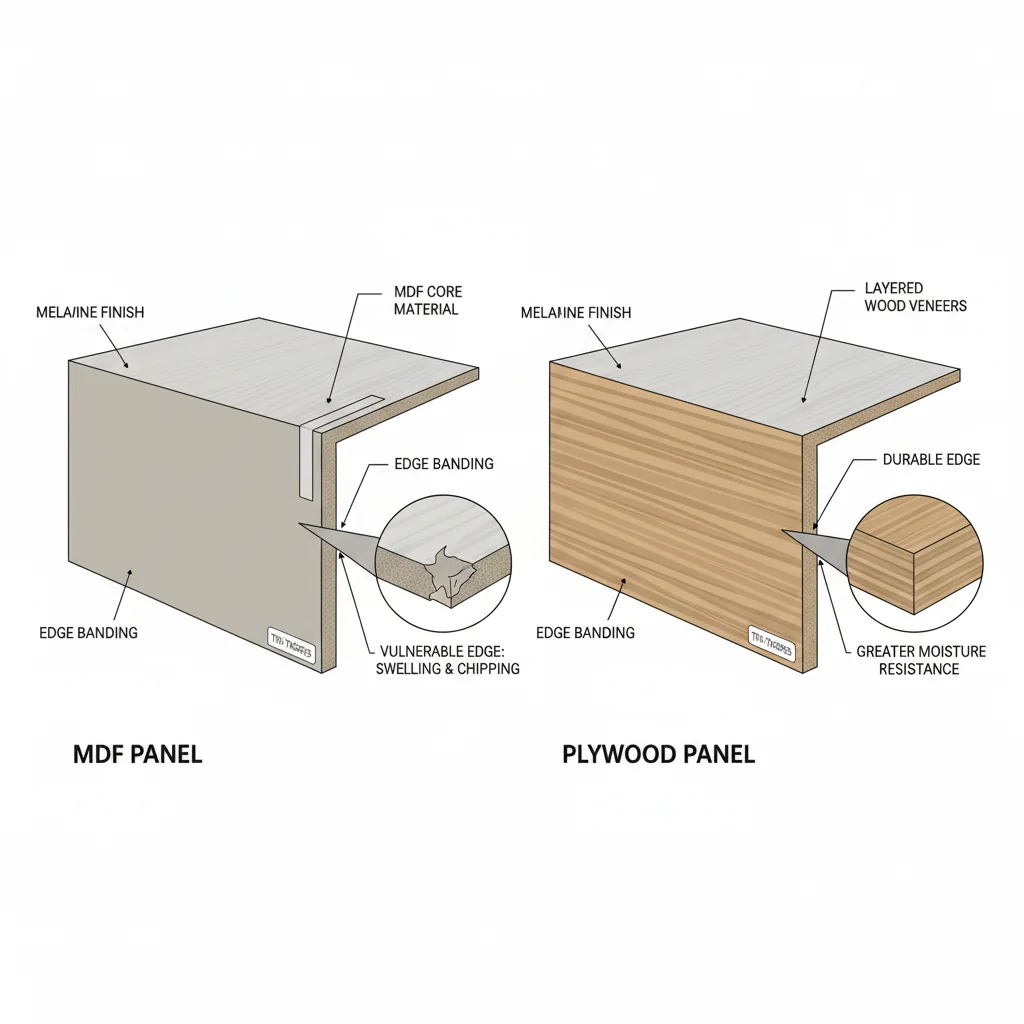
Most people don’t realize how quickly real-world use exposes MDF’s weaknesses in a kitchen. I recently spoke with a buyer from Germany who chose E1-rated 18mm MDF6 cabinets finished in matte white lacquer—mainly for the 30% upfront savings compared to plywood. The first year, everything looked perfect. But by year three, regular steam from the dishwasher and accidental water spills started to cause edge swelling near the sink units. MDF is dense and smooth, but it absolutely hates moisture. Once the edge banding fails or gets chipped, water seeps in fast. You can fill and repaint the worst spots, but the repair never quite matches the original finish.
From my experience, most kitchen MDF failures show up at high-use areas—under sinks, around dishwashers, lower plinths. In Poland, a wholesaler told me they had to replace nearly 40% of their MDF door panels after eight years. The cost of new panels, plus installation, actually wiped out their initial savings. Plywood or solid wood, on the other hand, can be sanded, refinished, or touched up—so the lifespan is usually double or more.
For tight budgets, MDF still makes sense, especially in short-term rentals or for secondary kitchens. But if you’re planning to stay in the property over 10 years, I suggest looking at moisture-resistant plywood core or solid wood frames, even if the initial quote is higher. Ask your supplier about upgraded edge banding and HMR-MDF options—sometimes the extra investment is worth it in the long run.
E1-rated 18mm MDF boards can offer a 30% initial cost savings over plywood for kitchen cabinetsTrue
E1-rated MDF panels are manufactured to strict formaldehyde emission standards and are generally less expensive to produce than plywood, which involves layering and adhesive bonding of veneers, leading to approximately 30% lower upfront material costs in cabinetry.
MDF cabinets maintain their structural integrity and surface finish equally well as plywood when exposed to regular kitchen moisture like steam and water spillsFalse
MDF is highly susceptible to moisture damage because its compressed wood fibers swell and degrade when exposed to steam or water, unlike plywood which has better natural resistance due to its layered veneer construction and waterproof adhesives, making MDF less durable in moist kitchen environments.
Key takeaway: While MDF cabinets are budget-friendly upfront, their vulnerability to moisture and edge damage can lead to costly repairs or replacements within a decade. For long-term value and durability, plywood or solid wood is often the better financial and functional investment.
Where Is MDF Suitable in Kitchen Cabinets?
MDF is best used in kitchen cabinet applications such as upper wall cabinets away from moisture, painted doors and drawer fronts in modern styles, and decorative or end panels in dry areas. It is not recommended for sink bases, dishwasher-adjacent cabinets, cabinet floors, or toe kicks where water exposure is likely.
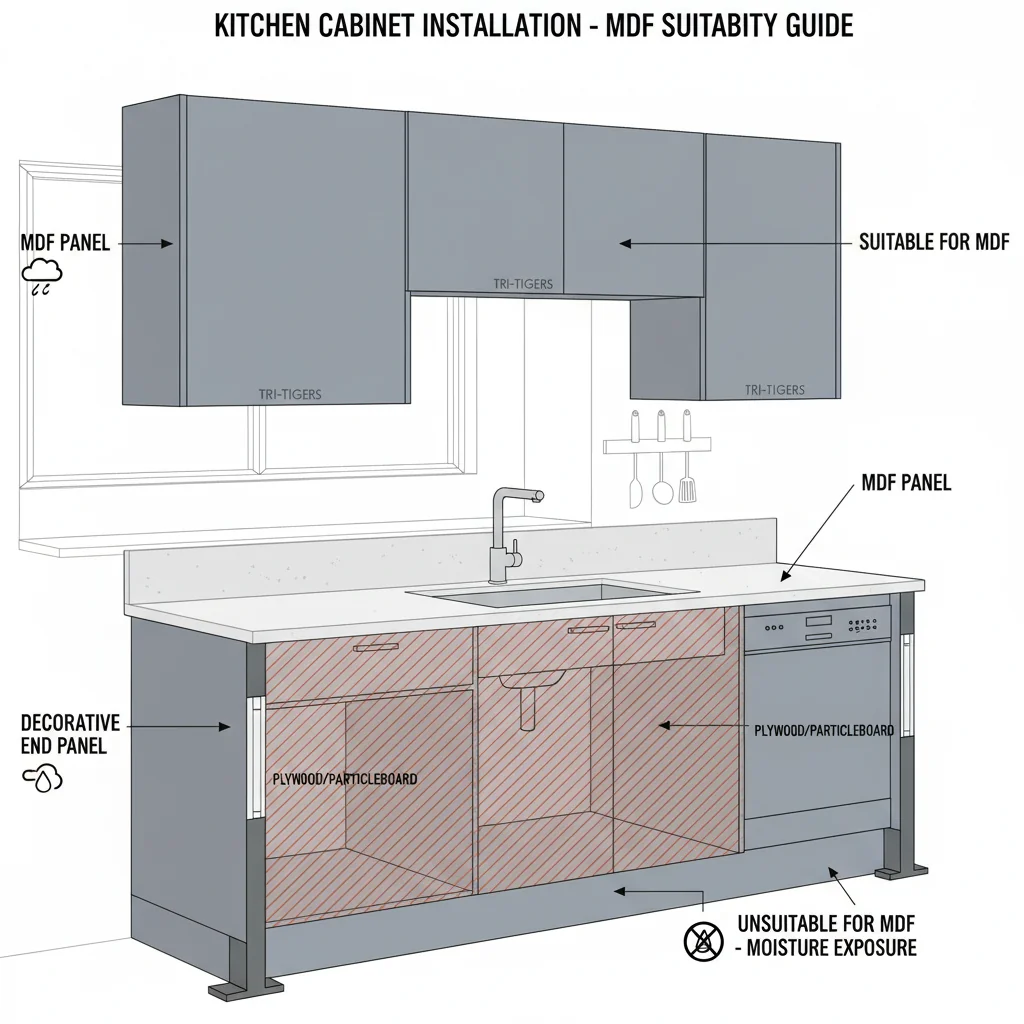
Most people don’t realize that MDF’s strengths—and its weaknesses—show up fast in kitchen applications. In Germany, I worked with a buyer who insisted on MDF throughout an entire kitchen line to save about 8% on material cost. Within two years, complaints from end customers started rolling in—mostly from units installed under sinks or near dishwashers. The problem? Standard MDF just can’t handle moisture. It swells and loses strength even from minor leaks or daily splashes.
For upper wall cabinets, especially away from water sources, MDF is a smart choice. It’s stable, perfectly flat, and takes paint beautifully. I’ve supplied 18mm, E1-rated MDF doors with PVC edge banding for a UK project—over 1,200 sets in a single 40HQ container. The lead time was about 35 days, and the finish looked fantastic in modern matte colors. As long as the cabinets are kept dry, MDF holds up well, especially for decorative end panels, open shelving, or painted drawer fronts.
However, I always caution buyers—don’t use MDF for sink bases, cabinet floors, or toe kicks. In Poland, a wholesaler tried it in high-traffic rentals and ended up replacing 20% of lower cabinets within five years. If durability is a priority or the kitchen will see heavy use, specify plywood or moisture-resistant particleboard for the cabinet boxes. For short-term projects or guest suites, MDF can be a reasonable compromise. I suggest checking whether your supplier offers HMR-MDF for slightly better performance—but always request a sample before bulk orders.
MDF panels used in kitchen cabinets installed above countertops can maintain structural integrity for over 10 years if properly sealed and finishedTrue
Although MDF is sensitive to moisture, when used in upper wall cabinets away from direct water exposure and sealed with moisture-resistant coatings, it can last a decade or more without significant swelling or strength loss. Proper finishing prevents water ingress that typically causes MDF deterioration.
MDF is ideal for base kitchen cabinets near sinks because it absorbs moisture to reinforce its density and durabilityFalse
MDF's fibers swell and weaken when exposed to moisture, especially around sinks or dishwashers. This absorption causes loss of strength and deformation, making MDF unsuitable for base cabinets in wet areas unless specially treated or replaced with moisture-resistant alternatives.
Key takeaway: MDF is a viable option for certain kitchen cabinet components, especially in low-moisture, low-wear areas or for short-term projects. For high-use or high-moisture zones, manufacturers should specify plywood or moisture-resistant materials to ensure durability and long-term performance.
How Should MDF Be Specified for Kitchens?
MDF used in kitchen cabinets must be specified as moisture-resistant (MR) grade, typically denser and green-tinted, to withstand humidity. A minimum thickness of 18mm is recommended for doors and fronts. Factory-laminated or UV-cured finishes offer superior water resistance compared to raw or brushed finishes. Hybrid cabinet construction uses plywood for boxes and MR MDF only for visible components.
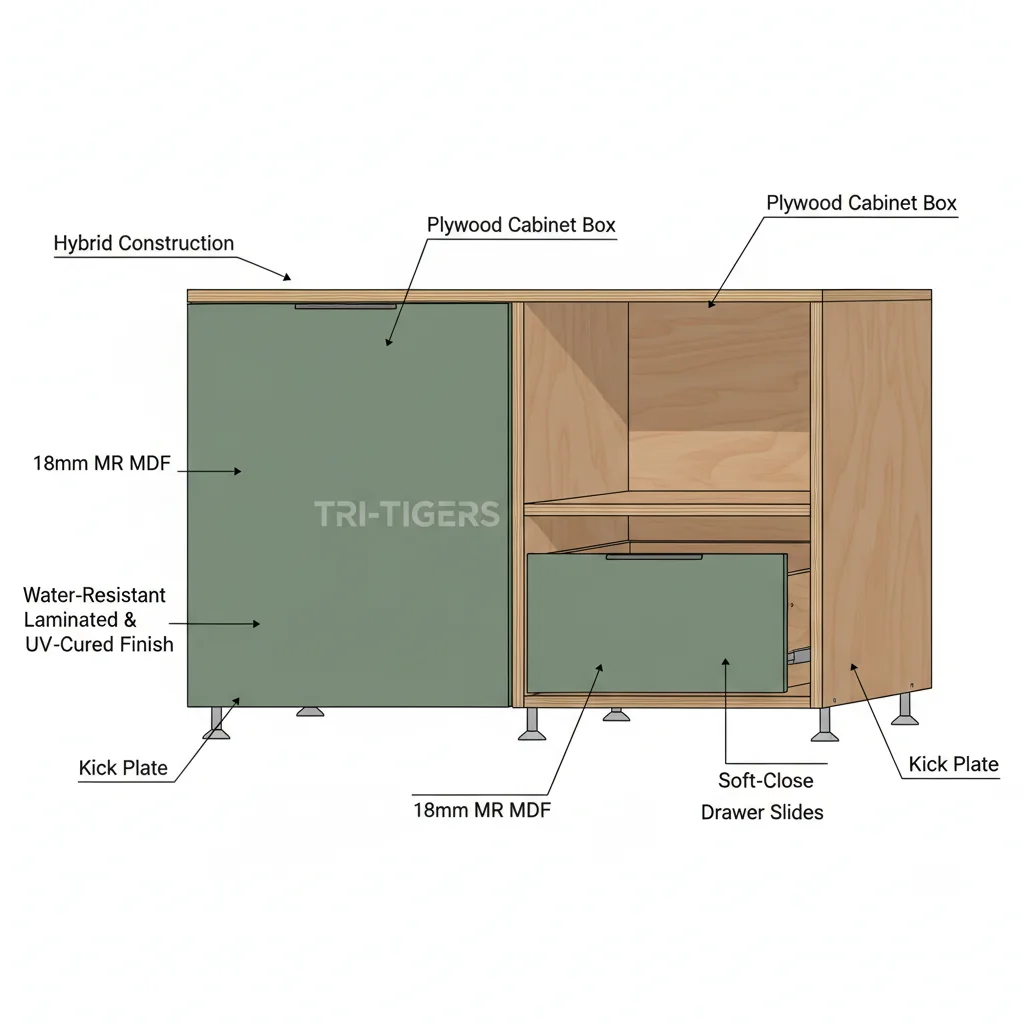
Last month, a kitchen importer in Germany called asking why their cabinet doors warped after just six months. When I checked their specs, they'd used standard MDF—no moisture resistance, 16mm thick, and only a basic roller paint finish. That’s a recipe for problems in humid kitchen environments. For any kitchen project, I always recommend specifying moisture-resistant (MR) MDF7, which usually has a green core and a density of at least 700 kg/m³. Go with 18mm thickness for doors and drawer fronts—not only does this help prevent warping, but it also improves impact resistance and gives a more solid feel.
Here's what matters most when it comes to finish: factory-applied coatings make all the difference. A UV-cured or high-quality spray finish forms a much harder, water-resistant surface than anything site-painted. I’ve seen French buyers go with factory-laminated melamine and reduce after-sales complaints by at least 40%. If you need color-matched paint, ask for PU or UV-cured options, not basic NC lacquer. For visible edges, specify 1mm PVC or ABS edge banding—thin melamine tape just doesn’t hold up to years of use.
Hybrid construction is common in the UK: plywood or high-grade particleboard for cabinet boxes, MR MDF only for doors and visible panels. This keeps costs and moisture risks in balance. To avoid misunderstandings, I suggest writing all material specs—board type, thickness, finish, edge banding—directly into your contract. I’ve seen too many buyers burned by vague “MDF” orders. Get samples, confirm details, and you’ll avoid most headaches down the road.
Moisture-resistant MDF for kitchen cabinets typically has a green core and a density of at least 700 kg/m³ to prevent warping in humid environmentsTrue
The green core in MR MDF indicates added moisture-resistant resins, and a density above 700 kg/m³ enhances panel stability, both crucial to withstand kitchen humidity and avoid warping.
Standard MDF with a thickness of 16mm and a basic roller paint finish is sufficient for kitchen cabinet doors in humid environmentsFalse
Standard MDF lacks moisture resistance, and 16mm thickness does not provide enough structural stability; combined with basic paint, it leads to warping and degradation in humid kitchen conditions.
Key takeaway: For kitchen cabinets, always specify moisture-resistant MDF of at least 18mm thickness for doors and fronts. Use factory-applied finishes for durability, and combine MR MDF with more moisture-tolerant materials for structural parts. Document all material specifications in contracts to prevent quality issues and misunderstandings.
How Crucial Is MDF Edge Sealing?
Edge sealing is essential for MDF kitchen cabinets, as exposed fibers on cut or routed edges are highly susceptible to moisture damage. Factory-applied PVC edge banding or sprayed finishes offer superior protection compared to DIY sealing. However, ongoing maintenance—immediate spill cleanup, gentle cleaning, and timely touch-ups—is required, since any breach in the seal can quickly lead to swelling and deterioration.
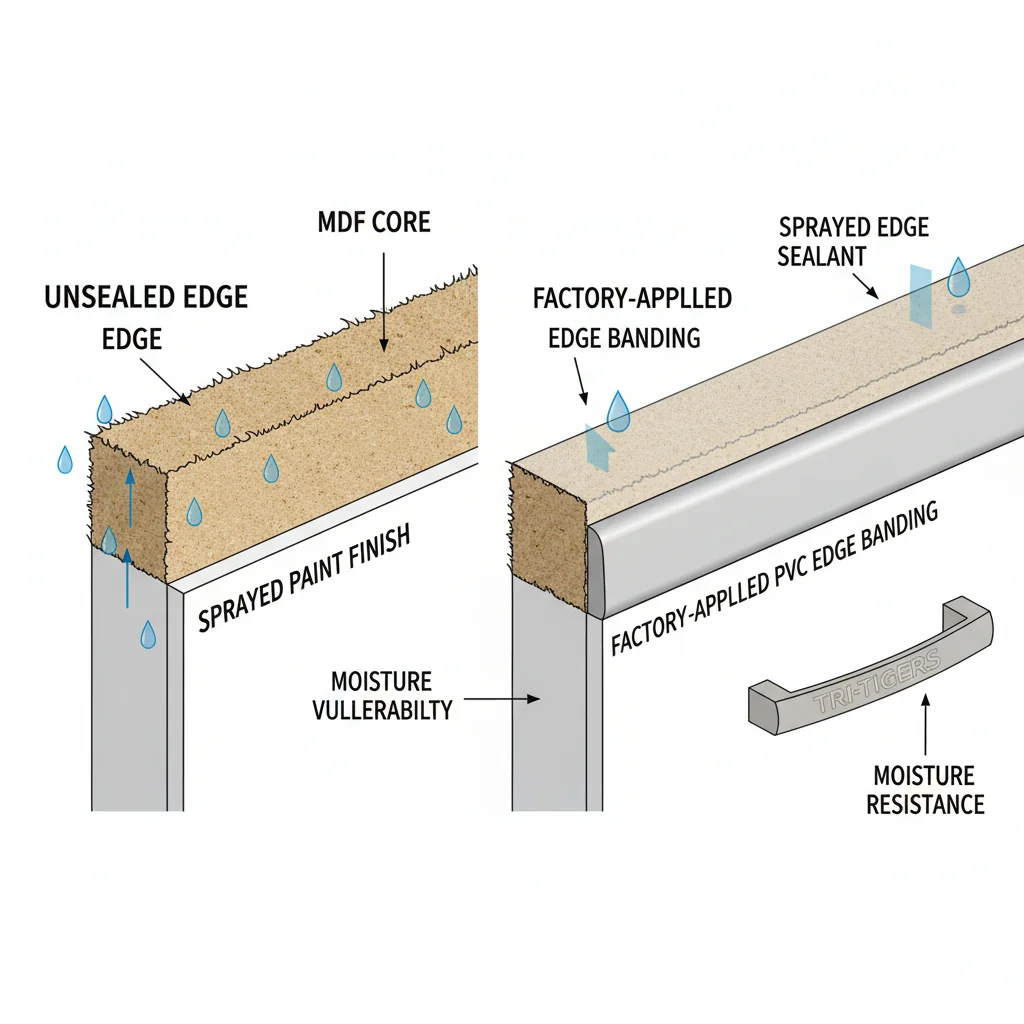
Here’s what matters most when specifying MDF for kitchens: edge sealing is not just a technical detail—it directly impacts how long your cabinets last. I’ve seen German buyers lose entire sink base runs within 18 months simply because exposed MDF edges swelled after a minor leak. The reality is, MDF’s internal fibers act like a sponge on any cut or routed edge. Even E1-rated 18mm boards with premium melamine faces are only as good as their weakest edge.
Factory-applied PVC edge banding—usually 1mm thick for visible edges—gives the best protection. In Poland, most importers now require all cabinet door and drawer fronts to be fully banded, even on the hinge side. Sprayed PU or UV lacquer can also work, but it needs to be applied in a dust-free factory environment for a complete seal. I always warn customers: DIY edge painting on site isn’t enough for high-moisture zones like under-sink cabinets or next to dishwashers.
Over time, daily use takes its toll. Hinges loosen, corners chip, and cleaning with too much water slowly breaks the seal. Once water gets in, edges puff up—sometimes within weeks. I suggest visual checks at least once a year, and touch up any cracks immediately. If you can’t commit to that level of care, plywood or HMR-MDF may be safer choices for wet-prone areas. Consistent edge protection is non-negotiable if you want MDF cabinets to last in a real kitchen.
Exposed MDF edges can absorb up to 10 times more moisture than sealed edges, causing swelling and structural failure in kitchen cabinets within 12-18 months after minor leaksTrue
MDF’s porous internal fibers act like a sponge when edges are left unsealed. Studies show moisture absorption rates at cut edges are significantly higher, leading to swelling and degeneration much faster than the sealed surfaces, especially in moisture-prone areas like sink bases.
Applying only factory-applied PVC edge banding guarantees complete moisture resistance for MDF kitchen cabinets, eliminating the need for additional sealing treatmentsFalse
While factory-applied PVC edge banding improves edge durability, it does not create a fully waterproof barrier. Minor leaks or prolonged exposure to moisture can still penetrate seams or edges, causing MDF swelling without additional sealants or protective coatings.
Key takeaway: Properly sealed MDF edges are vital in kitchen environments to prevent moisture ingress and swelling. Factory finishing outperforms manual sealing, but regular inspection and maintenance are necessary. Without proactive upkeep, MDF may not be suitable for wet-prone kitchen locations due to its vulnerability compared to plywood or solid wood.
Will MDF Hardware Stay Secure Long-Term?
MDF’s internal structure offers lower screw-holding strength than plywood or solid wood, leading to potential loosening at hinges, drawer runners, and high-stress joints over time. Professionals often avoid MDF for cabinet boxes and structural joints, recommending its use mainly for non-structural fronts to reduce long-term hardware failure risk. Proper fasteners and reinforcement are essential.
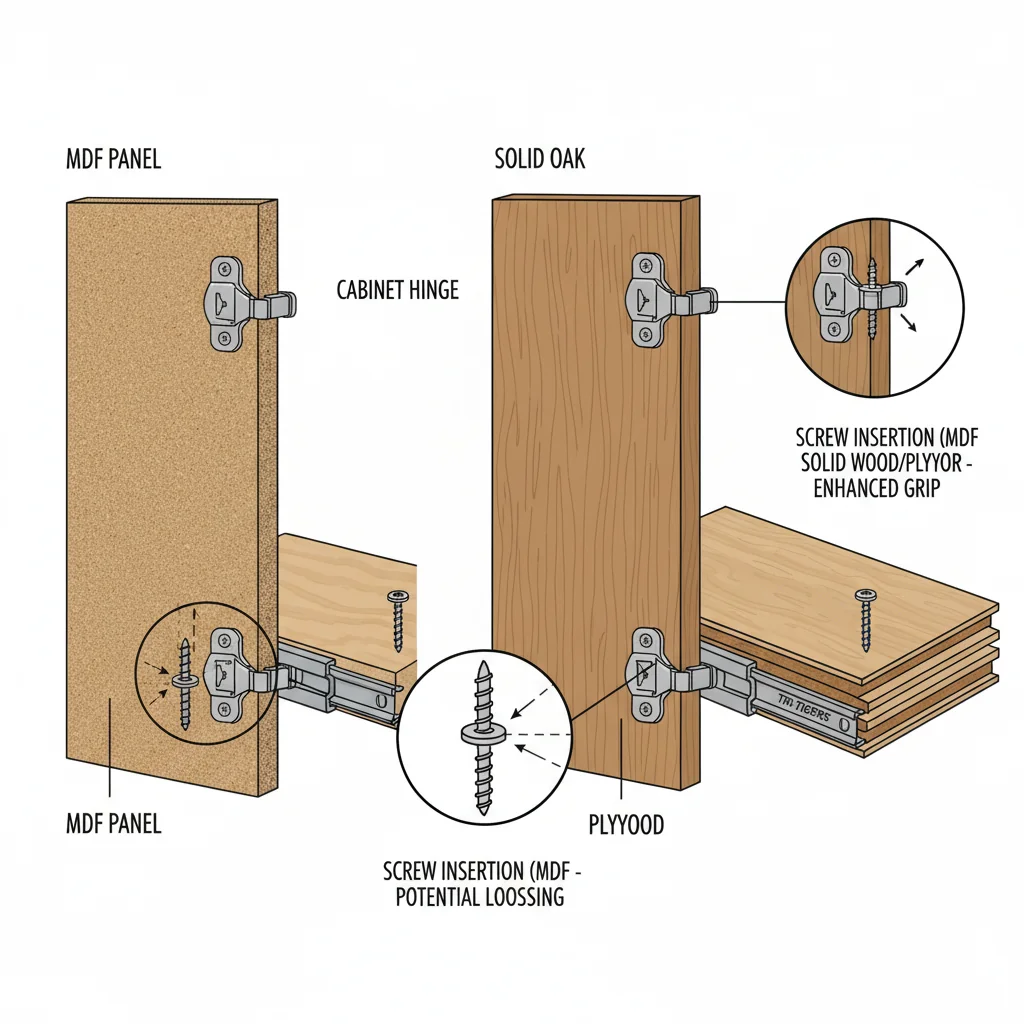
Last year, a buyer from Germany asked why their 18mm MDF kitchen doors started sagging after only two years. The issue came down to hardware loosening at the hinges—a classic weak spot when using standard screws in MDF. Unlike plywood, where screws bite into long wood fibers, MDF’s compressed fibers don’t grip as well. Over time, repeated opening and closing gradually enlarges the holes. Once that happens, simply re-tightening rarely works for long—sometimes you’ll need to upgrade to larger screws, add threaded inserts, or even replace the whole door.
From my experience, the most common failures show up on tall pantry doors and deep drawers—any place with weight or frequent movement. I’ve seen this with a UK importer who ordered a run of flat-pack sideboards: after six months in retail, about 12% came back with loose drawer runners. Their factory had used standard 16mm MDF boxes with basic cam-locks and no reinforcement. The solution? Upgrading to heavy-duty European hinges with larger mounting plates and switching to 18mm MDF for drawer sides reduced returns by half—but hardware longevity still didn’t match equivalent plywood cabinets.
To be honest, if you must use MDF for cabinet boxes, focus on non-structural areas like door fronts or panels, and always specify quality hardware. I suggest adding screw-in metal inserts at hinge points and avoiding overloading drawers. Even with all these steps, expect some hardware loosening over time. If long-term durability is critical, plywood or particleboard with a melamine finish will outperform MDF for structural parts.
Standard 18mm MDF kitchen doors often require hardware upgrades within 2-3 years because compressed fibers enlarge screw holes under repeated stressTrue
MDF's fine compressed fibers do not hold screws as securely as plywood's long wood fibers, causing hinge screw holes to loosen over time, especially with frequent door use. Hardware upgrades or larger screws help maintain long-term door stability.
Using standard screws in MDF cabinets is sufficient for long-term durability without any hardware reinforcement or special fittingsFalse
Standard screws tend to loosen in MDF over time because the material's compressed fibers do not provide strong screw grip, leading to sagging doors; hardware reinforcement or specialized fittings are necessary for lasting durability.
Key takeaway: MDF’s weaker screw-holding capacity makes hardware loosening a common long-term issue, especially for doors and drawers. To minimize failures, limit MDF to non-structural parts, use quality hardware, and reinforce high-stress points, but understand that hardware longevity will still lag behind plywood or solid wood cabinets.
Are MDF Cabinets Safe for Indoor Air?
MDF kitchen cabinets can emit formaldehyde and volatile organic compounds (VOCs) due to resin binders, especially during cutting and installation. Safety improves significantly with boards certified to E1, CARB Phase 2, or EPA TSCA Title VI standards, which restrict emissions. Proper ventilation and dust extraction are essential during fabrication and installation for optimal indoor air quality.
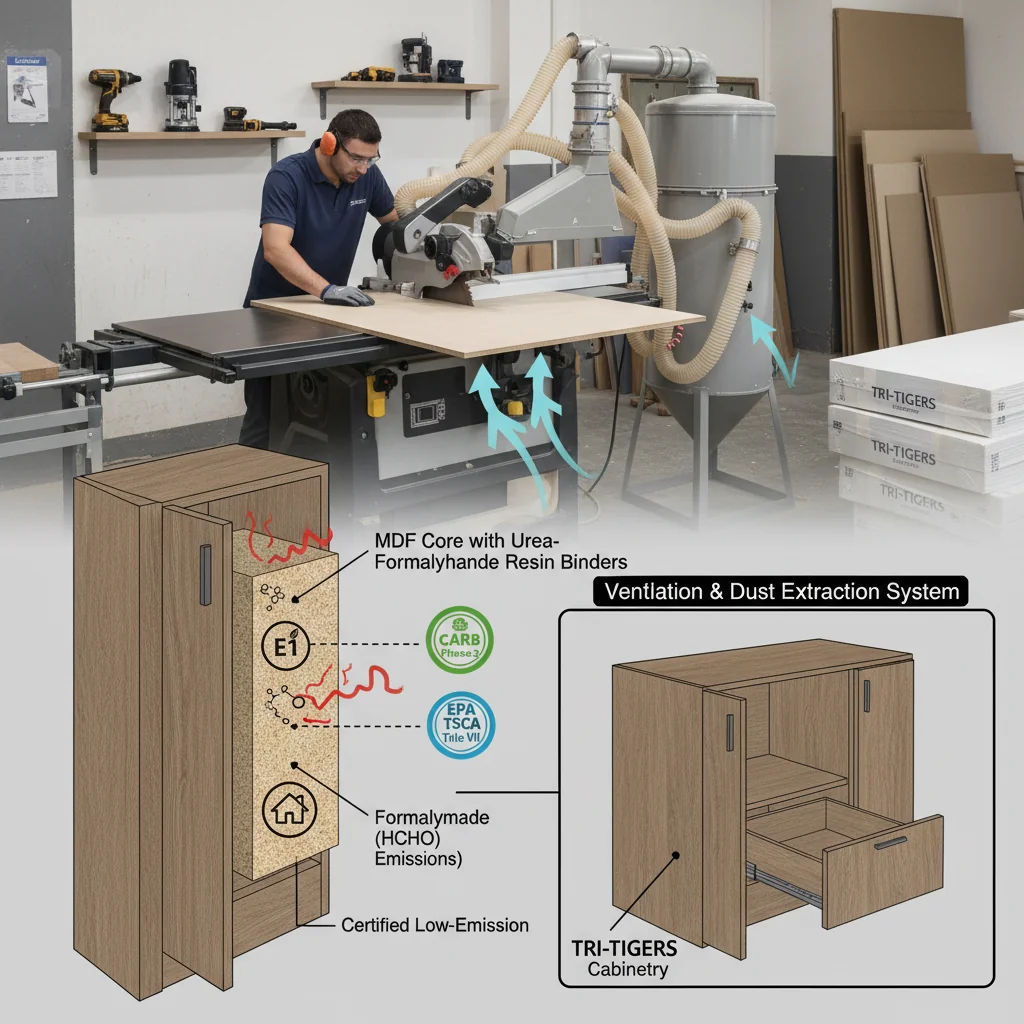
Last month, a kitchen installer in Germany asked me if MDF cabinets would affect his client’s indoor air quality. This is a common concern, especially when working with families or buyers who have children at home. The reality? Standard MDF contains resins that release formaldehyde and other VOCs—most noticeably when you’re cutting, edging, or drilling the panels. I’ve seen this firsthand during factory visits: if you walk into a workshop using non-E1 boards, the smell alone tells you the difference.
What matters is the emission rating. For the EU, E1 is the baseline—formaldehyde below 0.1 ppm. CARB Phase 2 and EPA TSCA Title VI are similar standards for the US. I always suggest requesting compliance certificates from your supplier, not just a sticker on the packaging. In Poland, one of my clients insisted on E0-rated 18mm MDF for a school project, and the air was noticeably fresher even during installation. There’s a price difference—typically 5-10% higher for low-emission boards—but the health benefits are real.
During fabrication, proper ventilation and dust extraction are essential. Cutting MDF generates not only dust but also airborne VOCs. I recommend ventilating the space well for at least 48 hours after installation. If you’re supplying cabinets to hospitals, nurseries, or homes with asthma sufferers, consider premium options like E0 MDF or even switch to plywood where possible. It’s worth paying a little more for peace of mind and healthier indoor air.
Standard MDF panels typically emit formaldehyde at levels around 0.1 to 0.3 ppm during cutting or machining, which can exceed indoor air quality guidelines if proper ventilation is not usedTrue
MDF contains urea-formaldehyde resins that off-gas particularly when disturbed; measurements show emissions spike during cutting, and concentrations above 0.1 ppm can irritate sensitive individuals, so ventilation is critical during installation.
MDF cabinets sealed with a high-gloss polyurethane finish completely eliminate all formaldehyde emissions, making them entirely safe for indoor air quality without additional ventilationFalse
While sealing MDF reduces emissions by creating a barrier, it does not completely stop formaldehyde off-gassing, especially if the seal is damaged or incomplete; thus, some VOCs can still be released into indoor air over time.
Key takeaway: For kitchen cabinets, always specify MDF that meets strict emission standards such as E1 or CARB Phase 2 to minimize indoor air pollutants. Request compliance documentation and ensure good ventilation during and after installation, particularly where sensitive individuals or children are present. Low-emission MDF or alternative materials are strongly recommended.
Does MDF Improve Kitchen Cabinet Aesthetics?
MDF offers a flawless, smooth painted finish ideal for modern flat-front, shaker, or intricately routed cabinet doors, thanks to its lack of grain and voids. While prized for crisp edges and consistency, its design flexibility is often overstated, as most contemporary kitchens favor simpler profiles that plywood or solid wood can also achieve effectively.
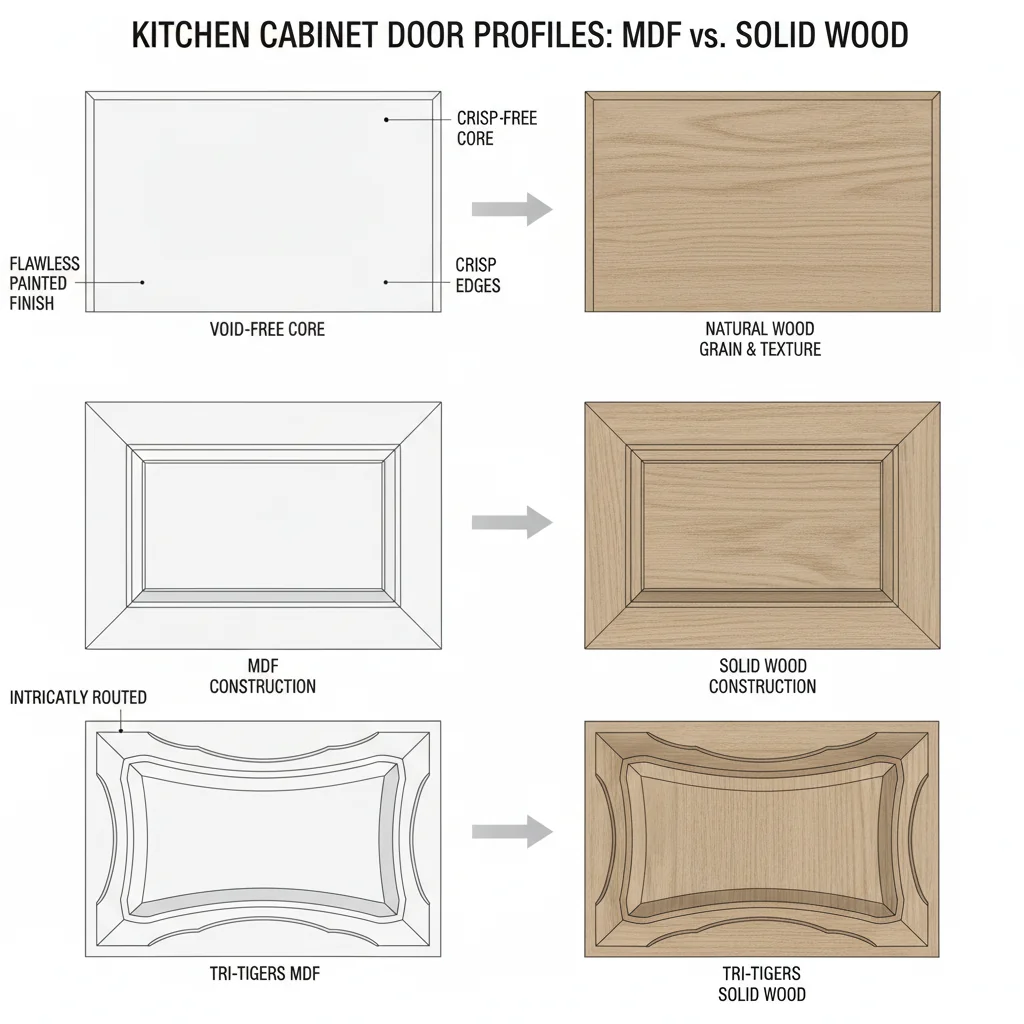
To be honest, the spec that actually matters for kitchen cabinet doors is surface smoothness—especially if you want a flawless, painted finish. MDF has a real edge here. Because it has no wood grain or knots, you get an ultra-smooth base that takes paint beautifully. That’s why so many high-end German and UK kitchens use 18mm MDF for flat-front or shaker doors. I’ve seen entire 40HQ containers—around 1,200 doors per load—leave our factory finished in matte white or deep blue, with zero sanding lines or touch-up required on-site.
But let’s clear up a common misconception: while MDF can be CNC-routed into ornate profiles, most European buyers these days stick to simple flat or shallow shaker designs. A Polish importer recently asked if deep, baroque-style grooves would justify switching from plywood. In reality, 90% of their projects only needed clean, 6mm-deep shaker lines—something plywood can handle just as well. The real benefit of MDF shows when you want crisp corners and absolutely no grain telegraphing through the paint.
There is a trade-off, though. Standard MDF isn’t moisture resistant. I always suggest using HMR-MDF (High Moisture Resistant, green core) for doors near sinks or dishwashers. Even then, I’d never recommend MDF for cabinet carcases or plinths in a busy kitchen—plywood or melamine-faced particleboard is safer for those.
If you want that perfect, modern painted look, MDF is the right call for doors and drawer fronts. For maximum durability or wood grain, look elsewhere. I suggest requesting both MDF and plywood samples to compare before placing a bulk order.
18mm MDF boards are preferred for high-end kitchen cabinet doors because their uniform density and lack of grain enable a paint finish that requires minimal sanding and results in a consistently smooth surfaceTrue
MDF's homogeneous composition eliminates knots and grain patterns found in natural wood, allowing paint to adhere evenly with fewer imperfections; this is why manufacturers ship up to 1,200 pre-finished MDF doors per 40HQ container with flawless matte or deep color finishes.
MDF kitchen cabinet doors are more resistant to water damage than plywood doors due to their dense fiber compositionFalse
Despite MDF's density, it is highly susceptible to swelling and degradation when exposed to moisture, whereas plywood has better water resistance because of its layered construction and natural wood veneers treated for moisture exposure.
Key takeaway: MDF is an excellent choice for kitchen cabinet doors where a perfect, paint-ready surface is required, especially for flat or shaker designs. However, its true design edge—deep routing and ornate profiles—is seldom used in modern kitchens, and MDF’s durability is a limiting factor in high-use or damp areas.
Which Materials Outperform MDF in Kitchens?
In 2026, plywood and aluminum8 surpass MDF for kitchen cabinets in moisture resistance, durability, and screw-holding strength. Quality plywood offers 2–3 times better moisture resistance than MDF and is now standard in mid- to high-end kitchens. Aluminum excels in high-humidity settings, while solid wood remains preferred for doors due to longevity and refinishing potential.
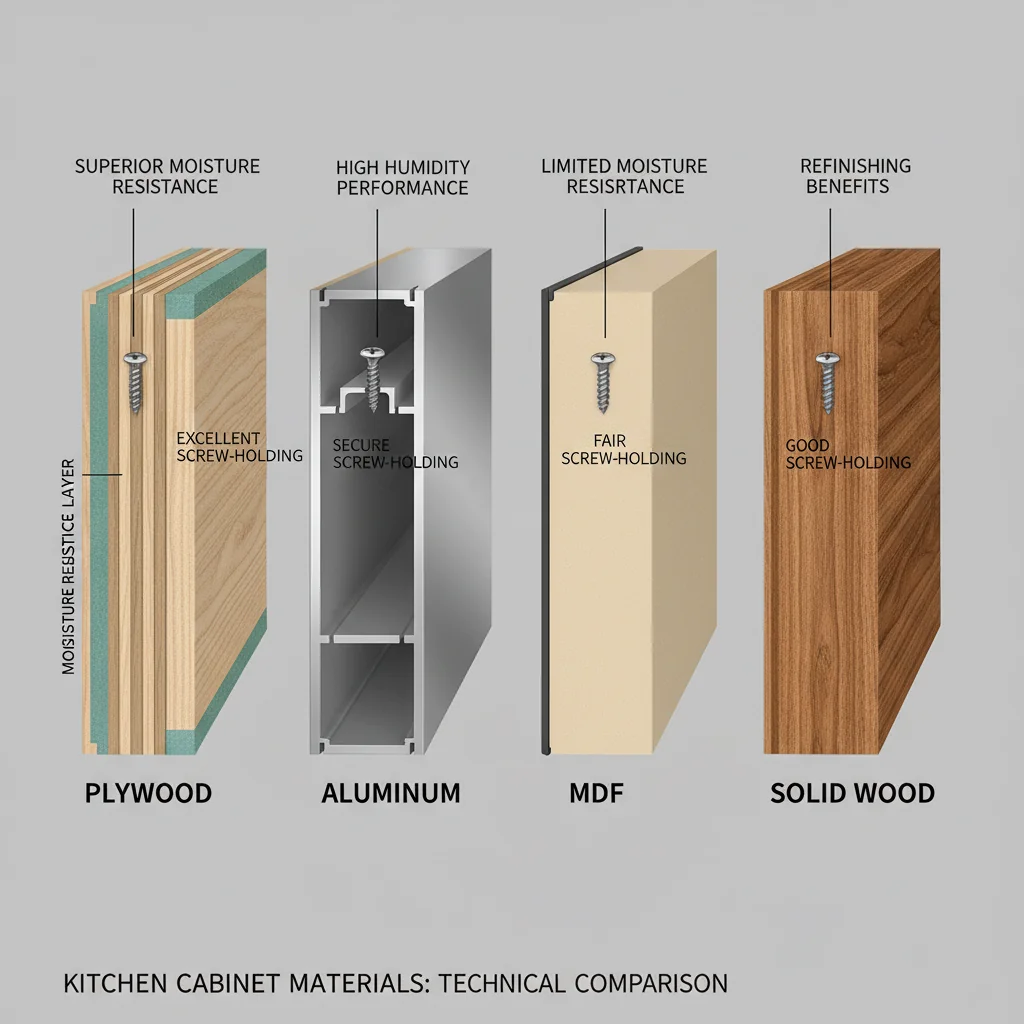
Most buyers I speak with are surprised how quickly plywood and aluminum have overtaken MDF for kitchen cabinets—especially in Germany and the Nordics. A Polish distributor told me last quarter that their warranty claims dropped by nearly half after switching to 15mm birch plywood carcasses instead of 18mm MDF. The reason? Plywood’s layered core resists swelling and holds screws far better, critical for flat-pack assembly and daily use near sinks or dishwashers.
To help you compare the main options, here’s a quick breakdown:
| Material | Best For | Moisture Resistance | Screw Holding | Aesthetic Options | Price Range |
|---|---|---|---|---|---|
| MDF | Painted doors, decor | Low | Moderate | Paint, PVC | €€ (budget-mid) |
| Plywood | Cabinet boxes, structure | High | High | Veneer, paint | €€€ (mid-premium) |
| Aluminum | High-humidity kitchens | Excellent | Excellent | Metallic, powdercoat | €€€€ (premium) |
| Solid Wood | Doors, visible sections | Moderate-High | High | Stain, lacquer | €€€€ (premium) |
From my experience, the current best practice is using a plywood cabinet box paired with either MDF or solid wood doors. MDF still shines for painted or PVC-wrapped door panels, but I avoid it for any part exposed to regular moisture. Lead times for plywood cabinets are typically just a week or two longer than MDF—worth it for the durability boost.
If you’re sourcing for mid- to high-end projects, I suggest asking for E1-certified plywood in standard 15–18mm thickness, with 1mm PVC edge banding. Requesting a finished corner sample can reveal a lot about real-world durability before you commit to a 40HQ container order.
Switching to 15mm birch plywood carcasses can reduce kitchen cabinet warranty claims by nearly 50% compared to 18mm MDF carcassesTrue
Birch plywood's layered construction resists moisture-induced swelling and provides superior screw-holding strength, which lowers failure rates in kitchen environments prone to humidity and mechanical stress, as evidenced by distributor reports from Poland.
Increasing MDF thickness from 18mm to 25mm completely eliminates swelling issues in kitchen cabinets near sinksFalse
While thicker MDF may offer marginally better rigidity, it remains highly susceptible to moisture absorption and swelling; the core composition does not prevent water damage, unlike plywood’s layered core which actively resists moisture. Thickness alone cannot resolve MDF’s inherent vulnerability in wet conditions.
Key takeaway: Plywood and aluminum are now leading choices over MDF for kitchen cabinet construction, especially in moisture-prone environments. Solid wood remains ideal for visible components. MDF is best reserved for painted doors or decorative use. Combining plywood cabinet boxes with MDF or wood fronts is the current industry best practice.
Conclusion
We’ve looked at where MDF really shines in kitchen cabinets—mainly for painted doors and panels—and where it’s best to specify another material, especially for moisture-prone carcasses and high-stress joints. From my experience, the most successful importers are clear about which components use MDF and which require plywood or particleboard, avoiding the “five-step fade” where quality drifts as orders scale up. If you’re weighing your first MDF kitchen line, I suggest asking for both sample parts and packing details—sometimes what looks good in a sample ends up as “packing roulette” in the container. Have questions about which board suits your design, or want to compare cost impacts across markets? I’m happy to share what’s worked for buyers across Europe—just reach out. Every project has its own ideal material mix—choose what’s right for your customers and brand.
References
-
Technical insights into MDF’s screw-holding limitations, failure modes, and best practices for hardware installation in cabinetry. ↩
-
Expert insights on PVC edge banding thickness, sealing techniques, and its role in preventing water damage to MDF panels. ↩
-
In-depth look at moisture-resistant MDF grades, their manufacturing differences, and performance benefits in humid environments. ↩
-
In-depth explanation of moisture-resistant MDF variants, their green core technology, and limitations in wet kitchen conditions. ↩
-
Technical insights into moisture-induced edge swelling in MDF, its causes, prevention methods, and repair challenges in kitchen environments. ↩
-
In-depth explanation of E1 formaldehyde emission standards and how 18mm MDF thickness impacts durability and safety in cabinetry. ↩
-
Explains the importance of MR MDF for humidity resistance, preventing warping, and ensuring durability in kitchen environments. ↩
-
Expert analysis of aluminum's excellent moisture resistance and durability benefits for kitchen cabinets in humid conditions. ↩
Published: 2026-01-19