
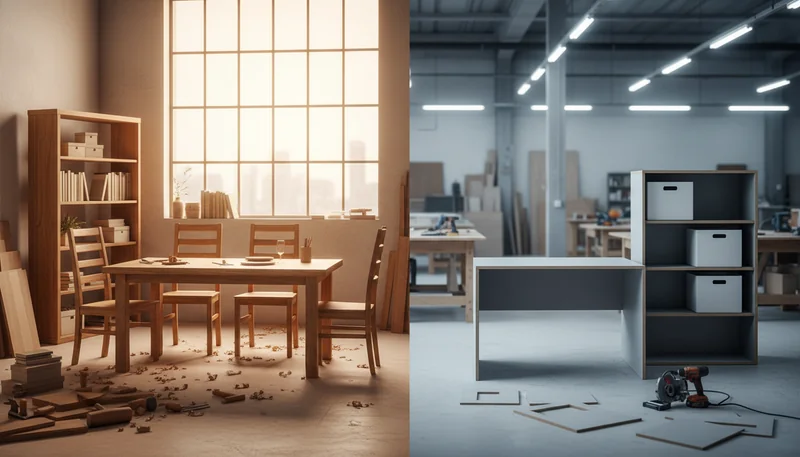
Featured image for How to Tell if Furniture is Wood or Particle Board: Factory Sourcing Guide
How to Tell if Furniture is Wood or Particle Board: Factory Sourcing Guide
Last week, a Polish wholesaler sent me photos of two nearly identical wardrobes—one felt sturdy and heavy, the other suspiciously light. He asked the classic question: “Is this really solid wood, or just clever wrapping over something cheaper?” I’ve seen this puzzle trip up even seasoned buyers on a factory visit.
Distinguishing solid wood from particle board hinges on close attention to grain patterns, exposed edges, and construction details. Authentic wood grain flows naturally across surfaces and changes direction at joints, while printed patterns on particle board repeat and abruptly wrap edges. Hidden areas under tables or inside drawers often reveal a speckled, chip-based core in particle board, contrasting with solid wood’s continuous fibers or plywood’s layered structure.
In my fifteen years working with manufacturers and European importers, this question comes up constantly. When you’re buying containers of furniture, you can’t rely on glossy brochures. You need practical, hands-on checks you can do in the showroom or even just by looking closely at a sample photo. I’ll walk you through the exact steps I use to determine what's underneath the veneer or laminate.
How Does Wood Grain Reveal Material Type?
Wood grain patterns help distinguish solid wood from particle board. Real wood displays continuous, irregular grain that naturally changes direction at edges and does not repeat. In contrast, particle board with veneer or laminate often shows repeated knots, identical grain, or printed wraps over edges, indicating a manufactured surface rather than genuine wood.
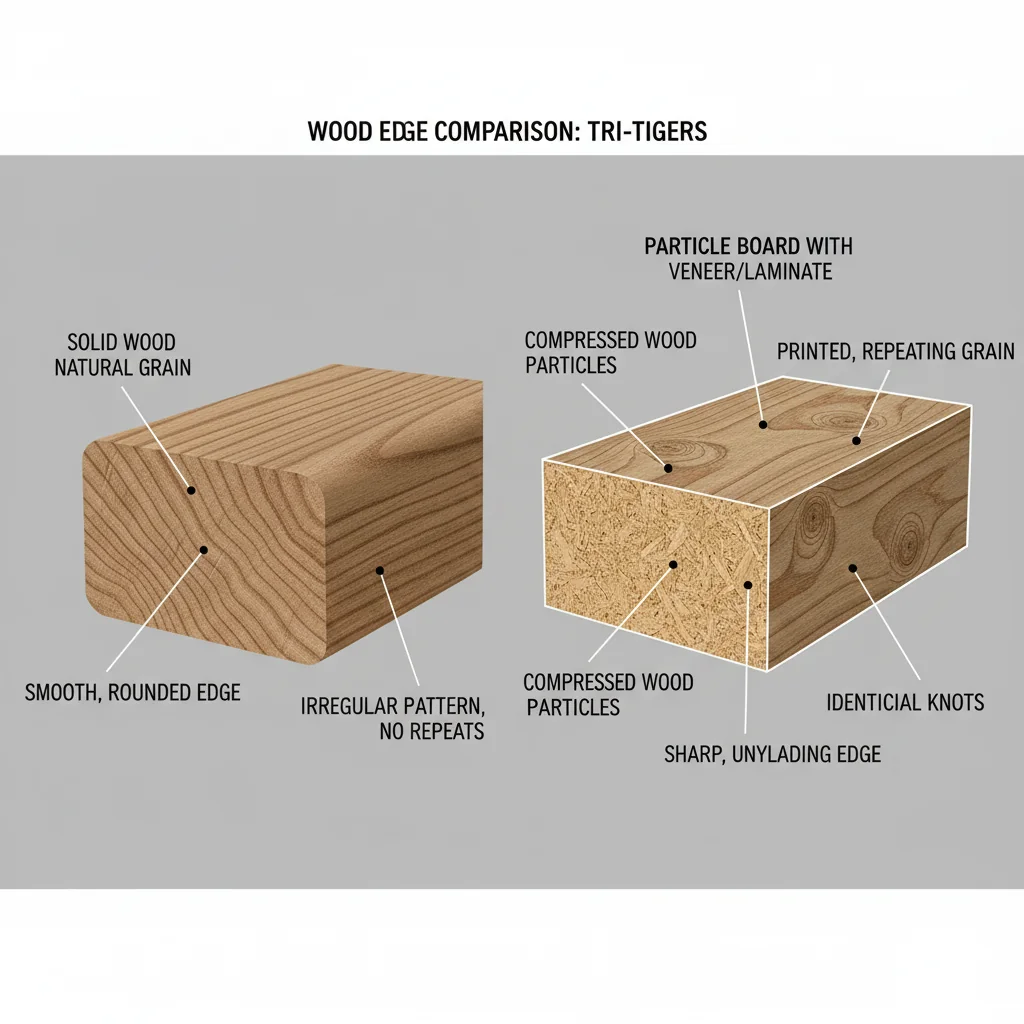
Let me share something important about wood grain—this is the first thing I check when evaluating a new supplier sample, especially for clients in Germany or the UK. Most people don’t realize that real wood grain is unpredictable. It flows across the top, wraps the sides, and never repeats itself. Last year, a UK wholesaler sent me photos of a sideboard. The top and both doors had the exact same “knot” pattern. That’s a red flag for printed laminate on particleboard, not real wood or even real veneer.
If you see a knot on the left side of a cabinet and the exact same knot mirrored on the right side, you know it’s a printed film. Real wood doesn't work that way.
Here’s a quick comparison to make it clear, based on what I look for in the factory:
| Feature | Solid Wood | Veneered Particleboard | Laminate Particleboard |
|---|---|---|---|
| Grain Pattern | Irregular, non-repeating | Natural but may repeat on large panels | Repeating, printed, identical |
| Edge Appearance | End-grain visible | Edge banded, possible veneer wrap | Edge banded, pattern “wraps” over edge |
| Touch/Feel | Warm, textured | Smooth, slightly warm | Cool, flat, synthetic feel |
| Price Range (ex-works) | Highest | Mid-range | Budget |
I always suggest opening drawers and doors—look at the edge banding and the inside faces. If the grain looks identical everywhere, it’s likely a printed film, not real wood. For high-use furniture, especially in rental apartments, I recommend E1-rated MDF with a quality PVC edge band. It offers durability and a more natural look, without the high cost of solid wood. Remember, a quick grain check can save you from quality headaches down the road.
Real wood grain patterns are unique to each board and can never be perfectly replicated on adjacent surfaces, making identical knot patterns across multiple panels a clear indicator of printed laminate or veneerTrue
Natural wood growth creates irregular grain and knots that don’t repeat, so identical patterns on different parts usually indicate a printed surface, often found on particleboard or MDF substrates rather than solid wood.
Particleboard with printed wood grain always has a rough texture on the surface, making it easy to identify by touch aloneFalse
High-quality printed laminates on particleboard can have smooth, sealed surfaces that mimic the texture of real wood, so tactile inspection alone often cannot reliably distinguish particleboard from solid wood. Visual grain pattern irregularity is a more accurate indicator.
Key takeaway: Inspecting wood grain patterns is a reliable, tool-free way to differentiate solid wood from particle board furniture. Genuine wood shows naturally varying grain, while repeating or perfectly matched patterns suggest a veneer or laminate surface. This insight is crucial for sourcing durable, high-use, or rental furniture.
How Do Edges Reveal Particle Board?
Edges and hidden surfaces are reliable indicators of core material in factory-sourced furniture. Solid wood displays continuous grain and fibers, while plywood shows neat, layered sheets. Particle board is identified by a speckled, chip-filled “sponge” appearance, often concealed by plastic edge banding. Inspecting undersides, joints, and screw holes quickly exposes particle board construction, which signals reduced durability and limited repairability.

The biggest mistake I see is buyers trusting only the catalogue photos, without checking the edges and hidden panels in real samples. In practice, the fastest way to spot particle board is by flipping a unit over or peeking inside a drawer box—especially on large volume orders from Poland or Germany. Solid wood shows a continuous grain that wraps around corners. Plywood edges look like stacked, consistent layers. But particle board? You’ll notice a rough, chip-filled “sponge” core, usually covered by a strip of plastic edge banding.
Last year, a UK wholesaler asked me why their 18mm “oak” desks started chipping at the corners after only six months. When I inspected a returned piece, the underside of the desktop revealed a speckled particle board core—classic for melamine-faced budget lines. Even with E1 rating1 and 1mm PVC edge banding, the core itself didn’t handle repeated knocks. I’ve seen the same thing with French importers: edges hidden on show surfaces, but exposed underneath or on shelf supports.
Here’s what matters most when you’re sourcing in bulk: always check at least one unfinished or hidden spot per SKU. Use a flashlight or small mirror at joints and screw holes. If you see visible chips or a porous core, you’re dealing with particle board, which means less screw holding strength and limited repair options. I suggest requesting a corner sample before placing a 40HQ order—what’s under the edge tells you more than any brochure.
Peeking inside a drawer box can reveal a particle board core because it has a rough, chip-filled structure unlike the layered appearance of plywood edgesTrue
Particle board is manufactured from wood chips and resin compressed into a dense but uneven core, which becomes visible at cut or hidden edges, whereas plywood shows uniform, stacked veneers creating distinct layers. Checking inside drawers exposes these differences clearly.
Solid wood furniture edges are always smooth with no visible grain patterns, making them harder to distinguish from particle board by edge inspection aloneFalse
Solid wood edges display continuous grain patterns that wrap around corners, providing a natural, smooth appearance; this grain continuity is a key visual indicator distinguishing solid wood from particle board, which lacks such grain and has a rough, chip-filled core.
Key takeaway: Examining edges, joints, and hidden surfaces is the fastest way to distinguish particle board from solid wood or plywood. Visible chips, plastic edge banding, and unfinished areas often reveal particle board, which indicates lower durability and diminished repair options for bulk furniture buyers.
How Do Weight and Sound Indicate Material?
Weight and sound are reliable indicators when distinguishing solid wood from particle board in furniture. Solid wood is denser and significantly heavier, resisting movement when lifted. A knock test on panels reveals deeper, more resonant tones in solid wood, while particle board produces flatter, muted sounds. Quality plywood flexes less than particle board, ensuring greater stability and durability.
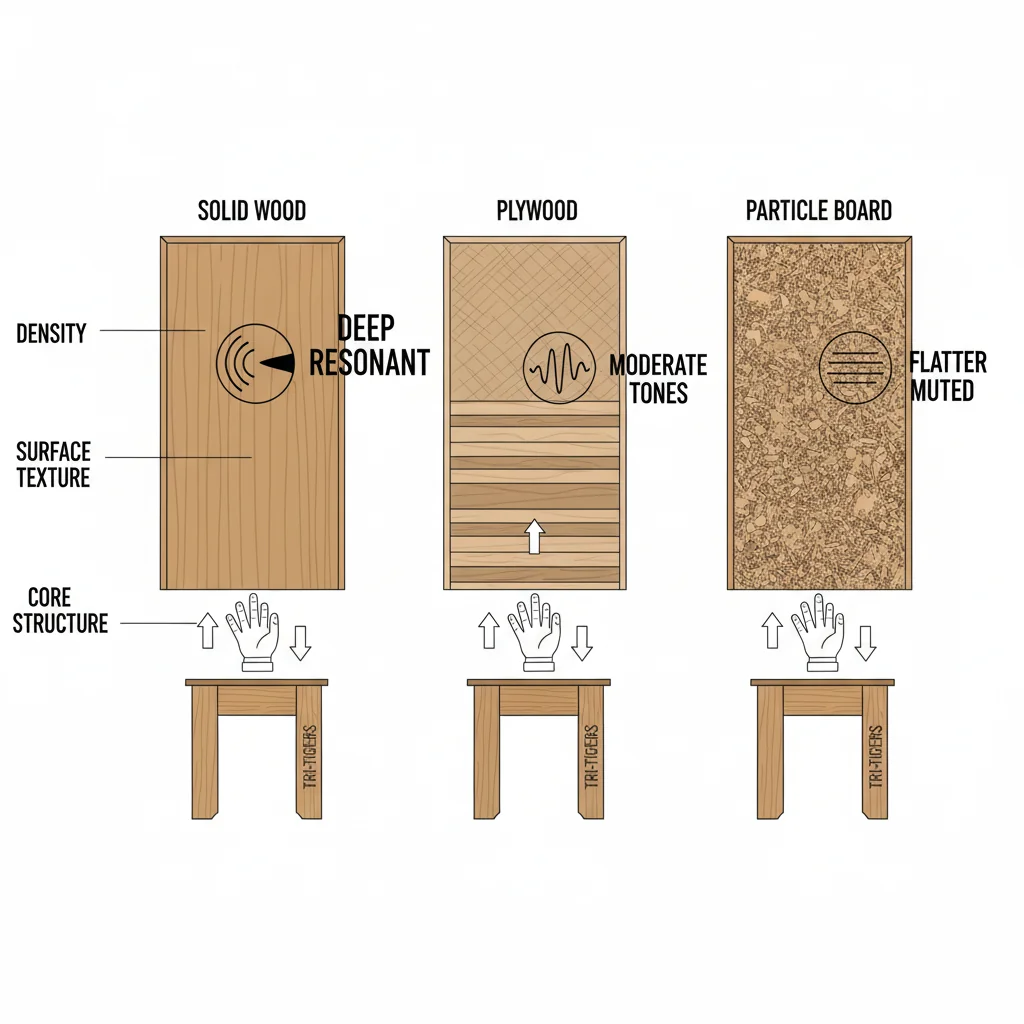
Most people don’t realize that simple hands-on checks can reveal a lot about what’s inside panel furniture—long before you get to the technical specs. Take weight, for example. In my work with German wholesalers, I’ve seen solid oak nightstands that are almost twice as heavy as similar particleboard units. If you lift one end of a 120cm-wide shelf and it feels light for its size, chances are it’s particleboard or hollow-core. Solid wood and high-grade plywood simply have more density—you can feel the difference, especially with panels over 18mm thick.
Sound is another great indicator. I always suggest the “knock test” when I’m in a showroom with buyers. Tap the underside of a tabletop or the inside of a cabinet side. Solid wood gives a deep, solid thud—almost like knocking on a tree. Quality plywood is less resonant but still firm. Particleboard, on the other hand, tends to sound flat or even a bit hollow, especially on larger panels. A UK client once spotted poor core material in a melamine wardrobe just by tapping—it saved them from a costly second-order surprise.
Flex is the final quick check. Press down on the center of a shelf. Solid wood and thick plywood barely move, even at 90cm spans. Particleboard, especially below 18mm, may flex or creak. I suggest checking these features before you review certificates or quotes. It’s a simple routine, but it can prevent big headaches down the road.
Solid wood panels typically weigh 30-50% more than particleboard panels of the same dimensions due to higher material densityTrue
Solid wood has a density ranging from 600 to 900 kg/m³ depending on species, whereas particleboard density usually falls between 500 and 700 kg/m³, making solid wood noticeably heavier for equivalent sizes. This weight difference helps identify material composition before technical testing.
Particleboard emits a higher-pitched sound than solid wood when tapped because its denser structure vibrates fasterFalse
Particleboard is less dense and more porous than solid wood, causing it to produce a duller, lower-pitched sound when tapped. Solid wood’s tighter grain structure allows it to resonate with clearer, higher-pitched tones, making sound a useful diagnostic tool.
Key takeaway: Assessing furniture by weight, sound, and flex can quickly differentiate solid wood, plywood, and particle board. Solid wood feels heavier, sounds deeper when tapped, and remains stable under pressure, while particle board is lighter, sounds hollow, and may flex or creak under load.
How Does Joinery Reveal Wood Quality?
Joinery type and hardware performance are key indicators of furniture material and build quality. Solid wood pieces often feature visible wood grain and dovetail joints2, known for strength and durability. In contrast, particle board uses staples or screws, lacks wood grain, and feels less sturdy, especially under repeated use in high-traffic settings.
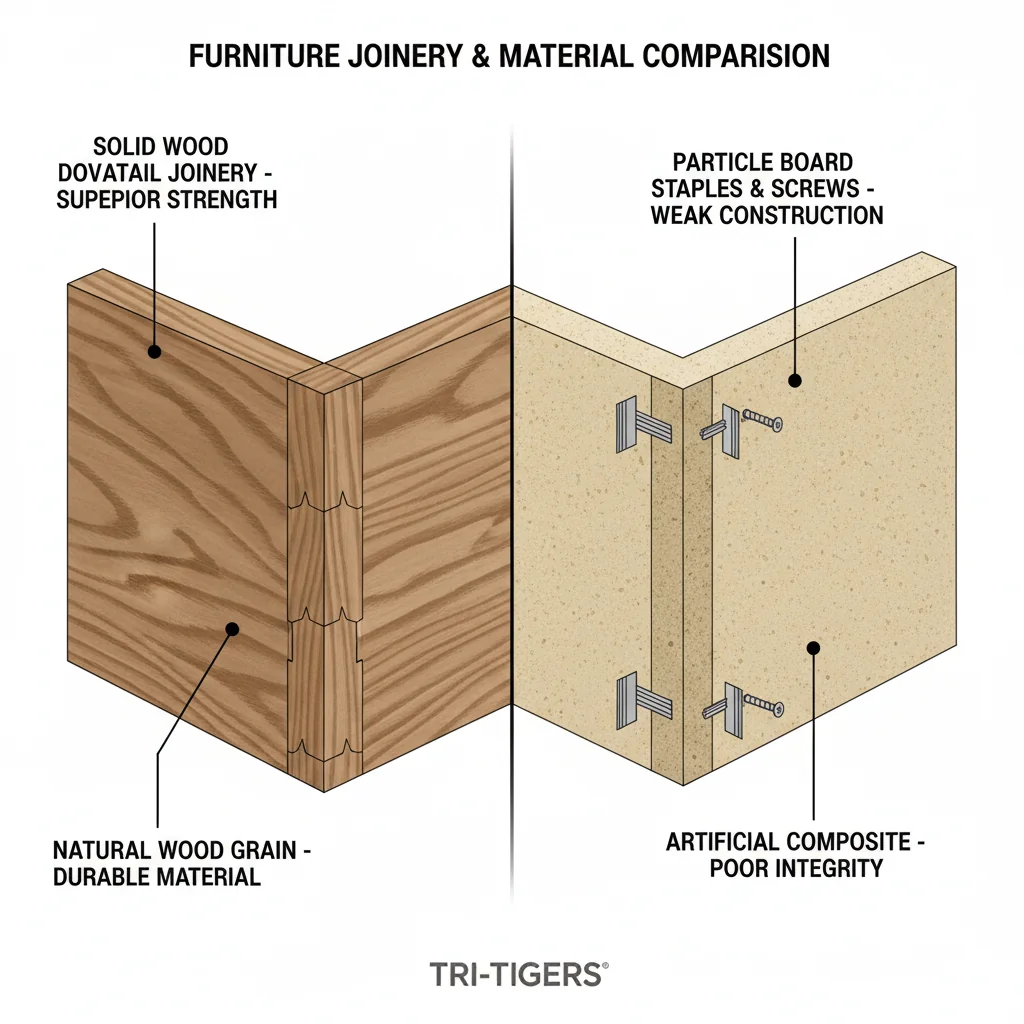
Here’s what matters most when you’re evaluating wood furniture—look beyond the catalog photos and run your hands along the joints. I recently walked a German importer through a factory audit, and the difference between dovetail and screw-fastened drawers was night and day. Solid wood items almost always feature dovetail joints, where the trapezoid-shaped cuts interlock tightly. These not only show off the wood grain but also stand up to years of opening and closing—think hotel rooms or student housing where drawers see heavy daily use.
Now, open a drawer on a particleboard cabinet. The sides usually show a uniform, chip-like texture—no visible grain, just compressed particles. Fastening is often just staples or screws, and I’ve seen plenty where the screw heads started to strip after six months in a busy Polish hostel. Plywood is a bit different; you’ll notice the clean, layered profile on the drawer sides—each layer is a veneer glued crosswise, which resists warping and holds screws better than particleboard.
Check corners and undersides, too. Strong joinery uses corner blocks and minimal glue, so the frame feels solid and tight. If you wiggle a leg or pull on a drawer front and feel movement, that’s a red flag—especially when you’re buying for rental or contract use. I always suggest buyers request sample pieces for hands-on inspection before placing a 40HQ order. In my experience, those small construction details are what separate “sample hero, bulk zero” suppliers from long-term partners.
Dovetail joints typically feature trapezoid-shaped interlocking cuts that distribute mechanical stress evenly, making drawers with these joints last 3-5 times longer under heavy daily use compared to screw-fastened drawersTrue
The trapezoidal design of dovetail joints allows for increased surface area and mechanical interlock, which resists pulling apart and wear over time, especially in solid wood furniture subjected to frequent opening and closing. Screw joints concentrate stress and loosen more quickly.
Particle board furniture often uses dovetail joints to compensate for its lower density and improve durability compared to solid woodFalse
Dovetail joints require solid wood to hold the interlocking trapezoid shapes securely; particle board lacks the structural integrity and resistance to splitting needed, so it is typically assembled using screws, staples, or cam locks rather than dovetail joints.
Key takeaway: High-quality wood furniture features strong joinery, such as dovetails and corner blocks, with visible wood grain and minimal visible glue. Particle board is identified by uniform, chip-like interiors, weaker fastener retention, and less durable hardware, making it less suitable for high-use environments.
How to Identify Veneer vs. Laminate?
Veneer is a real wood slice applied over an engineered core, displaying natural grain that stops at edges and may use edge banding. Laminate is a plastic layer with a repeating printed grain over particle board, revealing an artificial look and pale or speckled core when chipped. Grain continuity and chip appearance are key indicators.
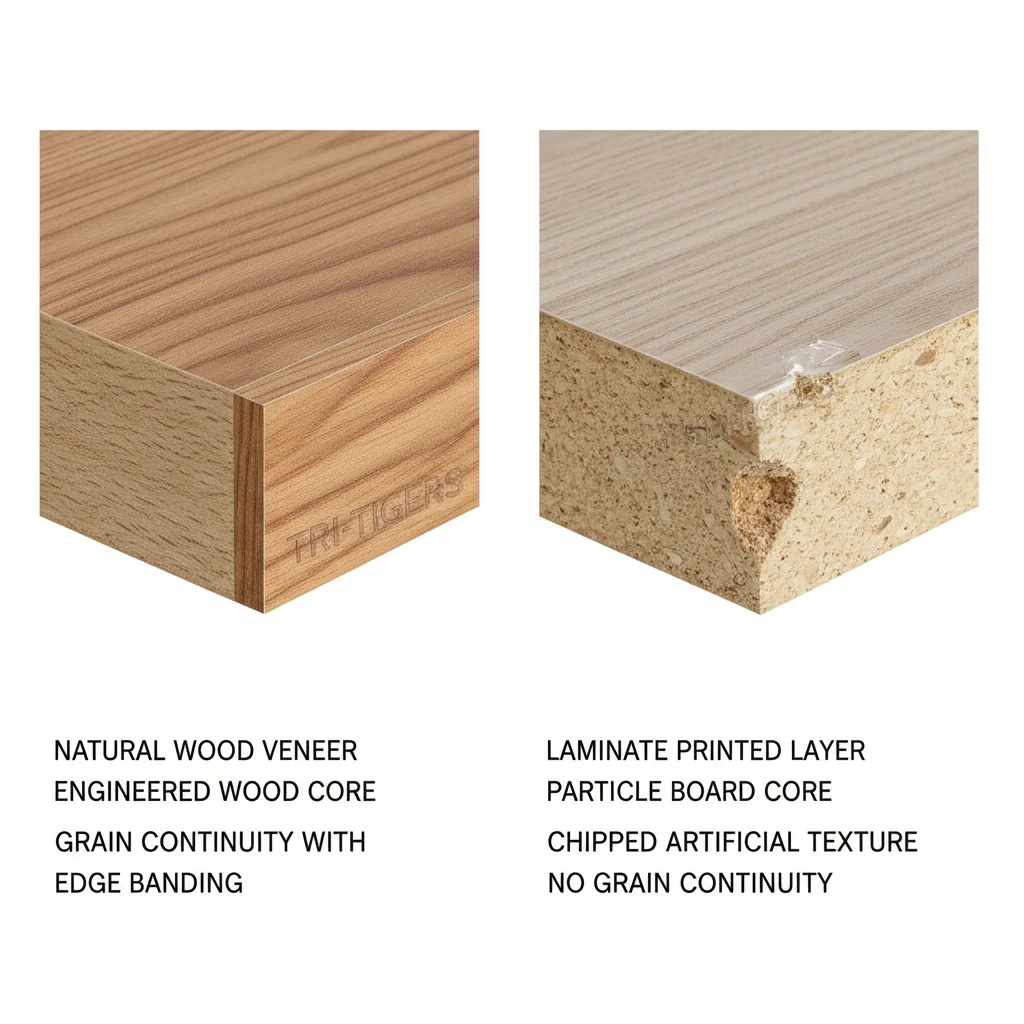
To be honest, the spec that actually matters is how the grain looks and feels at the edge. I’ve seen buyers from Germany get caught out—what looks like high-end wood turns out to be a printed laminate once you check the corners. Veneer is a real wood slice glued onto MDF or plywood, so you’ll see true grain, but it usually stops clean at the edge. Factories often use PVC edge banding to cover that transition. If you chip the surface, you’ll notice real wood fibers just beneath the veneer—especially on premium panels with 0.5mm or thicker veneer over 16mm or 18mm plywood. Laminate, on the other hand, is a plastic layer—think melamine or PVC film—pressed onto particleboard. The “grain” is a printed design, so it repeats predictably across multiple panels. When laminated boards chip, you’ll see a pale or speckled core and sharp separation between layers.
Last quarter, a Polish retailer sent me photos of a chipped shelf—turned out their supplier used a 0.2mm melamine laminate over low-density particleboard (around 620 kg/m³). The artificial look was obvious under good light, and repairs were impossible. I always suggest requesting a sample offcut: run your finger along the edge. Veneer feels like real wood—slight pores, unpredictable lines. Laminate is smooth or plasticky, and the pattern looks too perfect. For high-traffic furniture, I recommend 18mm plywood with a 0.5mm veneer—better durability, easier repairs, and a more authentic look. If it’s just for light use, a good quality melamine on dense particleboard (min. 680 kg/m³) can work, but check the edge finish and core before you sign off.
Veneer edges usually stop cleanly at the panel edge and are often covered with PVC edge banding to hide the transition between the wood slice and substrateTrue
Since veneer is a thin slice of real wood glued onto substrates like MDF or plywood, the natural wood grain stops sharply at the panel edge, which is why factories commonly apply PVC edge banding to create a smooth, continuous appearance.
Laminate surfaces contain real wood fibers embedded in their printed grain layer, making them indistinguishable from veneer when chippedFalse
Laminate is a printed plastic layer without real wood fibers; if chipped, it reveals synthetic layers rather than natural wood fibers, which are only present under genuine veneer surfaces.
Key takeaway: Differentiating veneer from laminate involves examining grain patterns, edge treatment, and chip marks. Veneer shows real wood grain and fibers beneath, while laminate reveals artificial patterns and a synthetic core. Veneer over plywood offers durability, whereas ultra-thin veneer or laminate over particle board is less robust and suitable for lighter use.
How Do Moisture and Screws Reveal Particle Board?
Moisture and screws affect particle board differently than solid wood or plywood. Particle board swells, blisters, or becomes fuzzy at exposed edges when exposed to water, while solid wood resists such damage. Loose screws, stripped holes, or crumbling around fasteners are strong indicators of particle board, as it cannot hold hardware as securely as solid wood.
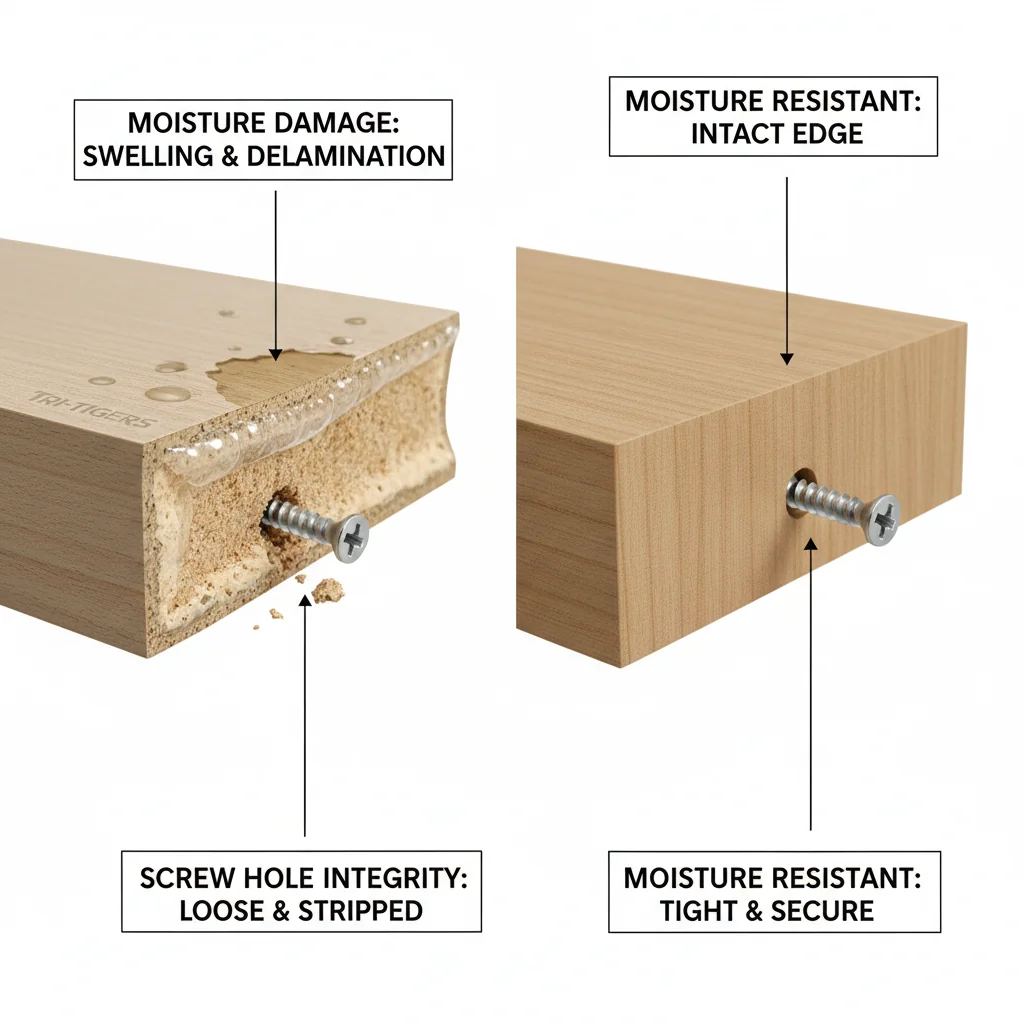
Last month, a retailer in Germany sent me photos of swollen cabinet edges from their rental units. The issue was clear—particle board panels had absorbed moisture around the sink and dishwasher. The edges looked fuzzy and soft, with the melamine finish peeling away. This is classic particle board behavior. Unlike solid wood or plywood, particle board’s core is made from small wood chips and glue. When water seeps in, it swells quickly, especially at exposed edges or if the edge banding is thin—usually under 0.6mm, which I’ve seen often on budget lines. Once swollen, the board never returns to its original shape.
Around hardware, particle board tells its own story. I’ve inspected flat-pack wardrobes3 in the UK where hinges or handles felt loose after just a year. Check the screw holes: if they’re stripped, crumbly, or the screws spin freely, it’s likely particle board. The board’s density (typically 620-700 kg/m³) just can’t hold hardware as firmly as MDF or plywood. In contrast, plywood’s layered construction grips screws much better, and solid wood can be repaired with wood filler if needed.
For kitchens or high-turnover rentals, this detail is important. Particle board shelves may sag or crumble near water sources within two years—sometimes less in humid climates like the Netherlands. I always suggest using moisture-resistant (MR) MDF or plywood for wet zones. If you’re sourcing from China, ask for E1-rated, 18mm thick core panels with at least 1mm PVC edge banding. It’s a practical way to avoid costly replacement and complaints down the line.
Particle board edges absorb moisture 3 to 5 times faster than plywood edges due to their porous core structure and thinner edge bandingTrue
Particle board consists of small wood chips bonded with glue, creating a porous structure that allows water to penetrate quickly, especially at exposed edges with thin or damaged banding, causing swelling and melamine peeling, unlike the denser plywood core.
Screws driven into particle board create a stronger hold than in solid wood because the glued chips compress tightly around the threadsFalse
Particle board’s glued chip structure is less dense and more brittle than solid wood, causing screws to loosen or strip more easily under stress, whereas solid wood fibers provide better screw grip and durability.
Key takeaway: Particle board is highly vulnerable to moisture and fastener stress, leading to swelling, crumbling, and loose screws, especially near sinks or high-humidity areas. Solid wood and plywood offer better moisture resistance and hardware retention, making them preferable for kitchens and rental furniture applications.
How Do Price and Lifespan Compare?
Solid wood furniture generally costs 30–70% more than particle board due to higher material and labor expenses, but offers a lifespan of several decades with the ability to refinish. Particle board is more affordable upfront, common in flat-pack designs, yet typically lasts just 3–7 years before showing structural or cosmetic failure.
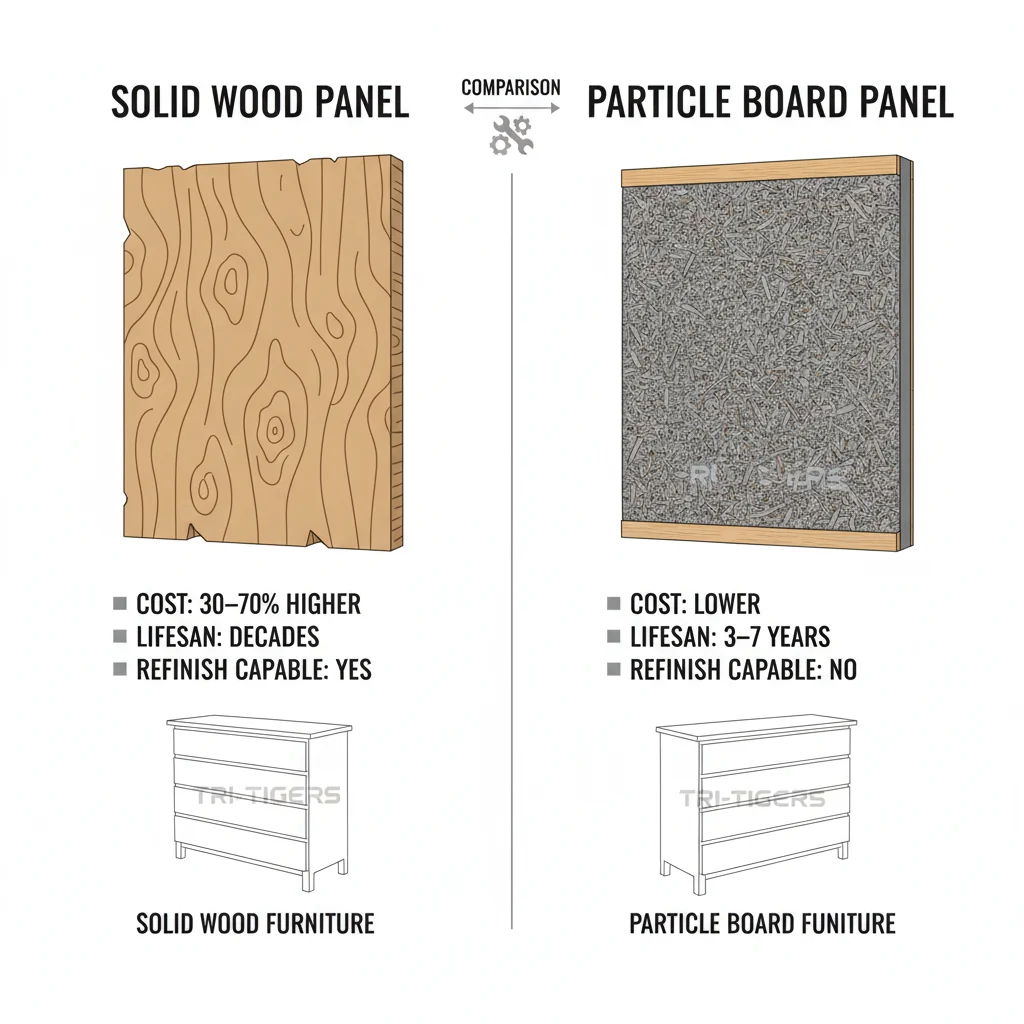
Most people don’t realize that the true cost of furniture isn’t just what you pay upfront—it’s how long it lasts in real use. I’ve worked with buyers in Germany and France who insisted on solid wood for hotel projects. Yes, they paid about 40% more than similar particle board units, but after five years, the solid wood beds still looked new, while the earlier particle board headboards we supplied for another client had already needed replacing twice. That’s not unusual.
Here’s a clear side-by-side to compare, based on my sourcing data:
| Material | Price (vs. PB) | Typical Lifespan | Refinishing | Best For |
|---|---|---|---|---|
| Solid Wood | +30–70% | 20–50 years | Yes | High-use, long-term |
| Particle Board | Base price | 3–7 years | No | Budget, light-use, rental |
From my experience, particle board works if you’re furnishing student housing or short-term rentals—especially when cost is the main concern. A standard 18mm particle board desk, melamine finished with PVC edge banding, might cost €35–€45 ex-works and fit around 400 units in a 40HQ container. But if you calculate the total cost over a decade, frequent replacements quickly eat into initial savings. For high-traffic spaces—hotels, offices, busy retail—I always suggest investing in solid wood or at least veneered plywood.
Before you commit, think about where and how the furniture will be used. I suggest running the numbers on replacement cycles and factoring in the total cost over 10–15 years, not just the first invoice.
Solid wood furniture typically lasts at least 3 times longer than particle board in high-use environments, despite costing only about 40% more upfrontTrue
Solid wood’s dense fiber structure resists wear and moisture better than particle board, which swells and weakens with exposure. Long-term studies show solid wood furniture maintains structural integrity and appearance for over 5 years, while particle board often requires replacement within 1-2 years in commercial settings.
Particle board furniture is generally more durable than solid wood in humid climates due to its engineered compositionFalse
Particle board consists of wood particles bound with resin, making it highly susceptible to moisture absorption and swelling. Solid wood, especially hardwoods, naturally resist humidity and provide better longevity in damp environments, whereas particle board often deforms and loses strength.
Key takeaway: Solid wood commands a higher initial investment but delivers exceptional longevity and value, especially for high-use furniture. Particle board suits short-term, budget-driven needs but requires frequent replacement. Contractors and buyers should weigh long-term ownership costs against upfront savings when sourcing furniture for various applications.
When Is Particle Board a Good Choice?
Particle board is suitable for low-cost furniture such as bookshelves, wardrobes, desks, and flat-pack storage where price and appearance matter more than long-term durability. It performs best in short-term rentals, student housing, or low-traffic rooms if kept dry and not frequently moved or heavily loaded.
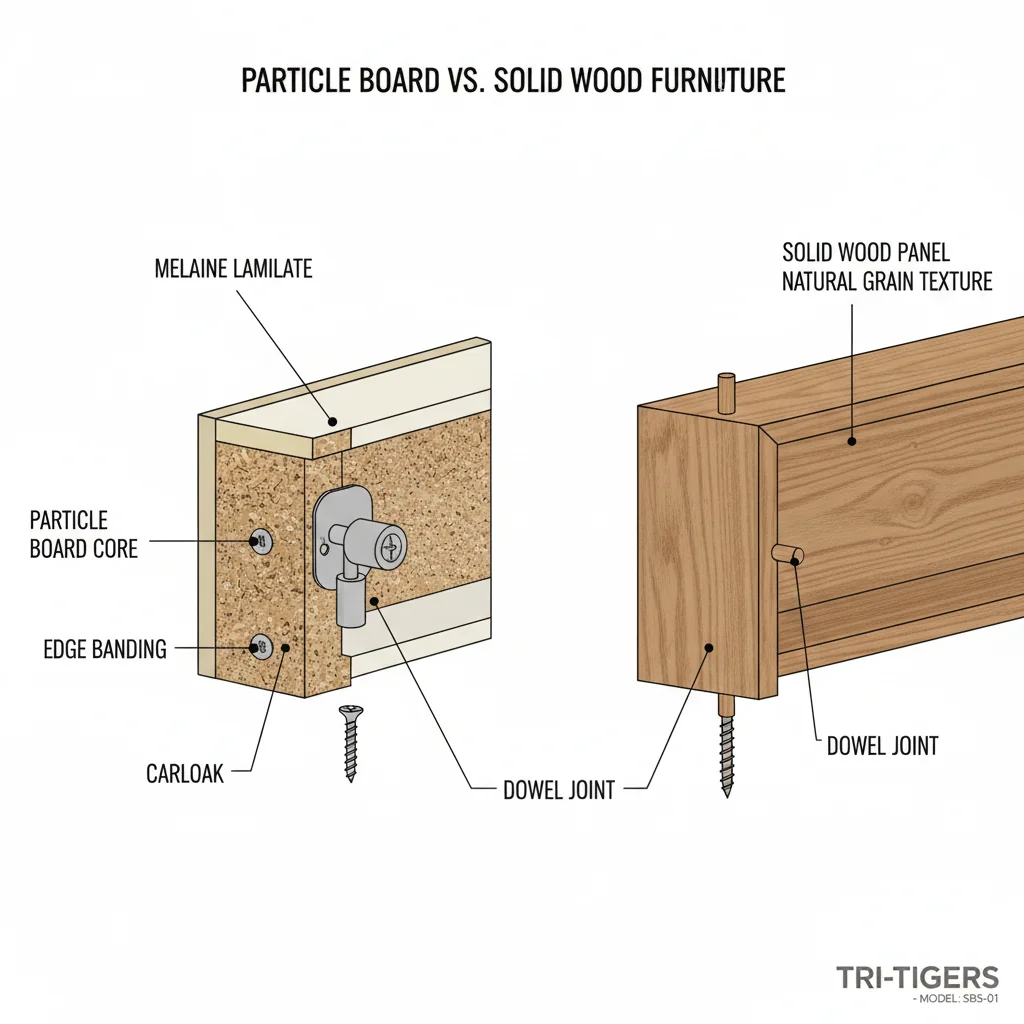
I've worked with buyers in the UK and Poland who needed budget-friendly storage solutions for student accommodation. Particle board’s main advantage is price—you can source melamine-faced panels4 at around 30% lower cost compared to MDF. For flat-pack wardrobes or bookshelves, especially in short-term rentals, this can make a real difference to project budgets. A typical 40HQ container fits about 1,000 flat-pack desks made from 16mm particle board with basic melamine finish and 0.8mm PVC edge banding. Lead times average 25–30 days, provided you’re within standard color and size ranges.
The biggest mistake I see is spec’ing particle board for shelving that’s too wide or expected to hold heavy loads. From my experience, anything over 80cm wide or supporting more than 15–20kg will start to sag over time—especially in high-traffic areas. I’ve had customers in Germany call me after six months, frustrated by screw holes loosening on frequently moved sideboards. Particle board is simply not designed for daily assembly/disassembly or humid environments—edges swell, and the board loses strength fast.
For lightly loaded, decorative furniture that stays put and remains dry, particle board is perfectly acceptable. I always suggest specifying a minimum 16mm thickness and E1 formaldehyde rating for European compliance. If you’re outfitting short-term rentals or need to hit a tight price point, it’s a practical choice. For anything with heavy use or frequent moves, upgrade to MDF or plywood—you’ll avoid headaches and unexpected costs down the line.
Melamine-faced particle board panels typically weigh around 700-750 kg per cubic meter, which is lighter than MDF of similar thickness, aiding in easier flat-pack furniture handlingTrue
Particle board with melamine finish generally has a density between 650-750 kg/m³, whereas MDF is denser, often 800-850 kg/m³. This difference makes particle board lighter and more manageable for flat-pack furniture assembly and transport.
Particle board’s structural strength allows it to support heavy loads comparable to solid wood in long-span shelving applications without additional reinforcementFalse
Particle board has lower internal bond strength and is prone to sagging under heavy loads over long spans. Unlike solid wood, it generally requires additional reinforcements like metal brackets or thicker panels to safely support heavy shelving.
Key takeaway: Particle board is acceptable for decorative or lightly loaded furniture in dry, low-traffic environments, especially for short-term or budget applications. It should be avoided for shelving with heavy loads, frequently moved items, or furniture intended for humid areas or daily use, where more durable materials are preferred.
What VOC Standards Apply to Panel Furniture?
Health and environmental safety in panel furniture is often measured by VOC emission standards5 such as E1, E0, and CARB Phase 2. Solid wood with water-based finishes emits fewer chemicals compared to particle board using urea-formaldehyde resins. Always verify supplier certifications and material disclosures to ensure compliance with low-emission requirements for residential or eco-sensitive projects.
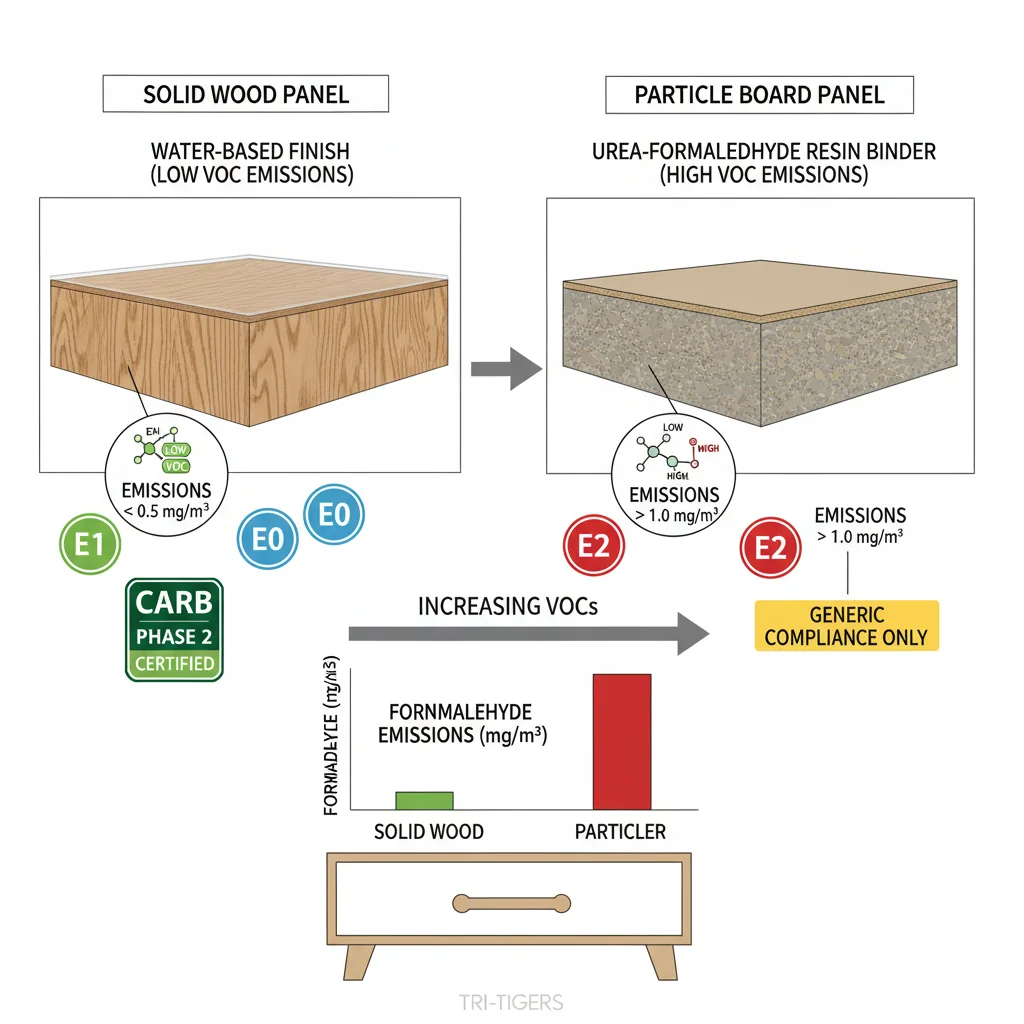
Most people don’t realize that VOC emission standards like E1, E0, and CARB Phase 2 are not just formalities—they directly impact indoor air quality, especially in homes or schools. For example, I recently worked with a buyer in France who needed flat-pack wardrobes for student housing. The project required E1-rated particleboard6, which keeps formaldehyde emissions below 0.1 ppm. That’s the European benchmark for safe, low-VOC furniture. If you’re aiming for even stricter limits, E0 boards (≤0.05 ppm) are available, but expect a price premium of about 8-12% compared to E1.
To be honest, the spec that actually matters is what’s behind the label. Solid wood with water-based lacquer or oil finish generally emits far fewer VOCs than engineered boards using urea-formaldehyde resins. I’ve seen German retailers pay more for solid pine shelves with E0 water-based finishes because their customers demand it—especially for nurseries and eco-certified projects.
It’s not just about the board, either. Check the edge banding and surface finish. Melamine-faced particleboard with PVC edge can meet E1, but a high-gloss PU spray finish might push emissions up unless it’s certified. I always suggest requesting recent test reports (EN 717-1 chamber test for Europe, CARB P2 for the US) and checking the production date—older certificates might not reflect current batches.
If indoor air quality is a priority, specify low-emission materials up front and ask for clear documentation. It’s a small step that can prevent bigger issues down the line.
E1-rated particleboard limits formaldehyde emissions to below 0.1 ppm, making it the European standard for low-VOC furniture suitable for indoor environments like schools and homesTrue
E1 classification defines a maximum formaldehyde emission of 0.1 parts per million, ensuring safer indoor air quality by reducing exposure to harmful VOCs, which is critical for sensitive environments such as student housing.
VOC emission standards such as CARB Phase 2 apply exclusively to solid wood furniture and not to particleboard or MDF productsFalse
CARB Phase 2 regulations specifically target composite wood products like particleboard and MDF to limit formaldehyde emissions, while solid wood furniture is generally exempt from these standards due to its naturally low emissions.
Key takeaway: Prioritizing furniture with verified low-VOC emission certifications, such as E1, E0, or CARB Phase 2, reduces indoor air quality risks and supports eco-friendly sourcing. Solid wood with low-emission finishes generally offers safer, more sustainable options than standard particle board, especially for health-conscious or environmentally responsible projects.
Conclusion
We've looked at how checking grain patterns can help you tell solid wood from particle board—no tools needed, just careful observation. This small step can make a big difference, especially when sourcing furniture for demanding or high-traffic environments. From my experience, the most successful importers don’t just trust glossy catalogs or samples; they ask for real production photos and sometimes even request cut samples to confirm the core material. It’s a simple habit that helps you avoid the “sample hero, bulk zero” scenario—great showroom pieces, but disappointing bulk shipments. If you’re uncertain about which panel material or finish suits your product line or need practical tips on what to request from the factory, feel free to reach out. I’m always happy to share what’s worked for other European buyers. Every sourcing situation is different—choose what really fits your business.
References
-
Comprehensive explanation of E1 formaldehyde emission standards and their impact on furniture safety and durability. ↩
-
In-depth look at dovetail joint design, strength benefits, and durability in high-use furniture like hotel and student housing drawers. ↩
-
Expert insights on flat-pack wardrobes, including cost savings, shipping efficiencies, and practical use in student and rental housing. ↩
-
In-depth look at melamine-faced panels, their cost benefits, durability, and suitability for budget-friendly furniture projects. ↩
-
Comprehensive overview of VOC limits like E1, E0, and CARB Phase 2, and their impact on indoor air quality and safety compliance. ↩
-
In-depth explanation of E1-rated particleboard’s formaldehyde limits, benefits for eco-sensitive projects, and cost considerations. ↩
Published: 2026-01-19