
Featured image for How to Tell if Furniture is Wood or Particle Board: Factory Sourcing Guide
How to Tell if Furniture is Wood or Particle Board: Factory Sourcing Guide
A British facilities manager once sent me photos of cabinet edges from a student housing project, puzzled by why drawers were disintegrating after just one term. He’d received “wood furniture”—at least that’s what the paperwork claimed. But a quick glance at exposed seams and the telltale weight spoke volumes: engineered board, not solid timber.
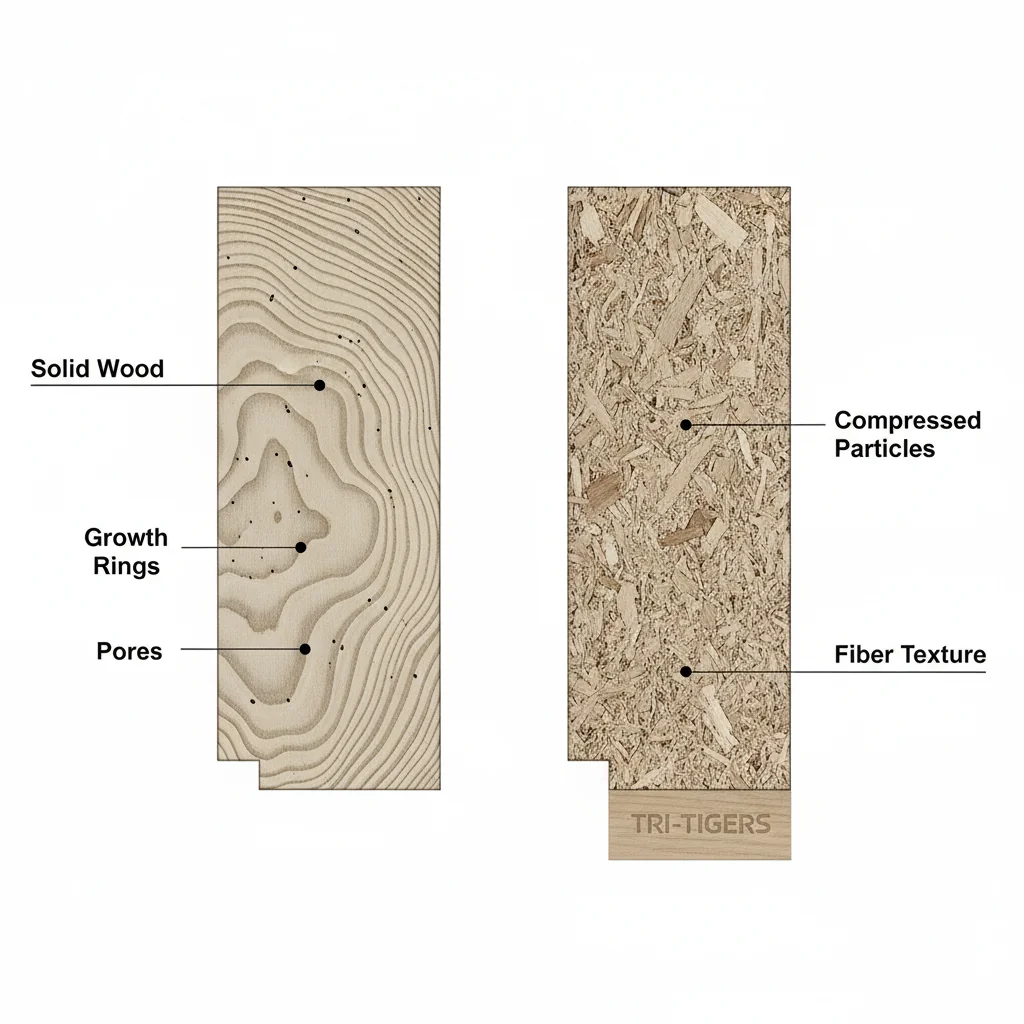
End grain inspection is the most reliable field method for distinguishing furniture materials: solid wood displays continuous growth rings and natural grain running through the thickness, while particle board reveals a compressed, irregular core of chips or fibers, and MDF presents a dense, homogenous structure. Surface grain patterns—irregularity, natural knots, or color variation—signal real wood authenticity, whereas repeated grain patterns usually indicate veneer over engineered board.
How Does End Grain Reveal Wood Type?
End grain examination1 is the most reliable method for distinguishing solid wood from particle board in factory sourcing. Real wood displays continuous growth rings and pores that transition naturally from face to edge. Engineered panels like particleboard2 or MDF exhibit compacted particles or uniform fibers with no natural pattern, indicating lower screw-holding strength and reduced durability compared to authentic wood.
Most people don’t realize that end grain is the quickest way to tell real wood from engineered panels on the factory floor. If you pick up a shelf in a showroom in Germany or check the underside of a table from a Polish importer, the end grain tells you everything. Solid wood shows clear, continuous growth rings and pores that run from the face through the edge—what you see on top wraps right around the side. This natural structure isn’t just about aesthetics; it delivers real strength, especially at the joints.
In contrast, when you cut into particleboard or MDF, you’ll only see compressed particles or dense, smooth fibers. There’s no grain—just a uniform, manufactured look. I remember a UK retailer who insisted on “solid wood only” for their dining table range. When we checked the sample, the end grain revealed fine wood fibers with no ring structure—classic MDF. They avoided a costly reorder right there.
Here’s a quick visual guide I always share with buyers:
| Material | End Grain Appearance | Strength at Joints | Refinishing Ability | Moisture Resistance |
|---|---|---|---|---|
| Solid Wood | Continuous growth rings, natural pores | Excellent | Can sand/refinish | Moderate |
| Particleboard | Visible chips, crumbly texture | Low | Not possible | Poor |
| MDF | Smooth, dense, cardboard-like | Moderate | Limited | Poor |
This detail is important because solid wood keeps screw joints tight, survives shipping knocks, and can handle light refinishing. I always suggest buyers request an unpainted corner sample before finalizing bulk orders. It’s a 10-second check that can prevent a major headache later.
The visibility of continuous growth rings on the end grain reliably distinguishes solid wood from particle board, as engineered panels lack these natural patternsTrue
Solid wood features uninterrupted growth rings and pores visible on the end grain, reflecting its natural cellular structure, whereas particle board is composed of wood chips and resin with no continuous grain patterns. This makes end grain inspection a definitive method to differentiate between the two.
Applying water to the end grain of furniture causes engineered wood to swell less than solid wood because particle board has a denser structureFalse
Engineered wood, including particle board, actually swells more when exposed to water due to the resin and adhesive layers absorbing moisture, whereas solid wood typically swells less because its natural grain can better regulate moisture absorption. Density alone does not prevent swelling in engineered panels.
Key takeaway: Examining end grain is the fastest and most reliable factory method to confirm solid wood versus engineered panels. Authentic wood shows natural grain continuity and structure, ensuring superior strength and longevity compared to particleboard or MDF, which appear as compressed particles or smooth, homogeneous fibers without visible growth rings.
How Do Surface Grains Indicate Core Material?
Surface grain patterns provide significant clues about furniture construction. Genuine wood displays naturally varied grain, including unique knots and inconsistent pore size, while particle board with veneer or laminate often features repeating or mirrored patterns and a uniformly smooth texture. Detecting pattern repetition, especially across large panels, suggests a decorative surface layer over a particle board core rather than solid timber.
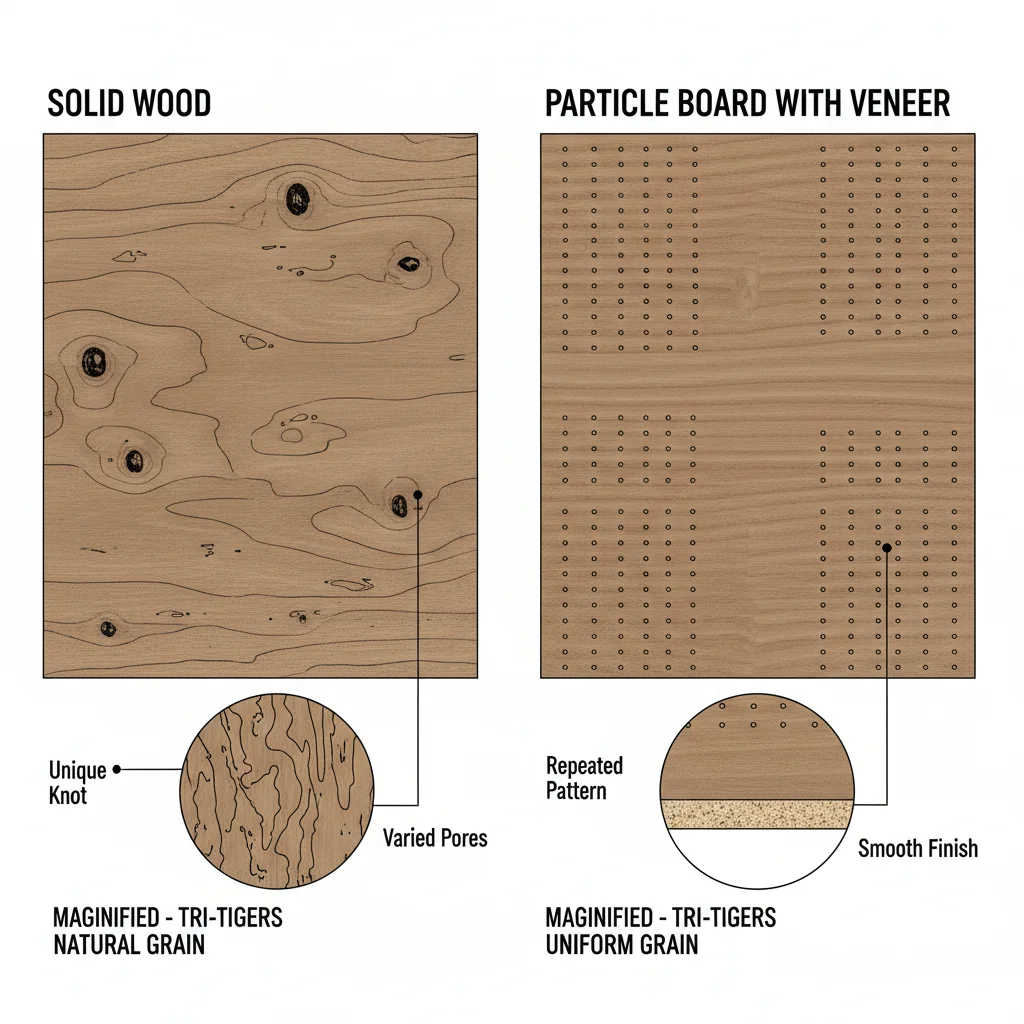
Let me share something important about reading grain patterns—I’ve seen this trip up even experienced buyers in places like Germany or the UK. Solid wood panels always have unpredictable character: lines curve unevenly, a knot interrupts here, the pore size shifts just a touch across the surface. But when I visit factories producing melamine-laminated or veneered particleboard, what stands out is the consistency—panels look nearly identical, even across several batches. For example, one Polish importer ordered about 600 flat-pack bookcases, each in oak-look melamine. Inspecting the surface, they noticed a repeating “cat’s eye” in the pattern every 60 cm—a classic giveaway of printed laminate on particleboard.
From my experience, even high-quality veneer can repeat, especially on wide cabinet doors, because factories book-match or slip-match the sheets. You’ll often see mirrored grain—a telltale sign. On genuine wood, that just doesn’t happen. Another check: run your fingertips across an 18mm E1 MDF shelf with PU lacquer, then over a melamine-faced panel. Real wood and good veneer let you feel some grain texture, tiny pores or “life” in the surface. Laminate is all smooth, even on a large 200x80 cm table top.
For buyers, this matters. Surface repetition is a strong clue you’re not dealing with solid timber—so don’t count on the same durability or refinish options. I suggest scanning large, flat areas and asking for an untrimmed edge sample. That’s often where the true core shows itself.
Solid wood grain patterns typically vary in pore size and direction within a single panel due to natural growth variations, unlike veneered particleboard which maintains uniform pore distributionTrue
Natural wood growth causes irregular grain and pore patterns that shift across the surface, while particleboard with a veneered layer uses printed or engineered grains leading to consistent pore size and direction across multiple panels.
A consistent grain pattern on a furniture panel always indicates it is made from solid wood, as manufacturers replicate this to match natural texturesFalse
Consistent grain patterns are usually a sign of engineered surfaces like melamine or veneers applied on particleboard, because solid wood inherently shows natural irregularities and cannot maintain identical patterns across different panels.
Key takeaway: Observing grain irregularities and feeling for authentic texture can help distinguish real wood from particle board with veneer or laminate. Repeat patterns and uniform smoothness often signal a lower-cost core, guiding sourcing decisions related to durability and furniture refinishing options.
How Do Veneer Edges Reveal Core Material?
Veneer seams and edges are key indicators of a furniture’s core material. When the wood or plastic veneer stops abruptly at the edge, exposing a different substrate—such as chip-filled particle board, layered plywood, or smooth MDF—this signals an engineered core. Visible edge banding3 further indicates hidden particle board or MDF, not solid wood, beneath the finish.
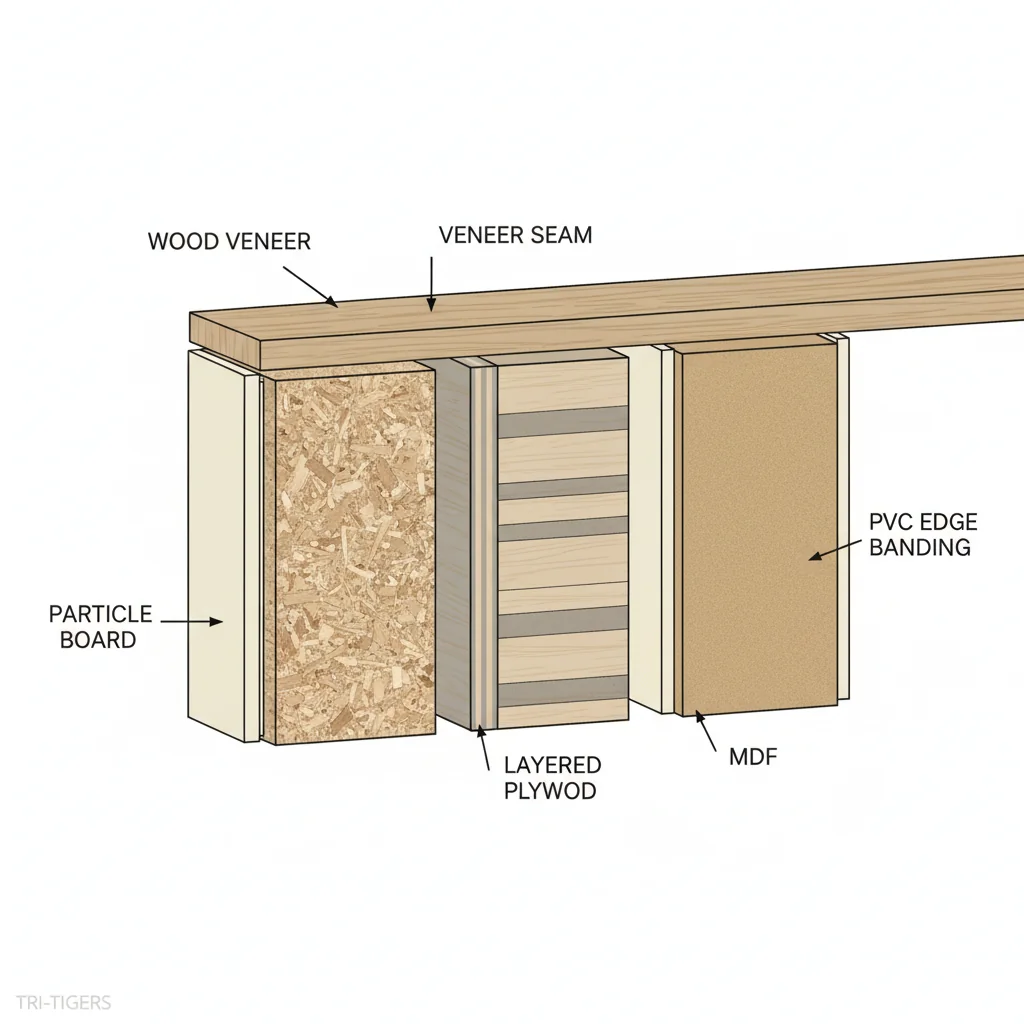
Here’s what matters most when I’m assessing core material on panel furniture—the edges really do tell the truth. Last month, a furniture retailer in France sent me photos of “oak veneer” cabinet samples, asking if these were solid wood or engineered panels. The giveaway was at the door edge: the veneer stopped suddenly, revealing a smooth, beige substrate. I could tell immediately this was MDF—no visible grain, just a homogenous surface. If you spot small chips and uneven particles under the veneer at the edge, that’s usually particleboard. Plywood cores show up as glued layers, easy to see if you check the underside or a shelf notch.
Many buyers focus on surface color and ignore edge banding. That’s a common mistake. I saw a case in Poland—retail flat-pack desks with “solid oak” labeling. But the edge banding was a 2mm PVC strip, hiding raw particleboard beneath. The moment they tried to drill a cable hole, the core crumbled. I always remind clients: proper edge inspection helps avoid costly surprises in fieldwork.
To be honest, simple checks at the seams and corners will save a lot of headaches. For projects needing on-site modification or heavy-duty fixing, I recommend requesting sample cross-sections—ideally 18mm thick, E1-rated MDF or plywood if durability matters. In most European contracts, clear substrate disclosure solves 90% of dispute risk. Check how edge treatments align, then decide if the core matches your technical needs.
A sudden stop in veneer coverage at an edge commonly reveals MDF core, identifiable by its uniform beige color and absence of wood grainTrue
When veneer ends abruptly exposing a smooth, consistent surface without grain patterns, it indicates MDF, which is made from finely ground wood fibers compressed into a dense, homogenous panel, unlike natural wood cores.
Particle board cores always show visible wood grain patterns along the veneer edges similar to solid woodFalse
Particle board is composed of wood chips and resin pressed together, resulting in a granular, uneven surface with no true wood grain, so visible grain patterns on edges are not typical and usually indicate either solid wood or plywood core.
Key takeaway: Inspecting veneer seams, surface terminations, and edge banding allows professionals to quickly identify whether furniture is made from solid wood, particle board, plywood, or MDF. These cues are essential for determining suitability for trimming, repairs, or modifications during factory sourcing assessments.
How Does Weight Indicate Panel Material?
Furniture weight and feel can distinguish wood from particle board. Solid hardwoods are noticeably heavier and denser than particle board. Lightweight furniture often signals hollow or composite construction. Stiffness also matters: particle board shelves flex and sag under load, while solid wood or quality plywood remain rigid. Tactile testing along unpainted edges and resonance from a knuckle tap further reveal material differences.
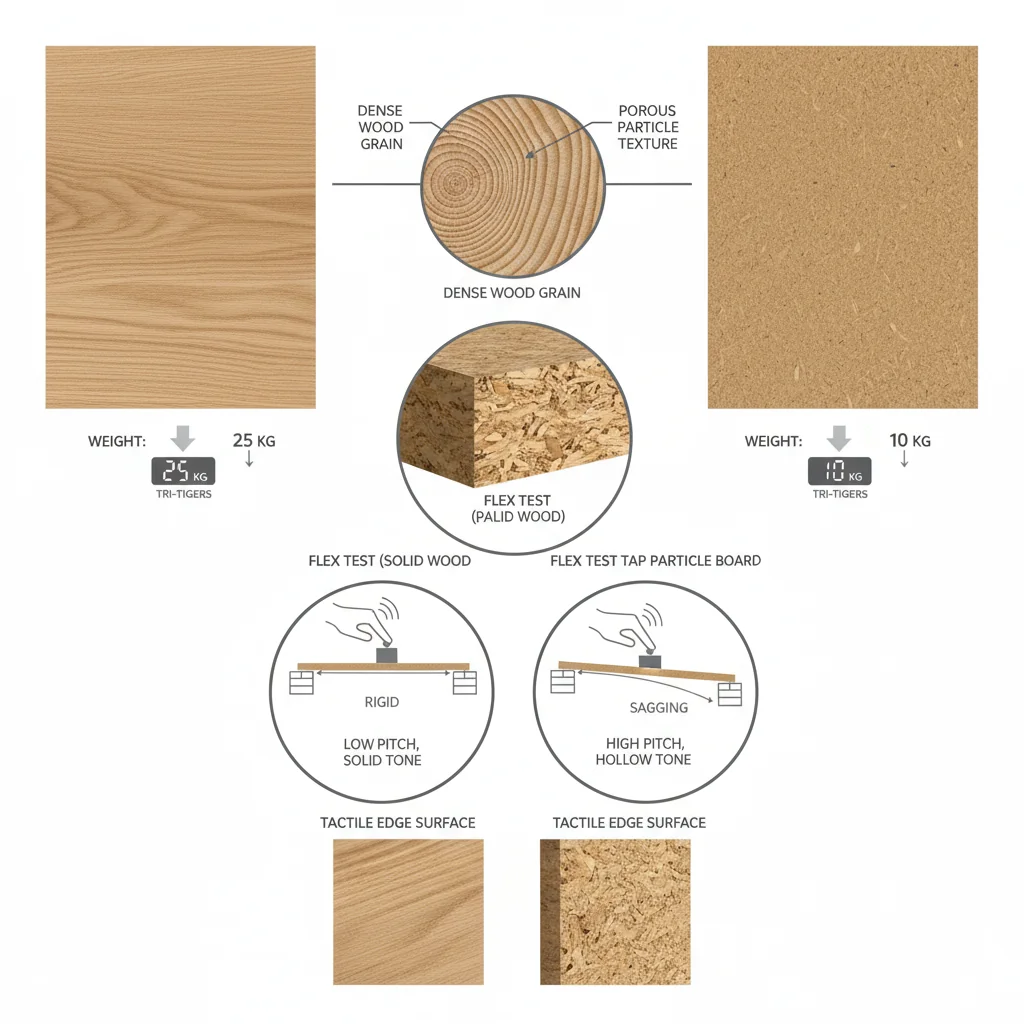
To be honest, the spec that actually matters is how heavy (or light) a piece feels when you lift it. I’ve worked with sourcing teams in Germany who were surprised when a 2-meter MDF sideboard weighed close to 60kg, but a visually similar particleboard one was barely 38kg. That difference comes down to density—standard MDF runs around 650-800 kg/m³, while typical particleboard hovers at 600-680 kg/m³. When you’re inspecting samples at the factory, this is one of the quickest reality checks. If a large bookcase feels light for its size, it’s almost always a composite or honeycomb panel inside, not real MDF or plywood.
Rigidity is your next clue. I always suggest putting pressure on long shelves—particleboard tends to flex and sag under weight, especially when thickness drops below the standard 18mm used for cabinetry. A 25mm plywood shelf, by contrast, stays rigid even when loaded with books. That can save importers real trouble—last autumn, a UK buyer complained when their particleboard TV stands started warping after just six months. We traced it back to 16mm thick boards used to cut cost.
Edge feel is another test I use. MDF edges are smooth and warm; particleboard feels rougher, sometimes sandy. If you tap with your knuckle, MDF or solid pine has a deep, solid sound, while particleboard feels dull. For factory visits or pre-shipment QC, I suggest these quick checks—they reveal a lot before you ever sign off on a container.
Standard MDF panels typically weigh 20-50% more than particleboard of the same dimensions due to their higher density range of 650-800 kg/m³ compared to 600-680 kg/m³ for particleboardTrue
MDF’s higher density arises from its fine wood fibers compacted under heat and pressure, resulting in noticeably heavier panels, which helps identify material type through manual weight comparison.
Particleboard generally weighs more than MDF because it includes resin binders that increase its density beyond 800 kg/m³False
Particleboard actually has a lower density range (600-680 kg/m³) than MDF (650-800 kg/m³). Though particleboard includes resin binders, its larger wood particle structure leads to a lighter overall panel compared to the finer, denser MDF composition.
Key takeaway: Heaviness, stiffness, and tactile feel reliably indicate whether furniture is solid wood, plywood, or particle board. Quick tests—lifting, pressing, tapping, and feeling edges—help buyers, inspectors, and sourcing experts distinguish higher-quality solid panels from lighter, more flexible composite cores or particle boards during factory evaluations.
How Do Drawer Boxes Show Material Quality?
Drawer box construction is a clear indicator of furniture material quality. Solid wood drawers feature dovetail joints4 and continuous wood grain edges, signifying durability and craftsmanship. In contrast, particle board or MDF drawers show layered or chipped edges and often use simple butt joints with staples, reflecting lower strength and short-term performance.
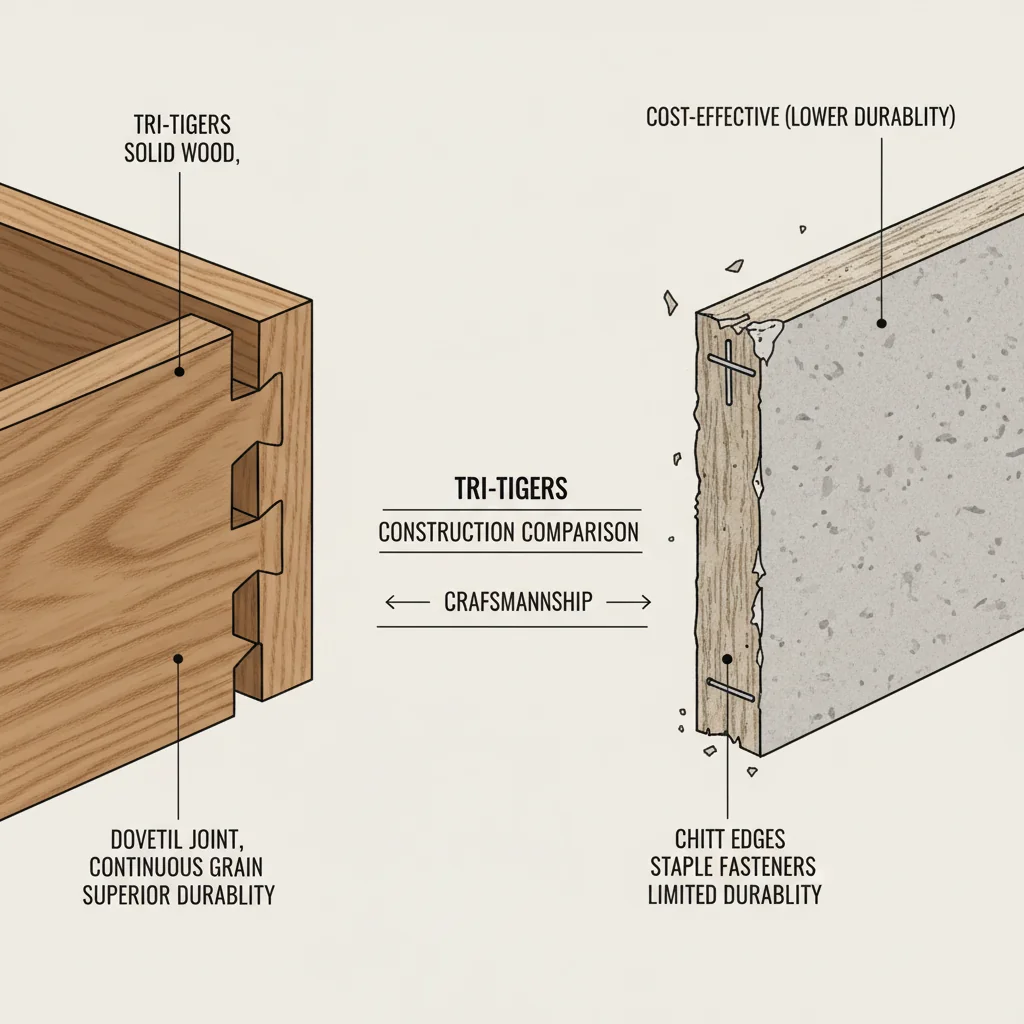
Last month, an importer from Germany sent over detailed photos of drawer boxes from four potential suppliers. All were quoted as "premium," but the differences were immediately clear. Solid wood boxes had dovetail joints—those interlocking “fingers” at the corners—not just glue and staples. This type of joinery takes extra skill and time, but it means real strength. When you run your finger along the top edge, a continuous wood grain going all the way through says a lot. If it feels like a single piece—no seams, no chips—that’s solid wood. If you see thin stacked layers, that’s plywood. Notice rough, crumbly edges? Particleboard or MDF.
In mid-market flat-pack ranges, especially those using E1-rated particleboard5, drawers usually rely on staple or nailed butt joints. To be honest, these drawers work for light use—like in occasional bedrooms or guest units—but they tend to loosen up after a year or two. I’ve seen rental apartment buyers in Poland go through dozens of replacements when these drawer sides start separating. Plywood drawers, on the other hand, often use dowels or sturdy screws and handle heavier loads without falling apart.
I always suggest actually taking a drawer out and checking the bottom. Is it a thin 3mm panel stapled just into a shallow groove? That’s a red flag for short life. For projects over 500 units—like student accommodation—I recommend specifying at least 12mm plywood drawer sides for better screw retention. A simple five-minute inspection can save months of warranty headaches later.
Dovetail joints in solid wood drawer boxes improve structural integrity by distributing stress evenly across interlocking fingers, unlike staples and glue which rely solely on surface adhesionTrue
Dovetail joinery creates mechanical interlocks that resist pulling forces, enhancing durability and lifespan. Staples and glue provide weaker bonding, often leading to joint failure under load or over time. This joinery is a key indicator of premium, skillfully crafted furniture.
A continuous wood grain pattern on drawer box edges always indicates the use of solid wood throughout the entire box, with no composite or particle board insideFalse
Manufacturers can apply a veneer or edge banding to particle board or MDF to mimic solid wood grain. A continuous grain on visible edges does not guarantee the core material is solid wood; core materials are often concealed beneath these finishes to reduce cost while maintaining appearance.
Key takeaway: Inspecting drawer box materials and joinery reveals whether furniture is solid wood, plywood, or particle board. Dovetail joints and continuous wood grain denote higher craftsmanship and durability, while stapled particle board drawers often signal lower-quality construction and reduced longevity, especially under frequent use.
How Does Joinery Reveal Furniture Material?
Joinery and fasteners distinguish solid wood from particle board furniture. Solid wood constructions typically use dowels, screws into solid stock, mortise-and-tenon6, and dovetail joints in key stress areas, reflecting superior strength. In contrast, particle board and MDF often feature cam-locks, metal pins, staples, and glued butt joints. Robust joinery indicates higher durability and repeated assembly suitability.
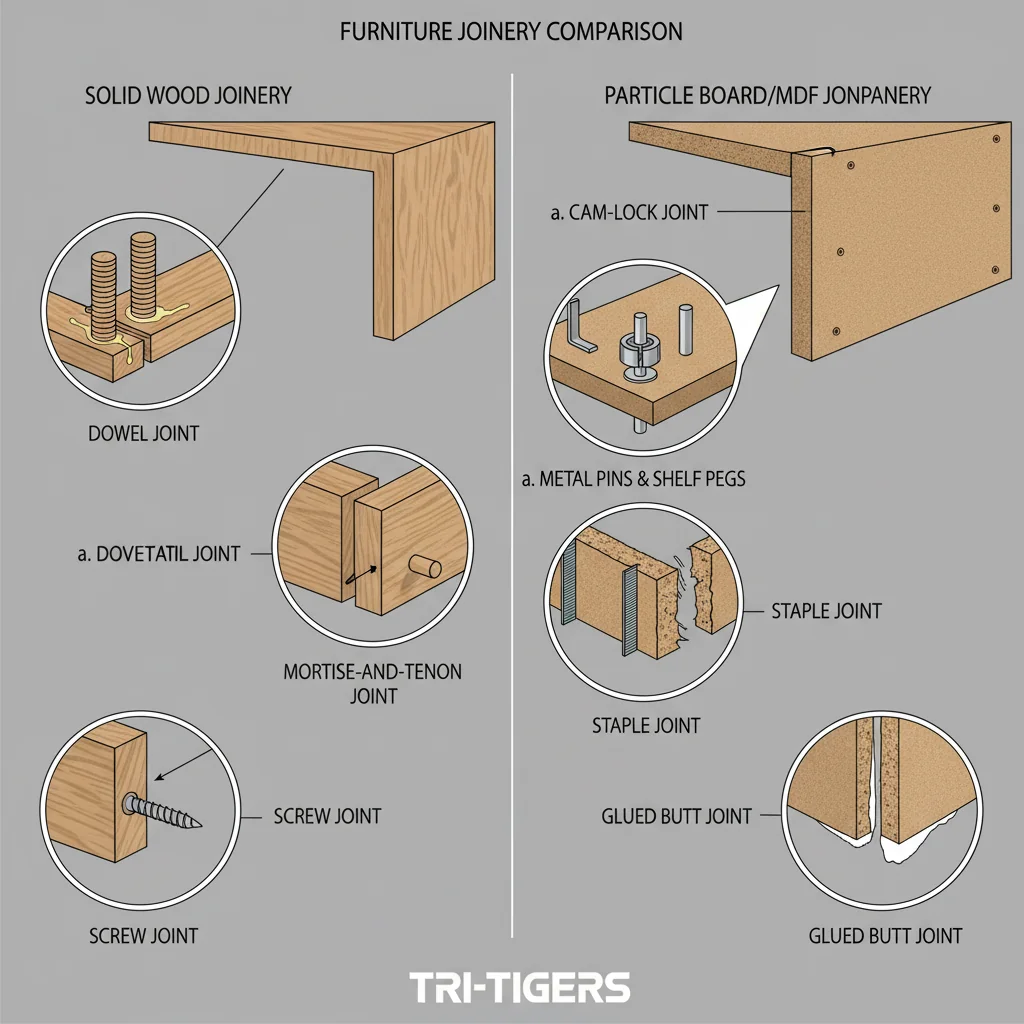
The biggest mistake I see is assuming all furniture with clean lines is made from quality materials—it’s the joinery details that give away what’s underneath. In Germany, one retailer asked me why their flat-pack wardrobes7 failed after just two reassemblies. When I checked, the panels relied on cam-locks and metal pins, all set into standard 16mm particleboard. Those fasteners work—for a while. But particleboard and MDF simply don’t hold screws tightly if you disassemble and re-tighten too often. You might notice this if you see “spinning” cam connectors or stripped screw holes inside the panels.
By contrast, I’ve supplied solid wood dining tables to clients in the UK that used dowels and mortise-and-tenon joints, reinforced with screws directly into 25mm hardwood. That’s robust—no wobbles even after several moves. Traditional joinery like dovetail drawers or tenon rails isn’t just a sign of craftsmanship; it means the internal structure depends on the wood’s natural strength, not just glue or a metal cam. If you check underneath a sideboard or inside a drawer box, look for these telltale signs.
For buyers planning projects that need repeated assembly—like student housing or offices—I always suggest checking the hardware layout and joint type in your sample. Don’t just focus on the surface or edges; real durability comes from the way pieces are joined together. It’s worth requesting detailed joinery photos before signing off a bulk order, especially if you expect heavy day-to-day use.
Cam-lock fasteners embedded in 16mm particleboard typically lose holding strength after just two to three disassemblies due to the board's fiber compression and screw hole expansionTrue
Particleboard’s composite fibers compress and degrade with repeated screw insertions, especially with cam-lock fasteners that exert lateral pressure, causing a rapid decline in joint stability after limited reassemblies.
Furniture made with mortise and tenon joinery is generally less durable than cam-lock assembled particleboard panelsFalse
Mortise and tenon joints, traditionally crafted in solid wood, provide stronger mechanical interlocking than cam-locks in particleboard, resulting in more durable and repairable furniture over multiple disassemblies.
Key takeaway: Examining joinery methods and fasteners helps identify if furniture is solid wood or particle board. Traditional joints like dovetails and mortise-and-tenon signal higher durability, while cam-locks and staples suggest lower-grade composite materials prone to wear during frequent use or reassembly.
Why Inspect Furniture Backs and Bottoms?
Factory-sourced furniture often hides cost-saving materials like particle board or thin fiberboard in unseen areas, such as cabinet backs and drawer bottoms. Checking these parts reveals construction quality: solid wood is less common, while composite panels with staple fastenings can reduce long-term durability, especially under heavy use or frequent relocation.
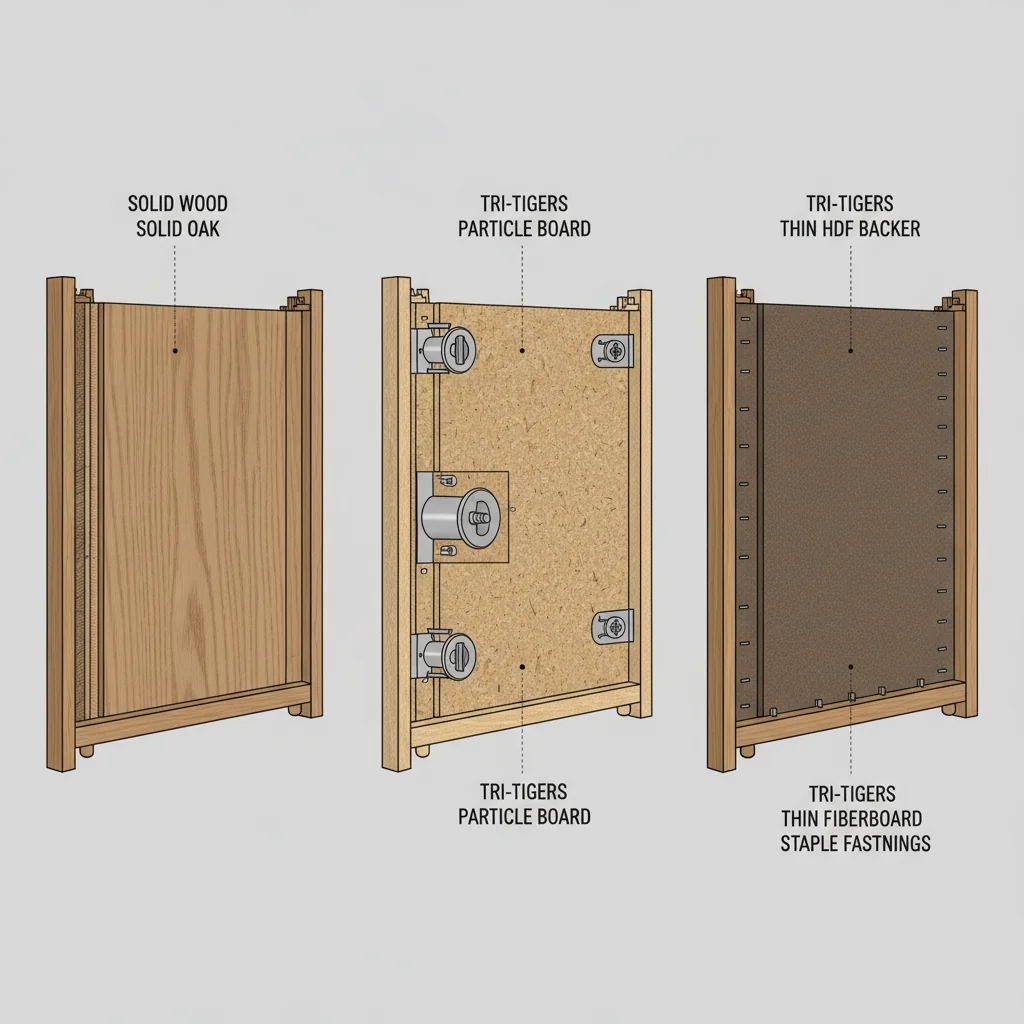
I've worked with customers who made the mistake of only inspecting visible surfaces—front panels, doors, and tabletops—when sourcing flat-pack wardrobes from factories in Poland. The fronts looked great: 18mm E1 MDF with flawless melamine. But after delivery, they found thin 2.5mm fiberboard backs attached with staples. The units handled normal use at first, but once they had to relocate the furniture—about 300 sets for a student housing project—half the backs cracked or pulled loose. From my experience, this kind of hidden cost-saving is much more common than buyers realize, especially when ordering lower MOQs (say, 100 sets per model).
Why does it matter? The backs and bottoms may only represent 10-15% of total material cost, yet they take the brunt when furniture shifts, tilts, or faces moisture. I’ve seen German retailers specify a minimum 8mm MDF for dresser backs after too many 3mm particleboard panels failed. That change added €1-2 per unit—roughly a 5% increase—but the return rate dropped by at least 30%. For facility projects or furniture destined for rental markets, these hidden panels affect racking strength and hold screws for wall-mounting or cabinetry.
I always suggest removing a drawer or tipping a product sample—look for solid attachment, board thickness, and material type. If you’re quoted E1-rated MDF for the main carcass, make sure the supplier doesn’t downgrade the hidden parts. Asking for a full construction sample is wise before placing that first 40HQ order.
Thin fiberboard backs under 3mm in thickness commonly rely on staples rather than screws, which often leads to structural failures during relocation and handlingTrue
Fiberboard less than 3mm thick lacks rigidity and fastening strength, so manufacturers typically use staples. However, staples provide poor holding power compared to screws, causing backs to crack or pull loose under stress like moving or heavy use.
If furniture features 18mm E1 MDF fronts, it always indicates the backs are made from the same quality and thickness of MDF as wellFalse
Manufacturers often match front panel quality for aesthetics but economize on backs, using thinner, lower-quality materials like 2.5mm fiberboard with staple fastenings. Thus, front panel thickness and grade do not guarantee similar backing construction.
Key takeaway: Always inspect the backs and bottoms of panel furniture when sourcing from factories. These hidden components reveal real material quality and structural stability, impacting strength, moisture resistance, and service life—especially critical for heavy-use or facility environments where lasting durability matters most.
How Does Damage Reveal Furniture Material?
Damage patterns are key indicators in distinguishing solid wood from particle board in factory-sourced furniture. Solid wood exhibits dents, chips, or scratches with continuous grain, maintaining integrity. Particle board reveals peeling veneers, exposed crumbly cores, or swelling, especially at corners or near water exposure, often highlighting structural weaknesses and the composite’s layered construction. Observing these features during inspection aids accurate material identification.
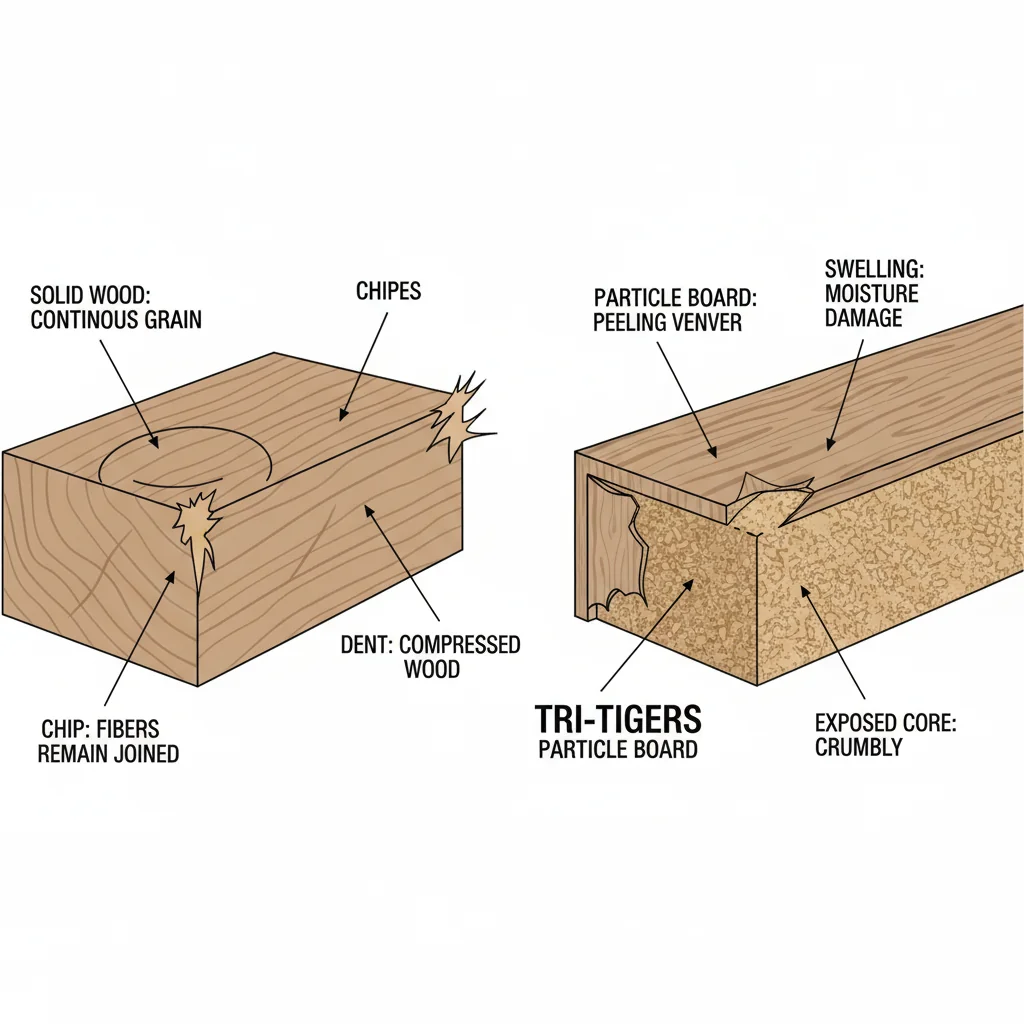
Last week, a buyer from France sent me photos of a bathroom cabinet with chipped corners, asking if it was really “solid wood” as the supplier claimed. Damage is a fast track to telling what’s beneath the surface. In solid wood, a dent or chip shows the same grain running through the damaged spot—it feels dense, and the structure holds, even if scratched. With particleboard, it’s a different story. Look at the exposed area: you’ll notice a crumbly, light-colored core if the top layer peels back. Melamine or PVC edge banding often lifts or splits at corners, especially in humid spots like under a sink. Once, a UK wholesaler received a shipment of flat-pack wardrobes. After a rainy unloading, over 30% showed swelling and “mushrooming” at the base—it was clear the cores were cheap particleboard, around 16mm thick, not moisture-resistant.
Here’s a practical guide for inspections:
- Check chipped corners and edges—continuous wood or layered, flaky material?
- Press lightly on any swollen spots, especially near cutouts or holes. Particleboard will often give way.
- For office desks and panels, water stains that spread with a wood-soft feel almost always mean composite core.
From my experience, quick field checks like these prevent a lot of “second-order surprises” that only show up after installation. I suggest requesting a small damaged sample or visiting the warehouse to see actual returned pieces. It’s a reality check that saves headaches and ensures you know exactly what you’re buying.
When a chip in solid wood furniture reveals the same continuous grain pattern on both the surface and interior, this indicates a density typically above 600 kg/m³, confirming its solid wood compositionTrue
Solid wood consists of continuous fibers running through its thickness, so damaged areas reveal matching grain and density. Dents and chips maintain structural integrity due to the high natural density, unlike manufactured boards.
Particleboard furniture typically shows a dense, uniform core with no visible color variation when chipped, often matching the surface laminate in texture and hardnessFalse
Particleboard cores are composed of compressed wood particles bonded with resin, resulting in a light-colored, crumbly interior that contrasts with the often harder surface laminate. It lacks the uniform density and grain continuity seen in solid wood.
Key takeaway: Examining damage—such as chipped edges, swelling, or peeling layers—can quickly reveal whether a furniture piece is solid wood or particle board. Recognizing these material-specific damage behaviors helps buyers assess quality and predict long-term durability of factory-sourced and used items.
How Does Durability Differ by Material?
Solid wood furniture offers superior durability and refinishing potential compared to particle board or veneered panels. Solid wood can last 20–30 years or more, tolerating multiple sanding and stain changes. In contrast, particle board's thin veneer and weak core limit its lifespan, resist moisture poorly, and cannot safely be heavily refinished or structurally repaired.
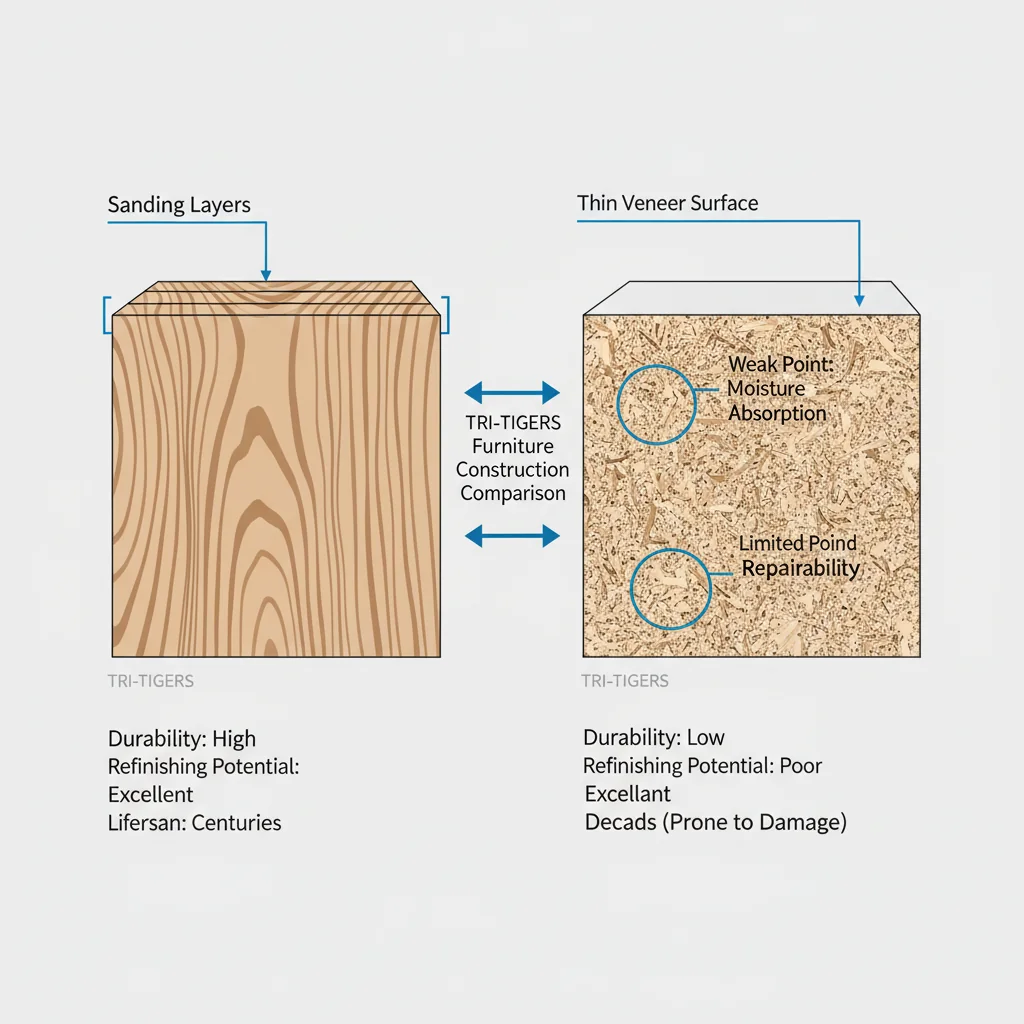
A lot of buyers ask me, “How much of a difference does the material really make if the furniture just needs to look good?” That’s the wrong question—durability isn’t something you see in showroom photos. For example, last spring, a wholesaler in Germany switched from solid oak to veneered particleboard bookcases for a hotel project. The price per piece dropped by about 25%, but when guests started stacking heavy folders and the cleaning staff mopped floors, trouble hit fast: edges swelled after minor water spills, and shelves sagged within 18 months.
With solid wood, you’re paying for decades of reliability. I’ve visited German schools still using solid beech benches made in the late 1990s—refinished twice, still rock-solid. That kind of lifespan isn’t possible with particleboard, especially at 16mm or thinner. If you try to sand or refinish a veneered piece, the top wood layer—often less than 0.5mm thick—disappears in seconds. Underneath, the raw core doesn’t accept stain or glue well, and water resistance is minimal.
From my experience, composite-cores work for short-term office fit-outs or budget home projects. They’re much more cost-effective when you need 400 flat-pack desks per 40HQ container, and lead times are usually a week shorter than with solid wood. However, if a retailer in France wants to sell “heirloom” quality pieces or offer refurbishment services, I always recommend solid wood or, at a minimum, veneered plywood with E1 rating. It’s worth checking panel core specs before committing to volume.
Veneered particleboard furniture typically has a 30-50% lower resistance to moisture-induced edge swelling compared to solid oak due to its engineered core structureTrue
Particleboard cores are made from compressed wood particles bonded with resin, which absorb water and expand more rapidly than the dense grain structure of solid oak, leading to noticeable swelling at edges after exposure to moisture like cleaning.
All particleboard furniture with veneers exhibits identical durability and moisture resistance as solid wood because the veneer layer fully protects the core materialFalse
The veneer is a thin surface layer that provides only limited protection; moisture can penetrate edges and exposed core areas, causing particleboard to swell and degrade faster than solid wood, which remains structurally stable under similar conditions.
Key takeaway: Solid wood outperforms particle board in both lifespan and refinishing flexibility. Particle board’s weak structure and thin veneer restrict its use to short-term or low-load applications, while solid wood is best for areas needing frequent repair, refinishing, or long-term serviceability.
How Do Cost and Age Indicate Material?
Cost, age, and intended use provide important clues but are not definitive proof of furniture material. Modern flat-pack, budget, or big-box pieces are usually constructed from particle board or MDF with laminate or veneer. Authentic solid wood is more likely in older, heavier furniture, especially pre–flat-pack era antiques, though veneer surfaces are still common.
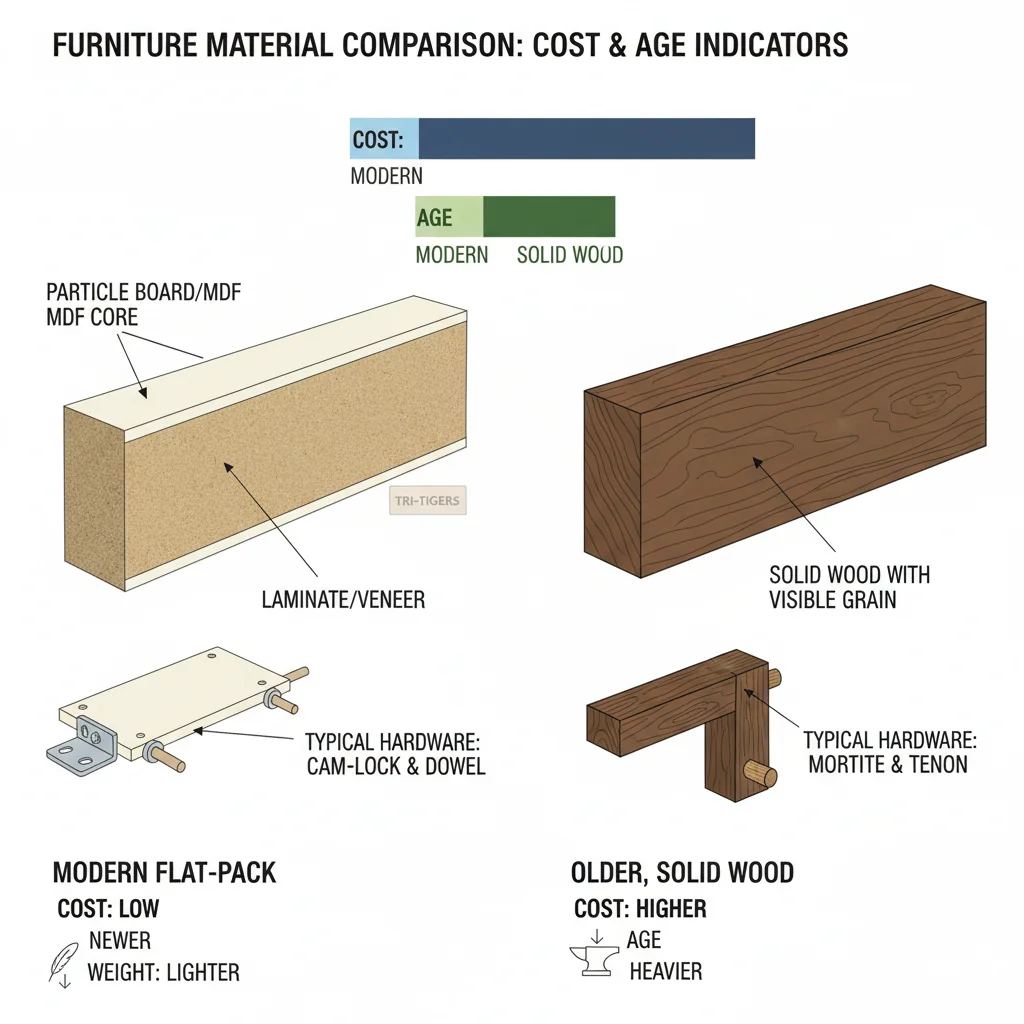
Here’s what matters most when you’re sizing up furniture materials: price and age aren’t 100% conclusive, but they’re strong signals. Last quarter, a wholesaler in Germany sent me photos of a “solid wood” sideboard, priced under €180 ex-works. My first reaction? At that level, it’s almost certainly particleboard or MDF with a wood veneer—true solid oak, for example, would run at least double that for similar dimensions. The weight was another giveaway: around 40 kg for a 1.6 m piece, far lighter than solid timber or even plywood.
I’ve seen many buyers—especially in the UK and Netherlands—assume anything heavy is solid wood, but plywood can also be substantial. On the other hand, genuine flat-pack furniture in the €50–100 retail range relies on particleboard or E1 MDF panels, usually 16–18mm thick, with melamine or laminate finishes to keep costs down. When someone sources for high-traffic commercial spaces, I always recommend budgeting for a good-quality plywood core over particleboard—yes, the FOB price is 20–30% higher, but durability is significantly better.
Intended use often tips the decision. If the item will hold weight or be moved repeatedly, like bookshelves for office files, material choice really impacts lifetime cost. My advice? Use price and age as filters, but always inspect samples or request cross-section images before placing orders—especially for orders above 1x40HQ. Material, thickness, and finish should never be left to guesswork if long-term value matters.
A solid wood sideboard measuring 1.6 meters and weighing around 40 kg is likely made of particleboard or MDF with veneer rather than true solid oakTrue
True solid oak furniture of similar size typically weighs significantly more—often 60% heavier—due to oak’s higher density. The comparatively light weight combined with a low price point under €180 strongly indicates engineered wood materials beneath a veneer.
Price alone is a reliable indicator for distinguishing between solid wood and particleboard furniture regardless of weight or ageFalse
Price can vary widely due to brand, design, and market conditions, so it is not a definitive measure on its own; weight and material density alongside age and construction details must be considered to accurately identify solid wood versus engineered materials.
Key takeaway: Assess furniture materials by considering price, age, and usage. Low-cost and recent flat-pack items are typically particle board or MDF, while older, heavier pieces are more likely solid wood or plywood. Always inspect directly if material certainty is essential for sourcing or durability.
Why Monitor Formaldehyde in Particle Board Furniture?
Particle board and MDF can emit formaldehyde, a volatile organic compound released from certain resins. Prolonged exposure, especially in bedrooms or children’s rooms, may impact indoor air quality and health. Certified low-emission options, such as E1 (Europe/China) or CARB Phase 2 (U.S.), minimize these risks, indicated on labels or technical sheets.
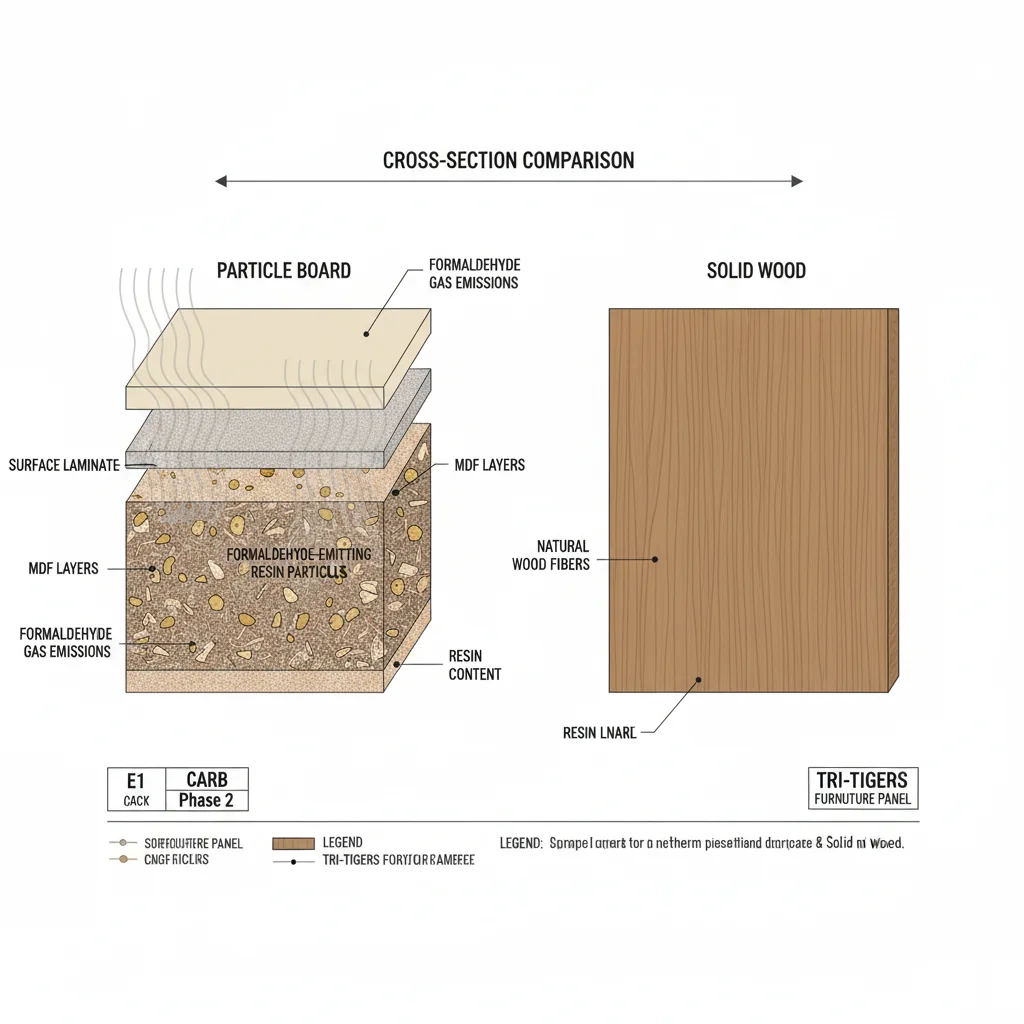
Let me share something important about particle board furniture that’s often overlooked: formaldehyde emissions8 are a real concern, especially for anyone furnishing bedrooms or children’s spaces. I’ve worked with importers in Germany and France who needed reassurance that every wardrobe and bookshelf was safe for indoor air—no exceptions. Formaldehyde is released mainly from the resins used in particleboard and MDF, and its off-gassing is highest in the first few months after production. In smaller, tightly sealed rooms, even moderate emissions from cheap flat-pack products can add up quickly.
Last year, a wholesaler from Poland ordered 40HQ containers of melamine-faced particleboard desks. The original supplier quoted rock-bottom prices, but when I checked their technical sheets, only E2 certification was listed—that’s well over the legal European limit. I advised switching to an E1-certified board, which caps emissions at 0.1 ppm per EN 717-1. Yes, the cost per piece rose by about 5%, but they avoided customs clearance issues and could safely target schools and office projects. It’s a detail too many buyers overlook until it becomes a problem.
If you can’t see E1, CARB Phase 2, or TSCA Title VI on the spec sheet, ask directly for proof—preferably a recent test report. For extra peace of mind, air out new furniture for a few days, and seal any cut or raw board edges with paint or edge banding to reduce off-gassing. This is especially important for 16-18mm particleboard shelving placed in small or poorly ventilated spaces.
Formaldehyde off-gassing from particle board is highest within the first 6 months post-production, decreasing exponentially but can continue at low levels for several yearsTrue
Studies show that formaldehyde emission rates peak shortly after manufacturing due to the curing process of urea-formaldehyde resins, and while emissions drop significantly after 6 months, trace amounts can persist for years, impacting indoor air quality especially in poorly ventilated rooms.
Thicker particle board furniture always emits less formaldehyde compared to thinner pieces because more material acts as a barrierFalse
Formaldehyde emission depends on resin content and curing quality rather than just thickness; thicker boards may emit the same or even higher levels if resin percentage is high, as emissions originate from the resin itself, not the thickness of the board.
Key takeaway: Indoor air quality can be compromised by formaldehyde emissions from particle board furniture, notably in sensitive environments. Always check for E1, CARB Phase 2, or TSCA Title VI certifications, and use practical mitigation steps for new purchases, such as airing out and sealing exposed edges.
Conclusion
We’ve walked through how to quickly identify if a piece is real wood or a particle board using end grain inspection right on the factory floor. From my years working with European importers, I can say: the best long-term relationships come from asking the right questions up front—about actual material structure, not just surface finish or a low quote. Too often I’ve seen buyers focus only on price, then stumble on the “quote-to-container gap”—where the hidden details like true board composition or packing method eat into margins later. Want to double-check a supplier’s claim or talk through which construction is best for your market? I’m always happy to share what’s worked (and what hasn’t) for other buyers—just reach out. Every sourcing decision should fit your business, not just the price list.
References
-
In-depth insights on using end grain patterns to differentiate solid wood from engineered panels for durability and authenticity. ↩
-
Comprehensive overview of particleboard's composition, lack of natural grain, and implications for strength and screw-holding capacity. ↩
-
In-depth insights on how edge banding conceals core materials like particleboard or MDF, affecting durability and finish quality. ↩
-
In-depth explanation of dovetail joinery techniques, craftsmanship benefits, and durability advantages in solid wood furniture drawers. ↩
-
Comprehensive details on E1 formaldehyde emission standards, particleboard construction, and performance implications for mid-market furniture. ↩
-
In-depth look at mortise-and-tenon joints' design, stress distribution, and durability benefits in solid wood furniture construction. ↩
-
Insights into common hidden cost-saving practices and durability problems found in flat-pack wardrobes sourced from factories in Poland. ↩
-
Clear explanation of health impacts, off-gassing timelines, and certification roles to ensure indoor air quality and compliance. ↩
Published: 2025-12-29