
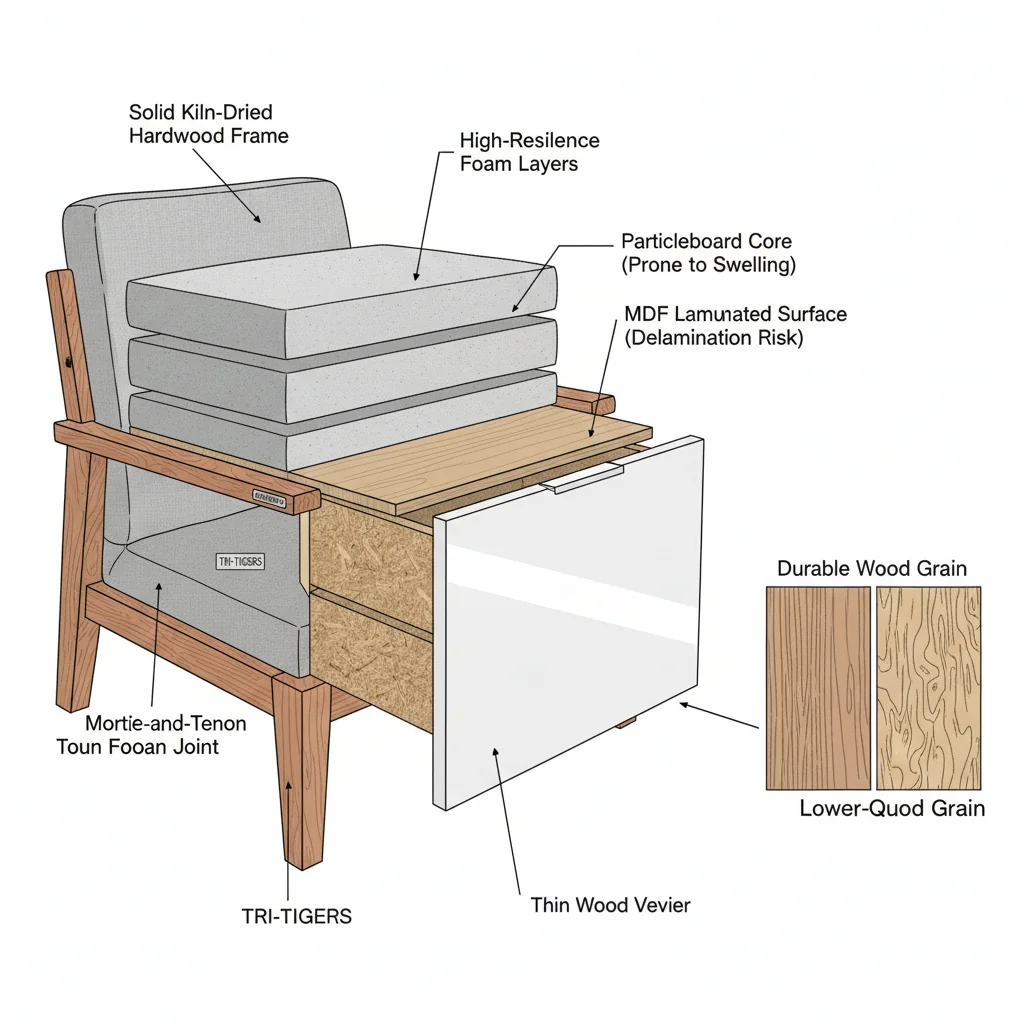
Featured image for Furniture Lifespan: Manufacturer’s Guide to Realistic Years of Service
Furniture Lifespan: Manufacturer’s Guide to Realistic Years of Service
One British retailer recently showed me their coffee shop chain’s lounge chairs—beautiful upholstery, only four years old, already sagging and faded. The buyer was shocked: wasn’t “commercial grade” supposed to mean more? It’s a scenario I see all over Europe, especially when real-life use outpaces a catalogue’s promises.
Furniture lifespan represents the period during which a product maintains structural safety and functional performance before major repair or replacement is required, under defined usage conditions. Commercial benchmarks typically set office desks at 8–12 years, heavy-use seating at 5–10 years, and solid wood tables at 15–20 years. Actual service life depends on substrate quality, joinery method, real use traffic, and cleaning regimen.
How Is Furniture Lifespan Measured Commercially?
Commercial furniture lifespan1 is defined as the expected number of years a piece will perform reliably and safely before needing major repair or replacement, under specific use conditions. Lifespan benchmarks vary: office desks typically last 8–12 years, heavy-use seating 5–10 years, and solid wood tables 15–20 years, influenced by material quality, construction standards, and real-world usage intensity.
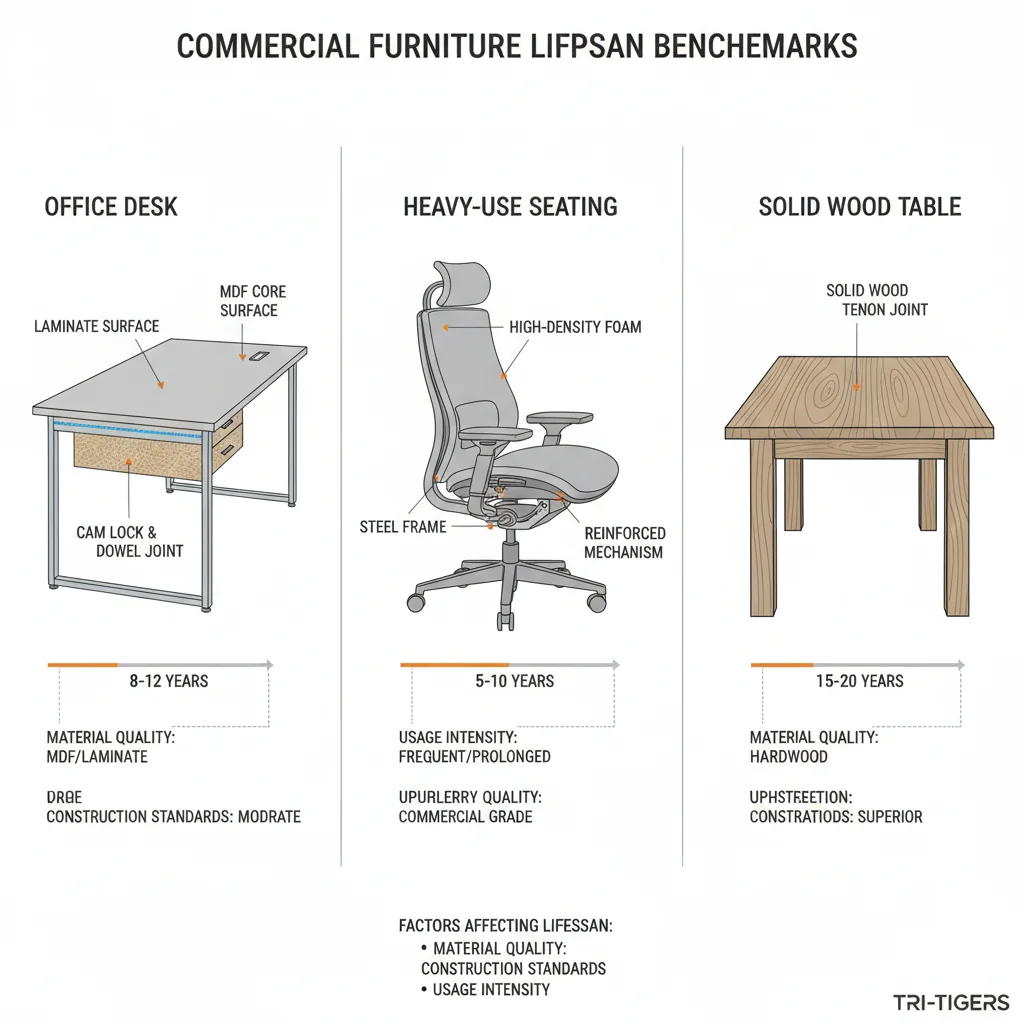
Most people don’t realize that in the commercial furniture world, “lifespan” is treated almost like a warranty—something you specify, measure, and check against real conditions. For example, when one of my German clients ordered melamine office desks with E1-rated particleboard2, they expected each desk to last a full decade under daily use. We set the target service life at 10 years, assuming 8-hour office shifts, 5 days a week. That’s not just a guess—it’s based on recorded performance from hundreds of similar installations across Europe.
I’ve seen cases in the UK where heavy-use canteen tables with 25mm plywood tops easily lasted 15 years, thanks to robust edge banding and thick lamination. In contrast, a Polish hotel chain bought budget 16mm MDF nightstands and started seeing failures—drawer slides and surface peel—in less than 4 years. That’s the reality when material quality, thickness, and hardware selection aren’t matched to real-world intensity.
Here’s what matters most: always get the supplier’s documented expected service life. It should be clear—“8–12 years for desks under office use,” or “5–10 years for lobby chairs in high-traffic zones.” Check how those figures compare to their standard warranty, and ask for references from projects at least 5 years old. Life expectancy isn’t just a nice-to-have; it shapes your replacement cycle and total cost.
I always suggest using “years of service” as a spec—just like size, finish, and price—when planning a project or making a bulk order.
Commercial furniture lifespan is often measured based on a standardized use scenario, such as 8-hour days and 5 working days per week, to ensure consistent service life expectations like 10 years for office desksTrue
Furniture manufacturers and clients establish lifespan using typical usage patterns—commonly 8 hours per day, 5 days a week—as a baseline to simulate realistic wear and validate warranty periods. This allows accurate prediction of product durability under expected conditions.
Commercial furniture lifespan is primarily determined by the thickness of the particleboard used, with thicker boards guaranteeing at least 15 years of use regardless of other factorsFalse
While particleboard thickness affects durability, lifespan depends on multiple factors including board quality, surface treatment, assembly methods, and usage intensity. Thickness alone does not ensure a long lifespan, and 15 years cannot be guaranteed solely by thickness without considering these other variables.
Key takeaway: Commercial furniture lifespan is best treated as a specification, based on actual years of safe, functional service under intended use conditions. Factors such as materials, construction, and expected intensity directly impact longevity, so requesting documented service life from suppliers is essential for informed purchasing and realistic budget planning.
How Long Should Upholstered Seating Last?
Upholstered seating longevity varies by use, material, and quality. Commercial-grade seating in heavy-use areas typically lasts 5–10 years; residential pieces see 7–15 years with light use, but show fatigue sooner in public spaces. Premium leather upholstery3 outlasts standard fabrics, achieving 15–20 years with proper care, while low-cost task chairs often fail within 3–4 years.
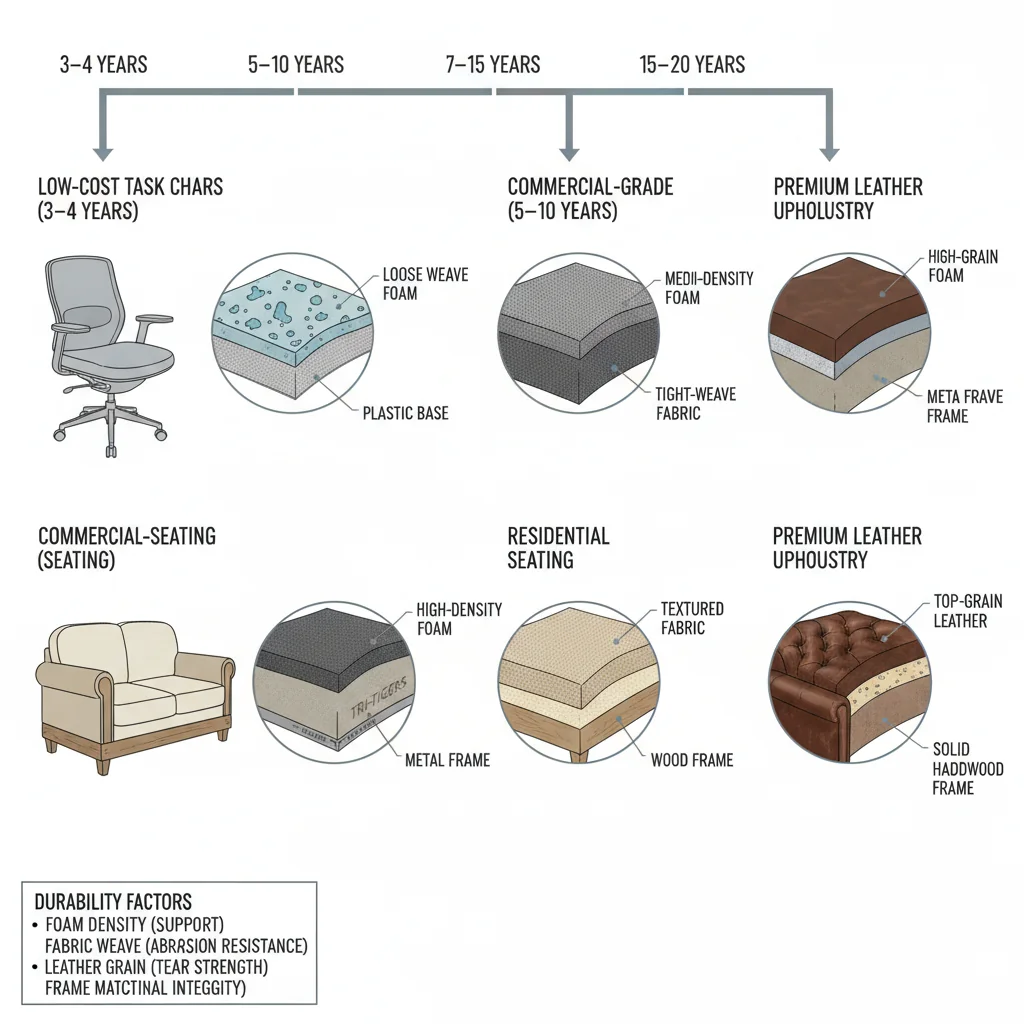
Let me share something important about seating lifespan that many importers overlook: usage intensity and build quality matter more than nearly any other spec. For example, I helped a hotel chain in Germany upgrade their lobby sofas from standard 16mm particleboard frames with midrange fabric to E1-rated MDF4F frames](https://vir-mdf.com/low-voc-mdf-healthier-indoor-option-for-home-and-office.html)[^3], high-resilience foam, and reinforced joints. Their previous sets started sagging after just four years—guests complained, and replacements disrupted business. With the upgraded design and a premium faux leather finish, their new seating has shown little fatigue after six years of daily use.
Many buyers ask about leather versus fabric upholstery. To be honest, real leather can double the lifespan if properly conditioned—often 15–20 years in low-sun environments. I’ve seen French office clients specify top-grain leather and achieve a decade-plus with no tearing or major wear. In contrast, budget task chairs with thin polyester covers and basic plastic mechanisms may fail in under four years—especially where staff rotate frequently or work extended hours.
If you’re planning for high-traffic areas—think airports, clinics, or retail—specify commercial-rated foam (at least 35kg/m³ density), hardwood or thick MDF framing (18–25mm), and robust hardware. Bulk orders usually start at 100 units, with a 40HQ container fitting around 350–400 flat-pack lounge chairs depending on design. I always suggest clarifying both frame and upholstery specifications in the PO. That reduces the risk of “sample hero, bulk zero”—great demo pieces but inconsistent mass delivery. Aim for materials and build that outlive your replacement cycle.
Upholstered seating with high-resilience foam and reinforced joints can extend usable lifespan by at least 50% compared to furniture using standard foam and basic frame constructionTrue
High-resilience foam maintains shape longer under repeated use, and reinforced joints reduce structural sagging, which together significantly prolong furniture durability beyond typical four-year spans.
Particleboard frames are generally more durable than E1-rated MDF frames for upholstered seating due to their higher density and resistance to moistureFalse
E1-rated MDF panels offer more consistent density and are engineered for better dimensional stability under moisture and load compared to standard particleboard, which is prone to faster deterioration and sagging in seating applications.
Key takeaway: Upholstered seating lifespan depends on usage intensity, construction quality, and material. Commercial environments require heavy-duty frames, high-resilience foam, and durable upholstery to maximize service life and minimize replacement intervals. Leather and robust mechanisms significantly extend usable years, especially where disruption or turnover is costly.
How Long Do Tables and Casegoods Last?
Tables and casegoods lifespan depends on substrate, construction quality, and usage environment. Solid wood dining or meeting tables can last 15–20 years, with casegoods like office desks averaging 8–12 years. Laminated MDF café tables5 in hospitality settings may show wear in 2–4 years, while robust tops and substrates extend service life to 8–15 years.
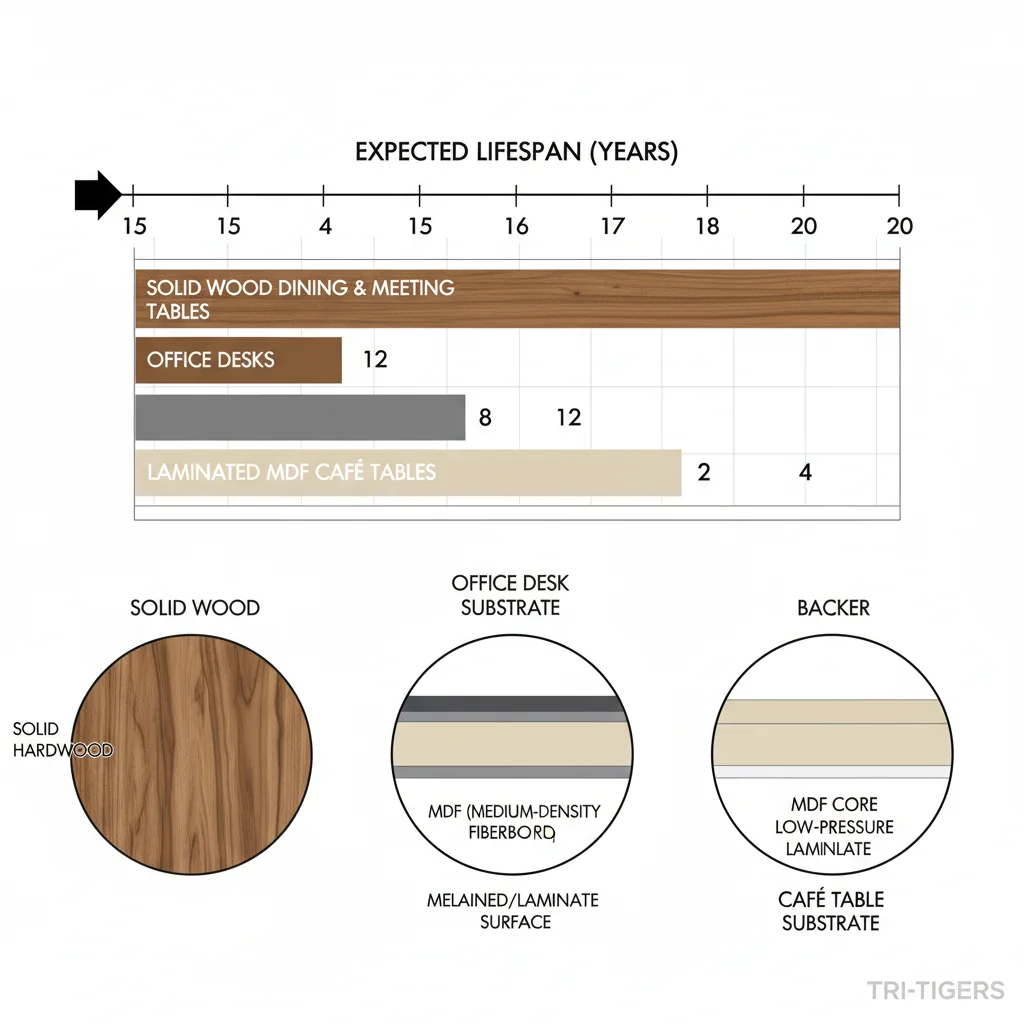
Here's what matters most when talking about table and casegood lifespan: substrate, edge detail, and how the pieces are actually used. I’ve worked with buyers in Germany and the UK who were surprised how quickly café tables with basic PVC edge banding started to chip and swell—sometimes just two or three years into service. Laminated MDF with poor sealing at the edges will always be vulnerable, especially in restaurants or hotel breakfast areas where moisture and heat are daily issues. By contrast, I supplied an office fit-out in Poland in 2021 using 25mm E1-rated MDF with PU-lacquered edges6 and thick melamine tops. Three years later, the post-occupancy review? No major wear, no swollen corners, and only a few chips—minor damage in high-traffic spaces.
Material tells the story. Solid beech or ash tables in dining or meeting use—if properly finished and humidity is controlled—regularly last 15–20 years. For particleboard and low-density MDF, expect far shorter cycles: office desks from these substrates are typically replaced every 8–10 years. In a 40HQ container, you can fit about 250–350 café tables depending on top size, but if you skimp on substrate or edge banding, you’ll replace twice as often.
I always suggest buyers clarify where and how tables will be used, then specify edge protection and substrate accordingly. For high-wear hospitality areas, invest in robust tops and premium edges—it’s worth it over time. And if in doubt, ask for detailed samples, not just a pretty photo.
Tables with edge banding made from basic PVC can start to show chipping and swelling within 2 to 3 years under high-moisture commercial useTrue
PVC edge banding lacks the durability and moisture resistance needed for environments like cafés or hotels. Exposure to heat and moisture causes the edges to swell and chip after only a few years, especially if the substrate is laminated MDF with poor sealing.
Solid hardwood tables typically begin to degrade after 5 years in commercial settings due to their natural susceptibility to moistureFalse
Solid hardwoods are generally more resistant to moisture and wear compared to laminated MDF and PVC edges. With proper finishing and maintenance, hardwood tables can last well beyond 5 years, even in commercial environments.
Key takeaway: Lifespan for tables and casegoods is highly dependent on material, construction, and environment. Solid woods and quality substrates significantly outlast particleboard or MDF, particularly in demanding settings. Proper usage policies and specified edge treatments further extend service life in panel furniture installations.
How Long Do Beds and Mattresses Last?
Commercial bed frames7 typically last 5–20 years depending on construction; kiln-dried hardwood and quality platforms offer maximum durability, while lower-cost metal models may loosen after 10–15 years. Mattresses in hospitality or multifamily settings generally require replacement every 5–8 years due to high usage, hygiene demands, and accelerated wear, with annual inspections recommended for proactive asset management.

The biggest mistake I see with new hospitality buyers is assuming a heavy-duty bed frame will last as long as it does in a private home. In commercial projects—like hotels in Germany or student housing in the UK—beds and mattresses see far more use. From my experience, even a kiln-dried hardwood bed with sturdy mortise-and-tenon joints might show wear after 10 or 12 years if it’s holding up to dozens of guests each month. On the lower-cost end, metal frames assembled with bolts and brackets often develop wobble or loose hardware after about 7–10 years of high turnover. It’s not just about strength—tightening cycles and part replacement matter more than buyers expect.
Mattresses are a whole different story in high-occupancy settings. I’ve worked with Polish hotel chains that budget for full mattress replacement every six years, even when the foam or springs seem “okay.” Why? It comes down to hygiene audits, odor, visible sagging, and guest satisfaction scores. In residential settings, you might get 10 years. In a 200-room hotel with 95% occupancy, five to eight years is the real ceiling—sometimes less for budget PU foam models. Proper rotation and regular inspection are key. If I’m advising a client, I recommend an annual walk-through with a checklist: look for depressions over 3cm, stains, or edge breakdown.
To keep standards up and avoid surprises, plan for a systematic replacement—beds every 10–15 years, mattresses in the 5–8 year range. Set reminders for annual inspection. That small discipline protects both your assets and your brand reputation.
Kiln-dried hardwood bed frames with mortise-and-tenon joints typically begin showing structural wear after 10 to 12 years in commercial hospitality settings due to high guest turnover and frequent useTrue
Repeated stress from dozens of guests monthly accelerates wear on wooden joints, even in high-quality hardwood beds, shortening their lifespan compared to residential use.
Metal bed frames assembled with bolts and brackets generally last longer than kiln-dried hardwood frames in commercial hospitality environmentsFalse
Metal frames with bolt and bracket constructions, especially low-cost ones, tend to loosen and fatigue faster under heavy, repeated use compared to sturdy hardwood frames with mortise-and-tenon joinery.
Key takeaway: Commercial beds and mattresses experience shorter lifespans than residential equivalents due to high usage and strict hygiene standards. Asset owners should plan for replacement cycles of 5–10 years, incorporating annual inspections to detect early failures and maintain guest satisfaction and regulatory compliance.
How Do Materials Impact Furniture Longevity?
Material and construction quality fundamentally determine furniture lifespan. Solid hardwood frames typically last 10–20 years, while particleboard or low-density MDF laminated surfaces often fail in 3–7 years due to swelling, delamination, or fastener issues. Kiln-dried wood8, engineered joinery, and dense, high-resilience foams significantly extend service life over cheaper alternatives and underbuilt mechanisms.
Last month, a retailer in Germany questioned why their particleboard wardrobes warped within three years—while units from another supplier lasted twice as long. The answer comes down to material density and construction choices. Lower-density particleboard (often under 620 kg/m³) swells and loses integrity fast, especially when exposed to humidity. By contrast, an 18mm E1 MDF board with solid PVC edge banding resists moisture and holds fasteners better, extending the unit’s service life to 6–8 years even in family homes.
From my experience, solid hardwood frames or furniture with kiln-dried components easily stay structurally sound for a decade or more. Kiln drying ensures the moisture content is stable—less than 10%—meaning less warping or cracking after installation. I’ve seen French customers specify mortise-and-tenon joints and dowel reinforcement on flat-pack dining tables. This adds a bit to cost, but the result? Fewer warranty claims and repeat business. Simple cam-lock-and-glue construction rarely offers the same durability.
Foam matters too. For seating, I always suggest at least 30–35 kg/m³ density foam. Anything lower compresses permanently in as little as two years with daily use. Recently, a UK wholesaler switched to high-density foam on their sofa line—returns for sagging cushions dropped by about 40%.
My advice: Don’t just check the surface finish or color sample. Ask your supplier for substrate density, joinery details, foam specs, and testing data. Spending a bit more upfront on the right materials means fewer returns, replacements, and headaches long-term.
Particleboard with density below 620 kg/m³ absorbs humidity more rapidly, causing warping within 2-3 years under typical household conditionsTrue
Lower-density particleboard has larger voids and less compressed wood fibers, which facilitate moisture absorption and swelling. This structural weakness accelerates deterioration, especially in humid environments, leading to warping usually within 2-3 years.
Using thicker particleboard (above 25mm) is more effective at preventing warping than switching to 18mm E1 MDF with solid PVC edge bandingFalse
Thickness alone does not prevent moisture damage; particleboard has inherent porosity and weaker bonding compared to E1 MDF. The 18mm E1 MDF combined with PVC edging provides better moisture resistance and fastener holding, extending longevity more effectively than simply increasing particleboard thickness.
Key takeaway: Selecting high-quality materials and robust construction methods is essential for maximizing furniture lifespan. Solid hardwood, kiln-dried wood, advanced joinery, and dense foams far outperform cheaper boards and hardware, reducing failures and replacements. Always request detailed substrate, joinery, foam, and durability testing information from suppliers.
How Does Usage Environment Affect Furniture Lifespan?
Furniture lifespan varies dramatically by usage environment. High-traffic areas like hotel lobbies reduce service years due to constant use, heavier loads, and frequent cleaning, often to 4–6 years versus 10+ in private offices. Factors influencing longevity include traffic volume, user behavior, cleaning practices, sunlight, and moisture exposure. Assigning realistic lifespans requires classifying spaces as heavy, medium, or light-use zones.
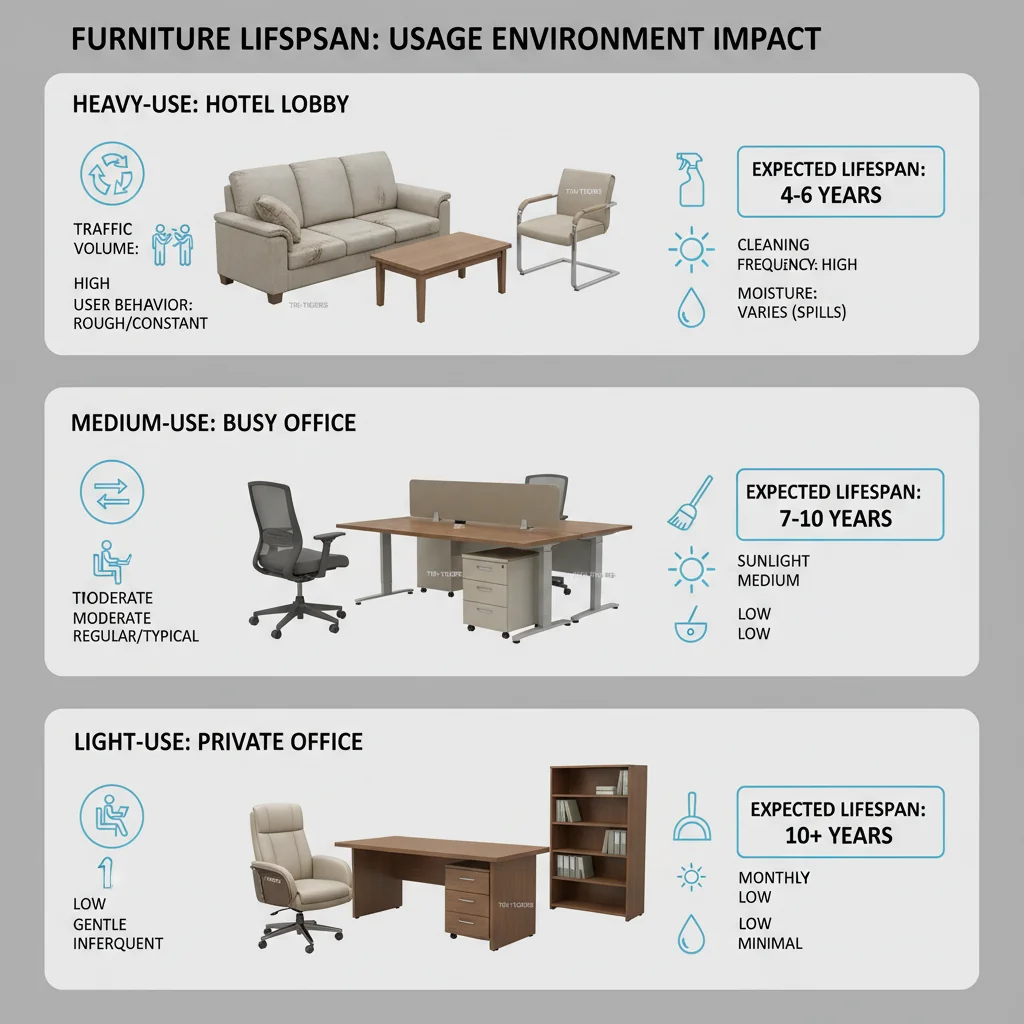
Last autumn, a hotel buyer from Germany told me their lobby sofas were needing full replacement after only five years. That surprised them—the same design in their staff offices had lasted more than a decade. The difference wasn’t material defects, but sheer volume of use and cleaning. I’ve seen this pattern many times: heavy-use environments9 cut service life in half, sometimes more. When 500+ guests use a sofa daily, or cleaning teams scrub every morning with strong chemicals, the wear stacks up fast.
Here’s what matters most when matching product to zone. High-traffic public areas like hotel lobbies or restaurants are “heavy use” by any practical standard. I usually advise specifying at least 18mm MDF or plywood for load-bearing parts, and a tougher surface—double-layer edge banding10 if possible. Melamine finish can resist scratches, but I suggest checking the edge details. Border tables in a UK café chain showed chipped edges within three years, even though the exact same model stayed undamaged in private meeting rooms. Why? In public settings, people bump, rest bags, and spill drinks constantly.
Sunlight and moisture are silent killers. Near big windows, UV exposure can fade even the best spray-painted finishes, while high-moisture spots (think poolside bars in France) can cause swelling in particleboard cores if edge banding isn’t perfect. I always suggest classifying order zones as heavy, medium, or light use, then requesting written warranty or expected lifespan for each space. It saves awkward warranty debates later—and helps build a realistic budget plan.
Sofas subjected to daily use by over 500 guests and daily chemical cleaning can have their lifespan reduced by at least 50% compared to similar furniture in low-traffic office environmentsTrue
High traffic and frequent exposure to strong cleaning chemicals accelerate wear and degradation of sofa materials, effectively halving their service life compared to furniture experiencing moderate use and less aggressive cleaning.
Furniture quality and lifespan are primarily determined by the initial material defects rather than the volume of use or cleaning frequencyFalse
While material quality matters, the frequency and intensity of use and cleaning have a more significant impact on furniture lifespan, often outweighing initial material defects in heavy-use environments.
Key takeaway: Furniture service life is directly impacted by operational environment, with heavy-use public zones reducing expected years compared to light-use private spaces. For accurate planning, manufacturers should classify installation zones and match product specifications and lifespan expectations to actual stressors, rather than relying solely on residential lifespan benchmarks.
How Does Maintenance Extend Furniture Lifespan?
Routine maintenance, including vacuuming upholstered furniture, treating stains promptly, and rotating cushions, can extend furniture lifespan by 2–5 years. Conditioning leather11, shielding it from sunlight, and protecting surfaces with coasters and desk pads prevent cracking, fading, and finish breakdown. Structural care, like tightening fasteners and lubricating moving parts, reduces frame failures and preserves long-term performance.
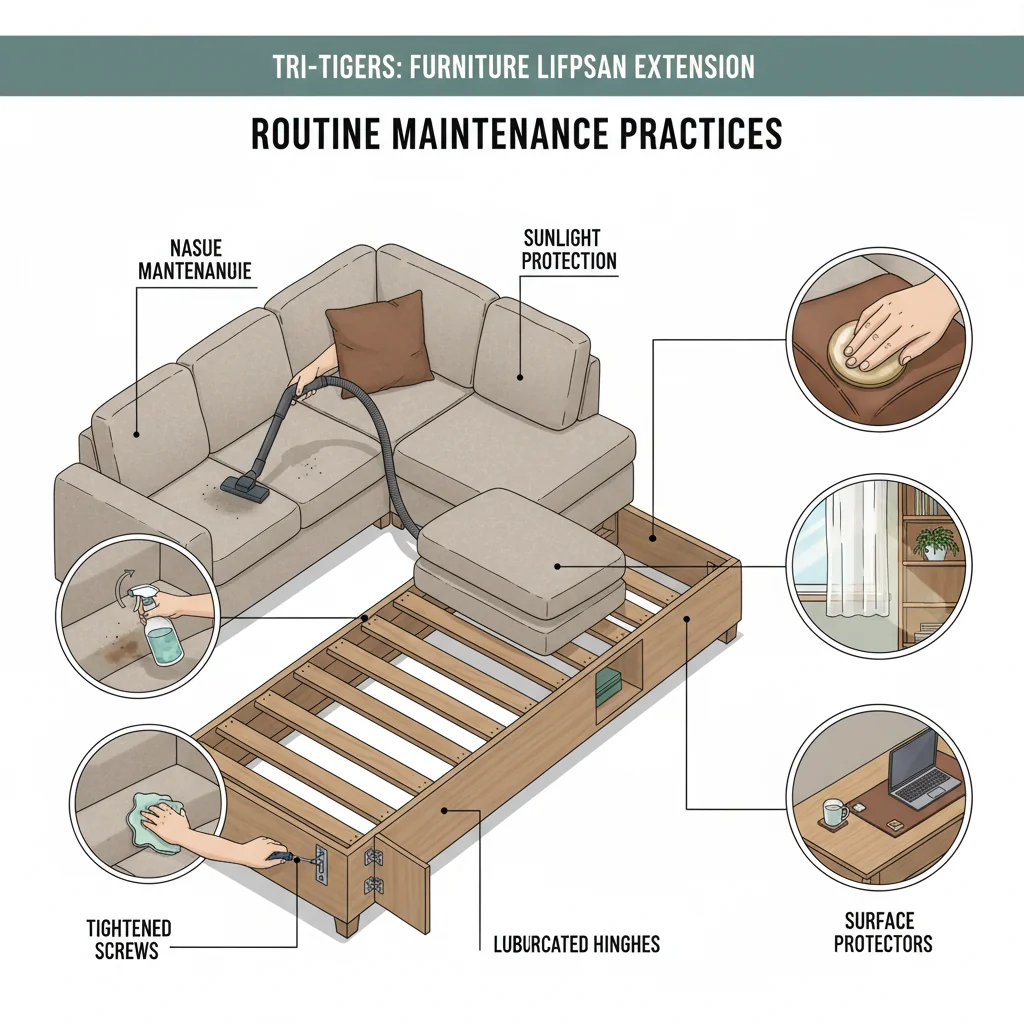
Many buyers focus on the materials and construction but overlook how simple maintenance routines can make a real difference. A Polish retailer I worked with added just a few steps—vacuuming seat upholstery weekly and rotating seat cushions—and saw their E1-rated MDF sofa frames last an extra three years before showing sagging or fiber breakdown. That’s not theory; it’s what their service records proved, compared to the same range used in high-traffic UK rentals.
Treating stains quickly and conditioning leather surfaces every 90 days is another area where I’ve seen big gains. One French hotel group, using E0 MDF headboards with PVC edge banding, cut their headboard replacement rate by almost half after adapting a simple monthly wipe-down and UV-blocking curtain policy. The leather looked newer for at least two years longer—far above average for commercial use.
Structural care is easy to ignore, but tightening screws or cam-locks every six months, and adding a little silicone spray to moving parts, can prevent what I call the “five-step fade”—those little wobbles that end in a warranty claim. In Germany, one office client logs quarterly checks for delamination, hardware rust, and loose joints. Their 20mm particleboard desks now serve five full lease cycles, with less than 8% annual repair rates.
Keeping a simple maintenance log isn’t just paperwork—it’s valuable data. I recommend documenting each inspection. This helps with warranty claims, planning replacements, and even negotiating easier terms with future suppliers. Small habits really do stretch every euro from your panel furniture investment.
Weekly vacuuming and rotating cushions can extend the lifespan of E1-rated MDF sofa frames by around three years compared to untreated use in high-traffic environmentsTrue
Regular maintenance reduces fiber breakdown and sagging by evenly distributing wear and removing dirt particles that degrade materials, as confirmed by service records from retail use versus high-traffic rentals.
E1-rated MDF furniture frames typically last no more than five years regardless of maintenance due to the inherent limitations of the materialFalse
Maintenance routines like vacuuming and cushion rotation have been shown to extend MDF furniture life beyond typical expectations, with documented cases of adding several years before degradation occurs, disproving the fixed lifespan assumption.
Key takeaway: Consistent inspection and proactive maintenance can add several years to the service life of panel furniture, minimizing breakdown and preserving appearance. Documenting routine checks improves durability, reduces liability and downtime, and provides valuable data to optimize replacement schedules and design specifications in both residential and commercial settings.
When Should Furniture Be Replaced Safely?
Furniture replacement should be driven not just by age, but primarily by safety, structural integrity, hygiene, and regulatory compliance. Key indicators include frame instability12, loose joints, rusted fasteners, peeling veneer, deep stains, and delaminating surfaces. Compliance checks, updated fire-retardant or VOC standards, and persistent hygiene issues warrant replacement even if the item doesn’t appear worn.
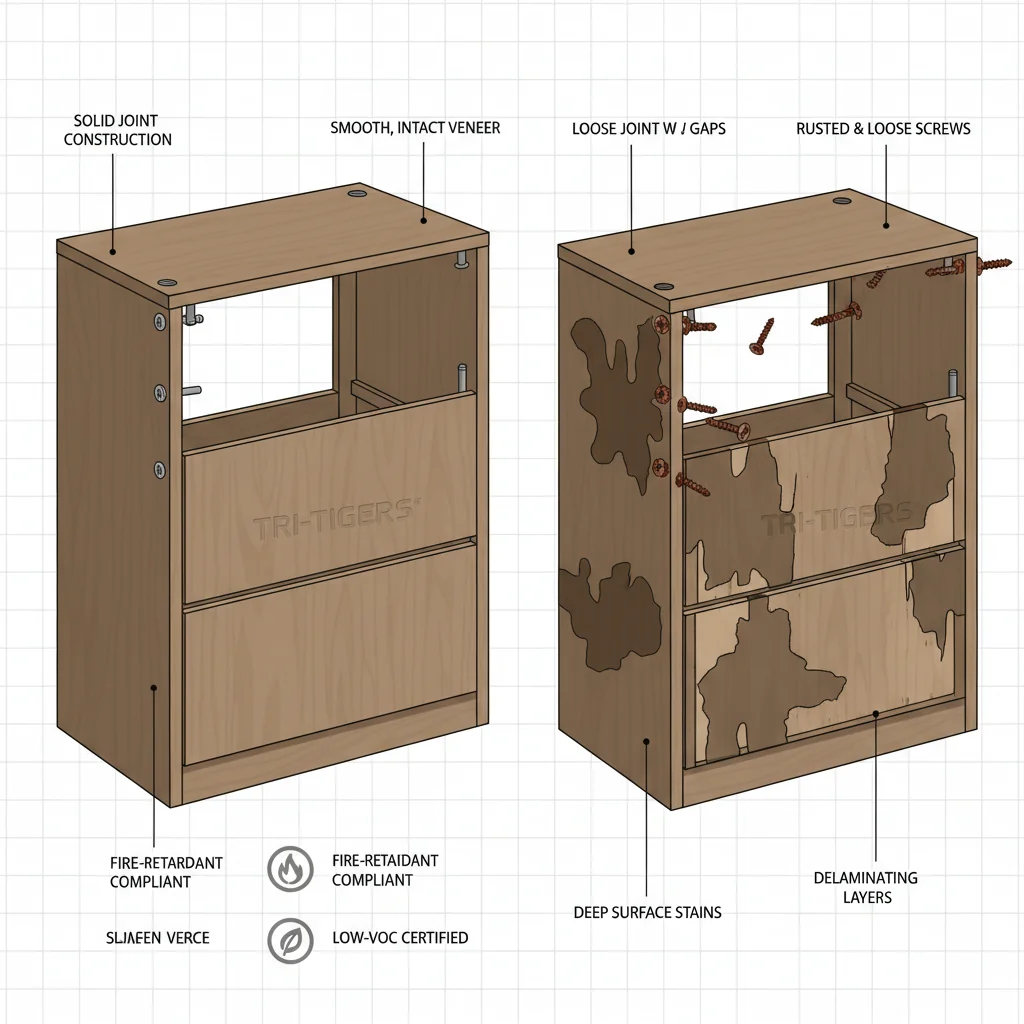
To be honest, age alone is rarely the right trigger for replacing furniture—actual condition matters much more. I’ve worked with customers in the UK who kept 18mm particleboard wardrobes for over ten years without problems, while one hotel in France replaced their melamine desks after just six when several units developed frame instability and the edge banding started to peel off. Deep stains that don’t come out, delaminating surfaces, or a wobbly frame are all signs it’s time to review safety; those issues can’t be fixed with a simple repair kit.
For seating, especially beds and sofas, I always suggest checking the hardware—cam-locks, hinges, and visible metal joiners for rust or looseness. One German retailer found that more than 15% of their flat-pack sideboards needed early replacement after discovering cracked legs and persistent squeaks despite only minor visible wear. Hygiene triggers are just as important: with mattresses, sagging, persistent odors, or allergy complaints should override set replacement timelines. Sometimes, the outer fabric looks fine, but internal panels or support have failed—especially with softer plywood cores.
Regulatory shifts can force a decision too. E1 formaldehyde rating, for example, is now a minimum for nearly all EU importers. If a board fails emission tests or doesn’t meet updated fire-retardant specs, replacement is not optional. I suggest linking inspection routines to safety, hygiene, and compliance checklists, not just age. This helps buyers avoid arbitrary replacements and ensures every site meets the right standard, every time.
Furniture made from 18mm particleboard can safely last over ten years if maintained properly, despite its susceptibility to moisture-related damageTrue
Though particleboard is prone to swelling when exposed to moisture, well-maintained 18mm particleboard furniture without significant exposure can remain structurally sound for more than a decade, as longevity depends more on condition than age alone.
Furniture should be replaced strictly after six years regardless of condition, as structural integrity always deteriorates beyond this timeframeFalse
Replacing furniture solely based on an arbitrary timeframe ignores actual wear and damage. As demonstrated by various cases, furniture may remain safe well beyond six years if there are no signs of frame instability, delamination, or deep stains compromising its integrity.
Key takeaway: Furniture should be replaced based on clear criteria—structural red flags, hygiene conditions, and compliance with regulatory or brand standards—rather than relying solely on visible wear or set age limits. Standardized inspection protocols ensure consistent replacement decisions, supporting safety and performance across all locations.
How Does Cost Relate to Furniture Lifespan?
The upfront cost of furniture must be weighed against total cost of ownership, including service lifespan, maintenance, and end-of-life responsibility. Higher-cost, commercial-grade furniture typically provides greater longevity and lower annualized costs13 compared to cheaper options, especially in high-traffic or commercial settings. Factoring warranties, usage environment, and replacement cycles optimizes long-term value and operational efficiency.
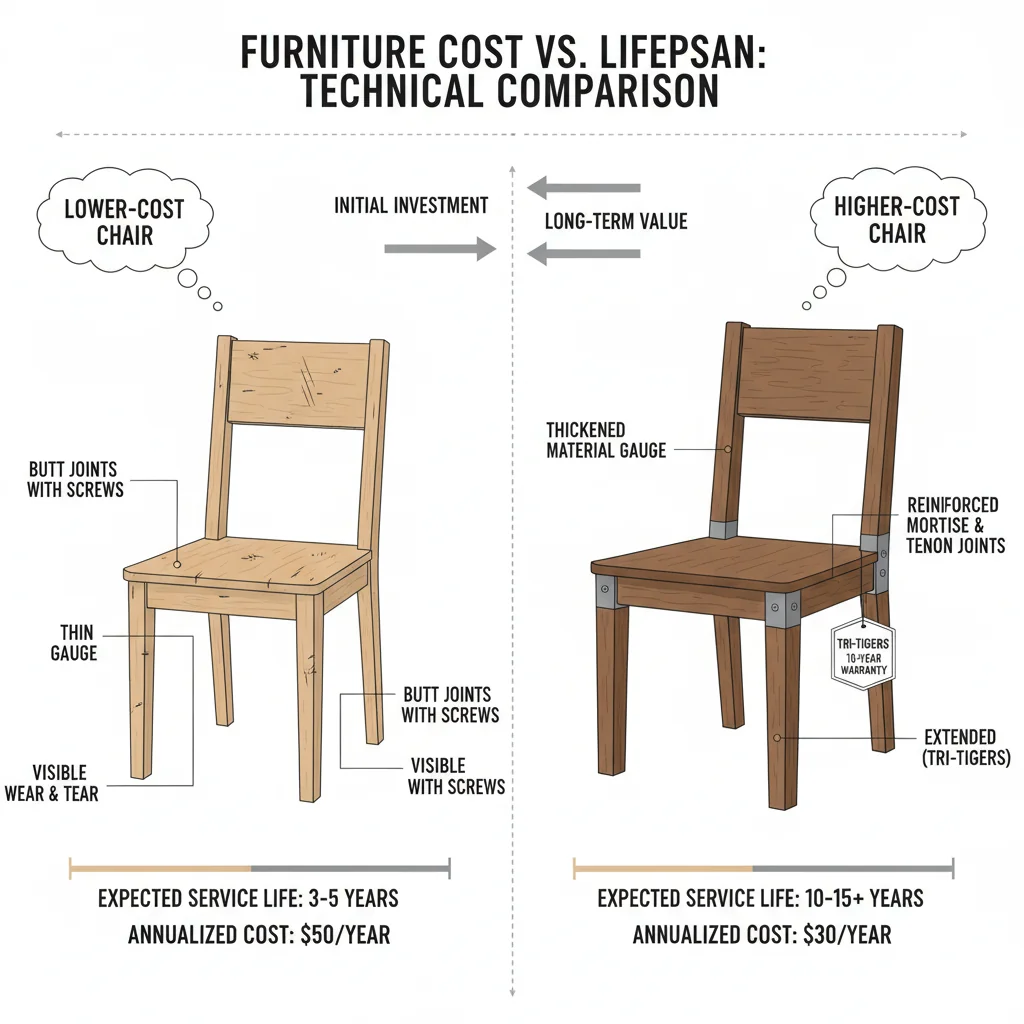
A question I get all the time from buyers in Germany and the UK: “Doesn’t cheaper panel furniture make sense if budgets are tight?” My honest answer? If your application is high-traffic—like hotel guest rooms, lounges, or student housing—low upfront cost often hides bigger long-term expenses. I’ve seen a UK importer choose a budget 16mm particleboard TV stand at €28/unit. Looked like a bargain until half their stock needed replacing within three years. In the same cycle, their competitor paid about €40/unit for an 18mm E1-rated MDF version, properly edge banded and backed by a five-year warranty. Even factoring in occasional repairs, unit cost per service year dropped by nearly 40%.
Here’s what matters most: calculate annualized costs, not just price per piece. Consider not only the initial outlay, but lead time for replacements (often 45-60 days from China or Poland), installation disruption, and disposal fees at end-of-life. In busy environments, I always suggest allocating your budget for better hardware—heavier-duty hinges, deep-drawn drawer slides, thicker PVC edge banding—where traffic is heaviest. For back offices or low-use zones, a standard melamine panel with basic edge banding and CAM-lock fixation is often sufficient.
To optimize value, I recommend mapping out your expected usage per space, comparing warranty lengths, and negotiating after-sales support at the start. Factory warranties can double as signals for minimum performance—if a supplier offers only 2 years, expect to replace sooner. A little more upfront almost always means less hassle, lower annual cost, and less disruption down the line.
Furniture made from 18-22mm plywood panels typically lasts 5-7 years longer in high-traffic commercial settings than similar items made from 16mm particleboardTrue
Plywood's layered structure provides greater resistance to moisture and mechanical stress. In intensive use environments like hotels, this translates to significantly extended lifespan compared to thinner particleboard, which tends to delaminate and break down within 2-3 years.
Using thicker particleboard panels of 25mm thickness guarantees furniture lifespan comparable to plywood in high-traffic areasFalse
Although thicker particleboard increases strength, it lacks the moisture resistance and structural integrity of plywood. Even at 25mm thickness, particleboard is prone to swelling, cracking, and failure under heavy use, making its lifespan substantially shorter than plywood in demanding commercial environments.
Key takeaway: Evaluating furniture value requires analyzing total cost over its expected lifespan, not just initial purchase price. Investing in commercial-grade items for critical spaces reduces replacement frequency and hidden costs, maximizing durability and minimizing disruptions versus low-cost alternatives, which often underperform in demanding settings.
How Do Warranties Indicate Furniture Durability?
Extended warranties, supplier support, and published longevity ratings are strong indicators of panel furniture durability. Leading manufacturers specify real-world service lives by use case, support claims with cycle testing, weight ratings, and compliance certificates. On-site inspections of older installations and verifying spare part availability further clarify a supplier’s commitment to long-term performance and predictable replacement planning.
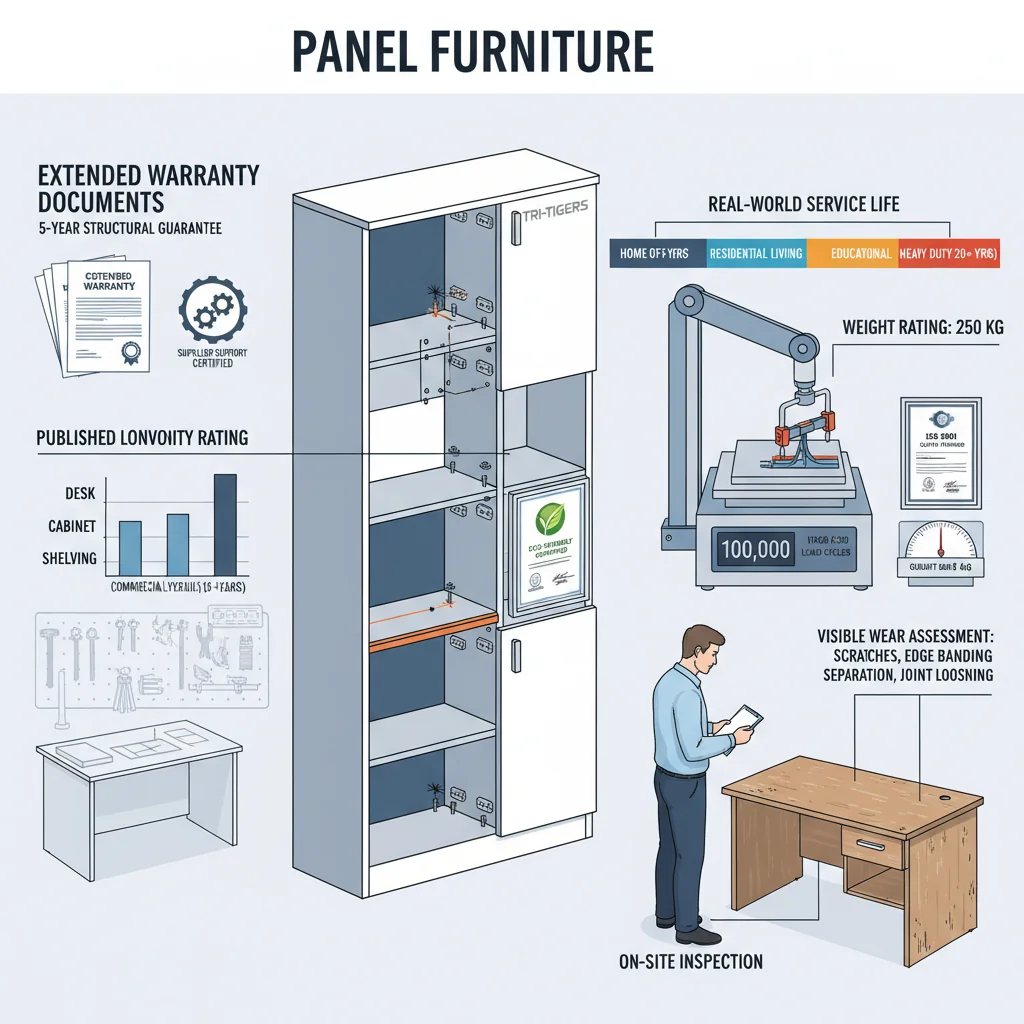
Let me share something important about how real durability shows up in the warranty details. In my experience, buyers who only glance at the catalog warranty—“1 year included”—often miss what’s really on offer. Take a recent project in Germany: a furniture distributor compared two suppliers. One promised a 2-year warranty on all MDF cupboards; the other gave a written 5-year warranty, along with test reports and cycle testing results. They chose the second, even though unit prices were 7% higher. Why? They could see cycle test results showing hinges lasting over 30,000 open-close cycles and shelf weight ratings marked at 30kg per tier. It gave them the confidence that the supplier was backing their quality, not just making sales claims.
It’s not just about the number of years on paper. When a factory is willing to offer spare part availability—like soft-close drawer runners, door hinges, or locking cams—for at least 5-7 years after purchase, that’s another strong signal. I always recommend asking to see certification documents: E1 formaldehyde ratings, FSC-sourced particleboard, and fire safety compliance. If possible, visit previous installations. I visited a hotel in France last year where the same flat-pack beds had been in use for over 6 years. Edges were still clean, hardware worked, and the finish hadn’t yellowed—a real-world endorsement you can’t fake with paperwork.
To reduce your risks, look beyond just lead times and prices. Choose suppliers open about longevity, spare parts, and actual design testing. That’s how you build predictable replacement cycles and protect your investment over the long term.
A written 5-year warranty with supporting cycle testing reports typically indicates a furniture item has undergone rigorous durability validation beyond standard industry practiceTrue
Manufacturers who provide extended warranties backed by formal testing demonstrate confidence in product lifespan, often reflecting actual durability rather than basic liability coverage. This level of documentation is uncommon and signifies higher quality.
Furniture items with only a 1-year catalog warranty generally fail within two years due to poor material qualityFalse
A short warranty does not necessarily mean early failure; warranties often reflect manufacturer risk tolerance or marketing strategy rather than precise durability. Many furniture pieces with 1-year warranties last well beyond that due to material standards and construction methods.
Key takeaway: For reliable furniture durability predictions, prioritize suppliers offering multi-year warranties, substantiated usage claims, comprehensive maintenance guidance, and accessible after-sales support. Inspecting aged installations and confirming spare part provisions can help accurately assess real-world lifespan, reducing risks of premature replacement and unexpected capital expenditures.
Conclusion
We've looked at how material choices, design, and real-world usage all factor into a furniture piece’s true expected lifespan. From what I’ve seen, the importers who plan ahead by asking suppliers for documented service life—and not just datasheets or sales promises—end up with clearer budgets and fewer surprises down the road. It’s easy to get caught in the “quote-to-container gap”—comparing only the cheapest quote, then discovering hidden costs or early failures that eat up your margins. If you want a sanity check on what’s typical for your product category or need help evaluating a supplier’s specs, feel free to reach out. I’m happy to share what I’ve learned from dozens of European projects. Every buyer’s priorities and markets are different, so take the time to get the details right for your own business.
References
-
Expert explanation on defining expected service life, benchmarking for different furniture types, and factors affecting durability in commercial settings. ↩
-
Comprehensive insights on formaldehyde emission limits, durability, and long-term performance of E1-rated particleboard in commercial furniture. ↩
-
Expert insights on how premium leather doubles seating life expectancy with proper care, outperforming standard fabric options. ↩
-
In-depth explanation of E1-rated MDF standards, its emission limits, and how it improves longevity and safety in furniture applications. ↩
-
Expert analysis on lifespan challenges, wear patterns, and maintenance requirements for laminated MDF café tables under moisture stress. ↩
-
In-depth insights on how PU-lacquered edges protect MDF furniture from moisture and chips, extending service life. ↩
-
In-depth insights on durability ranges, material impacts, and common wear issues for commercial bed frames under heavy use. ↩
-
Explains how kiln drying stabilizes moisture content below 10%, reducing warping and cracking for longer-lasting furniture. ↩
-
In-depth analysis of how heavy-use zones like hotel lobbies reduce furniture life due to traffic, load, and cleaning stress. ↩
-
Expert insight into double-layer edge banding durability, scratch resistance, and benefits in high-traffic furniture applications. ↩
-
Expert insights on leather conditioning techniques, recommended schedules, and benefits for preventing cracking and fading in commercial furniture. ↩
-
In-depth explanation of frame instability as a safety risk, including signs, causes, and impact on furniture replacement timelines. ↩
-
Explains calculating lifetime costs including maintenance and replacement to optimize budget and maximize furniture value. ↩
Published: 2026-01-19