
Featured image for Chipboard Furniture Lifespan: Manufacturer’s Guide to Expectations & Pitfalls
Chipboard Furniture Lifespan: Manufacturer’s Guide to Expectations & Pitfalls
Not long ago, a Polish hostel chain came to me, frustrated that their flat-pack wardrobes were already sagging and splintering after just three years. They thought they’d found a bargain—until door hinges started pulling free and panels swelled at the edges. It’s a classic chipboard story, and more common than most importers realize.
Chipboard, or particleboard1, is engineered from small wood shavings and particles bonded with resin and pressed into low-density sheets. While its melamine or laminate surface offers a visually appealing and budget-friendly option for mass-market furniture, the core’s mechanical strength is limited. Lifespan under typical residential use averages 3–5 years, stretching to 7–10 in ideal, dry conditions but dropping rapidly in high-humidity environments.
How Durable Is Chipboard Furniture Construction?
Chipboard furniture is constructed from small wood particles bonded with resin, resulting in a less dense, low-strength core compared to MDF or plywood. While economical and common in flat-pack designs, its melamine or laminate surface only offers superficial protection, leaving the soft interior susceptible to moisture and breakage at joints, particularly when edges or screw holes are exposed.
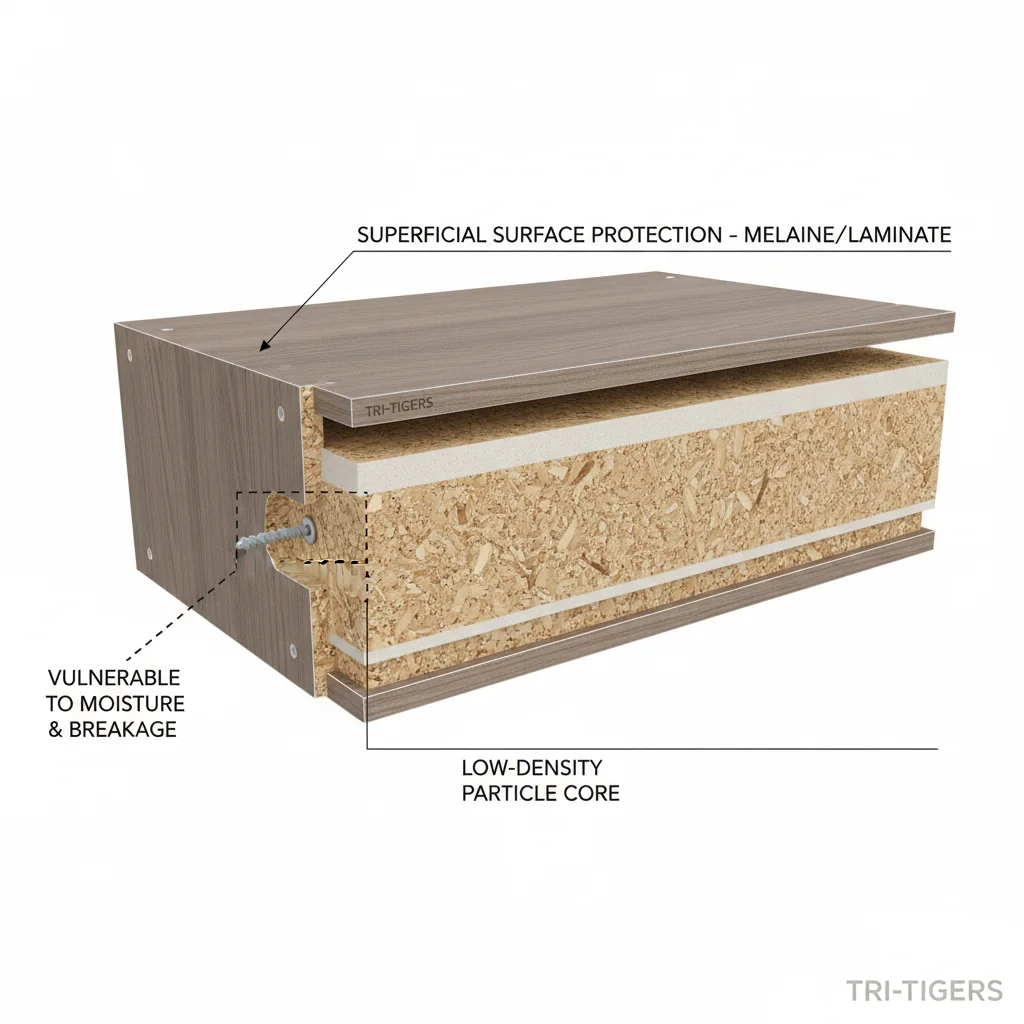
Last month, a wholesaler in Germany asked me if particleboard furniture2 could handle commercial office use. Let me share something important—particleboard (sometimes called chipboard) is built from small wood particles and resin, pressed into sheets. While it’s widely used for flat-pack wardrobes and desks, its core is much softer than MDF or plywood. That means screws can pull out more easily, especially at corners and joints. Most builds I oversee use a standard 16mm board, E1-rated for formaldehyde, with melamine laminate3 as the outer layer.
Here’s the catch, based on my 10+ years in this business: melamine protects against minor spills, but it’s only skin-deep. If edges get damaged or holes exposed during assembly, moisture can sneak in and swell the board. I’ve seen this happen when UK buyers try to use particleboard cabinets in busy rental units—after a year, swollen panels and loose hinges become a real issue. Unlike MDF or plywood, particleboard just wasn’t designed for that kind of stress or repeated moves.
A 40HQ container fits around 1,200 flat-pack units, and pricing can be 20-30% lower compared to MDF, which explains the popularity. But to be honest, I only recommend particleboard for light to moderate use—think student furniture, budget storage, or display shelves. If you’re sourcing for higher-traffic retail or rental, I always suggest requesting upgraded board thickness, double-checking edge banding quality, or even switching to MDF entirely. Setting clear expectations upfront protects both your investment and your reputation with end users.
Particleboard furniture constructed with 16mm E1-rated boards typically shows significant mechanical degradation within 3-5 years under constant commercial office use due to screw pull-out at cornersTrue
The softer core of particleboard compared to plywood or MDF reduces screw holding strength, especially under regular stress at joints, leading to loosening and structural weakening usually noticeable after 3-5 years in demanding office environments.
Using thicker 25mm particleboard instead of 16mm boards can extend the furniture’s lifespan in commercial settings to over 10 years without additional reinforcementsFalse
While thicker particleboard improves strength slightly, its inherent low-density particle core still leads to joint failures and screw pull-out under heavy commercial use; without reinforcements like metal brackets or plywood veneers, lifespan improvements beyond 5-6 years are minimal.
Key takeaway: Chipboard furniture is valued for its affordability and lightweight construction, but its low-density core makes it sensitive to damage and ill-suited for heavy, long-term, or frequently moved applications. Recognizing these limitations helps manufacturers and consumers set realistic expectations for lifespan and optimal use conditions.
How Long Does Chipboard Furniture Last?
Chipboard furniture typically remains functional for 3 to 5 years in standard residential settings, with optimal conditions—such as low humidity and light usage—extending potential lifespan up to 10 years. Heavier-use environments, like rentals or offices, often require replacement at 3 to 7 years due to wear from sagging shelves and loose joints.
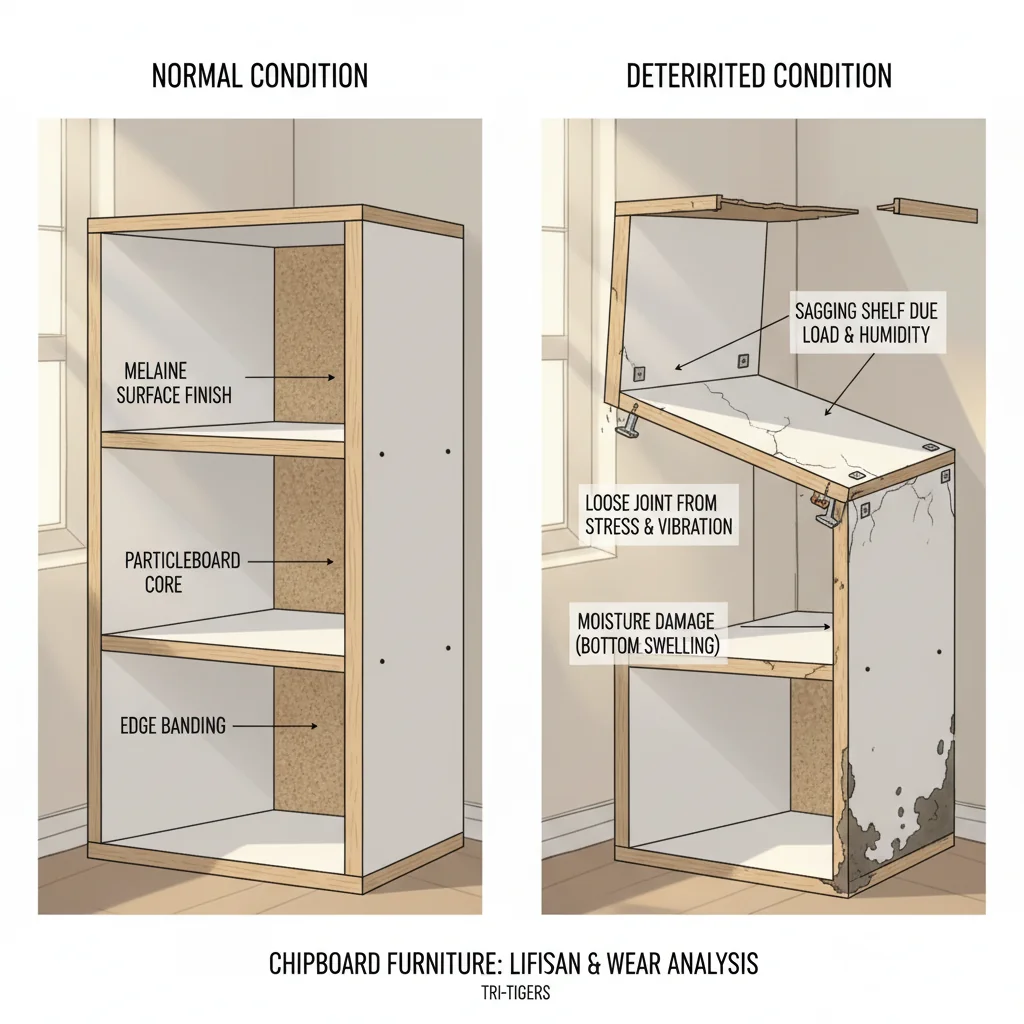
Most people don’t realize that particleboard furniture, while affordable, comes with a built-in expiration date. From what I’ve seen with German and UK buyers, even well-made flat-pack wardrobes with good melamine finishes4 tend to last around five years in busy households. It’s not just about the material thickness—standard 16mm or 18mm board can still swell or sag if exposed to high humidity or overloaded shelves. For example, I worked with one Polish importer who ordered 980 melamine bookcases (16mm, E1-rated, 0.8mm PVC edge banding5) for a student housing project. Within three years, about 30% needed replacement due to shelf bowing and swollen edges from cleaning mishaps.
In light-use spaces—guest rooms, display units, or short-term rentals—you might see chipboard furniture stretch closer to seven or even ten years. I’ve worked with a Dutch retailer who stocks low-load coffee tables and occasional cabinets; replacement cycles there average every six to eight years, mostly triggered by changing styles rather than material failure. Still, if you’re planning for daily wear—think office storage or children’s rooms—I always suggest budgeting for new pieces every three to five years. Edge banding quality and moisture control matter more than most spec sheets admit.
Here’s what matters most when sourcing: treat particleboard pieces as cost-effective solutions for short- to medium-term use. If longevity is your prime concern, consider MDF or plywood for anything expected to see daily stress. For budget buyers, I always recommend sampling a few units and putting them under real-life conditions before committing to a full container—this will reveal how the “theory” matches your reality.
16mm melamine-faced particleboard in flat-pack furniture can begin to sag noticeably in as little as three years under continuous shelf loading exceeding 15 kg per shelfTrue
Particleboard of standard thickness such as 16mm lacks the structural rigidity to resist sagging when consistently overloaded. The typical maximum recommended load per shelf is around 15 kg; exceeding this accelerates deformation, especially in humid conditions where board fibers swell and weaken bonding.
Increasing the particleboard thickness from 16mm to 25mm will double the lifespan of chipboard furniture in typical household useFalse
While thicker boards improve load capacity and reduce sagging, lifespan depends more on environmental factors like humidity, quality of bonding adhesives, and protectiveness of finishes rather than just thickness. A 25mm board doesn’t inherently double furniture life—it may only modestly improve durability under the same conditions.
Key takeaway: Chipboard furniture offers affordability but has a limited lifespan, particularly under everyday or heavy use. In most cases, manufacturers and buyers should treat it as a cost-effective but short- to medium-term solution, factoring in likely replacement or repairs every 3 to 7 years.
How Does Moisture Shorten Chipboard Lifespan?
Moisture exposure is the primary factor reducing chipboard furniture lifespan. Chipboard’s porous core absorbs water quickly, leading to swelling, warping, and crumbling within months. In humid areas or wet rooms, edge swelling6, delamination, and surface blistering are common within 2–3 years if edges aren’t fully sealed, unlike more moisture-resistant MDF or plywood.
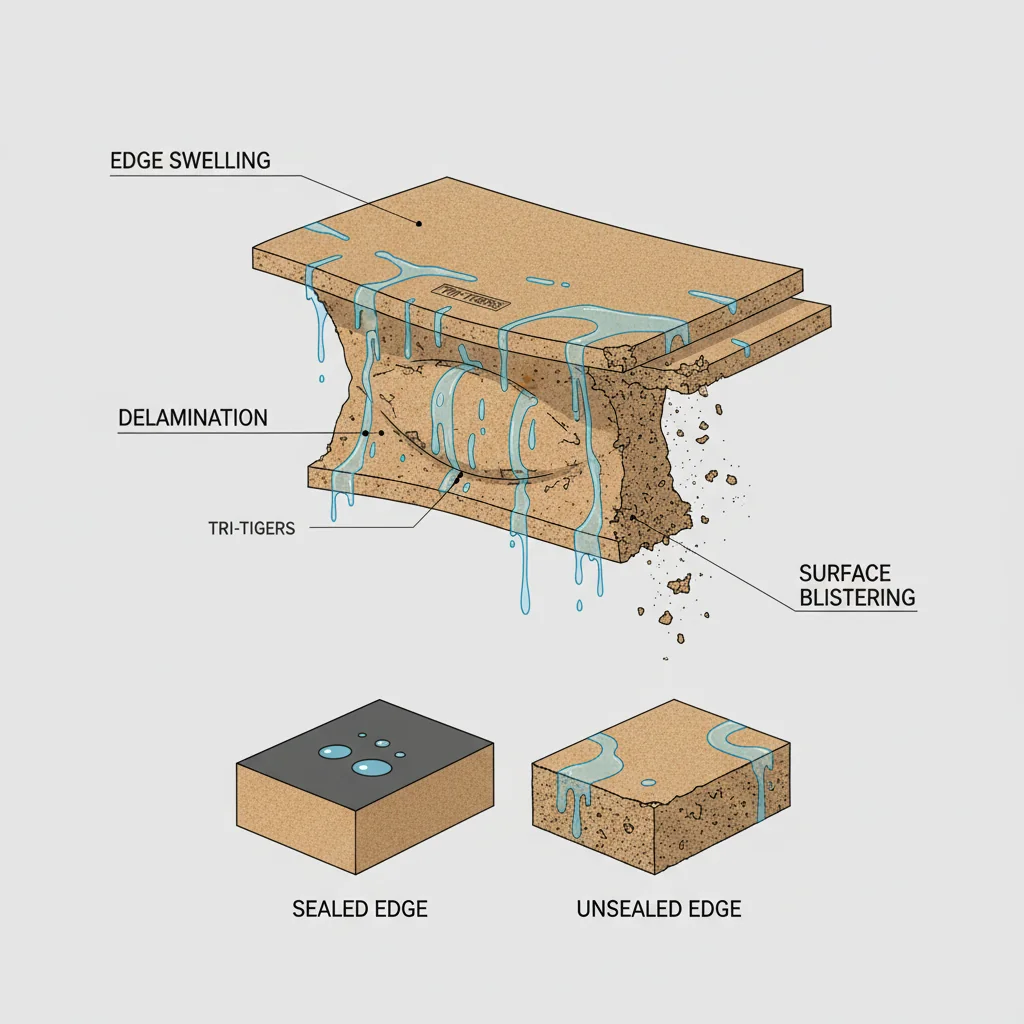
Let me share something important about particleboard and moisture—especially for buyers shipping to the UK or Nordic markets. Particleboard’s inner core acts like a sponge. Once water reaches any exposed edge or seam, it’s only a matter of time before the board swells, softens, and loses strength. I remember a distributor in Denmark—he ordered 1,000 flat-pack wardrobes, all melamine particleboard7 with 16mm thickness. Within 18 months, units installed near bathroom vents showed blistering, and the edge banding had started peeling away. The culprit? Poor edge sealing and ambient humidity above 60%.
This happens far too often in my experience. Even a small spill, if not wiped up right away, seeps into the edges. Standard melamine finish gives some protection on the surface, but the real weak points are the raw or poorly taped edges and the drill holes for hardware. Once moisture sneaks in, you get swelling—sometimes up to 4mm on a standard 18mm board edge. You’ll also see delamination, where the decorative film starts lifting, which looks bad and shortens usable life.
In my experience, MDF or even MR-particleboard (with moisture-resistant core) lasts much longer in kitchens or bathrooms. If you’re determined to use particleboard to hit a price point, I suggest insisting on 1mm PVC edge banding, full perimeter sealing, and feet that keep the board at least 2cm off the floor. And never store panels directly on concrete or unfinished surfaces during transit or warehousing. Small details like these prevent most early failures and keep your returns low.
Exposed edges of 16mm melamine particleboard absorb moisture up to 30% faster than sealed surfaces, accelerating core swelling and structural weakening within 12-18 monthsTrue
Particleboard has a porous core that absorbs water mainly through unsealed edges or joints; this moisture penetration disrupts the resin bonds, causing swelling and softening typically detectable within 1-1.5 years in humid environments near bathrooms or vents.
Applying a waterproof paint coating to melamine particleboard completely prevents moisture-related deterioration over its entire lifespanFalse
Waterproof coatings can reduce surface moisture ingress but do not protect internal edges or seams; over time, moisture can still penetrate exposed areas causing swelling and weakening, so coatings alone cannot fully prevent deterioration.
Key takeaway: Chipboard deteriorates rapidly when exposed to moisture and humidity. Unprotected edges are especially vulnerable, driving early failure. For durable panel furniture in damp environments, manufacturers should favor moisture-resistant materials, full edge-sealing, and installation strategies that keep chipboard off wet floors and away from frequent spills.
How Does Chipboard Furniture Typically Fail?
Chipboard furniture typically fails first on the surface, with laminate chipping, scratching, or peeling. Once breached, the low-density core can swell, crumble, or flake, compromising structural stability. Fasteners loosen as screws pull out, shelves sag under moderate loads, and most damage is hard or impossible to repair invisibly, often necessitating replacement.
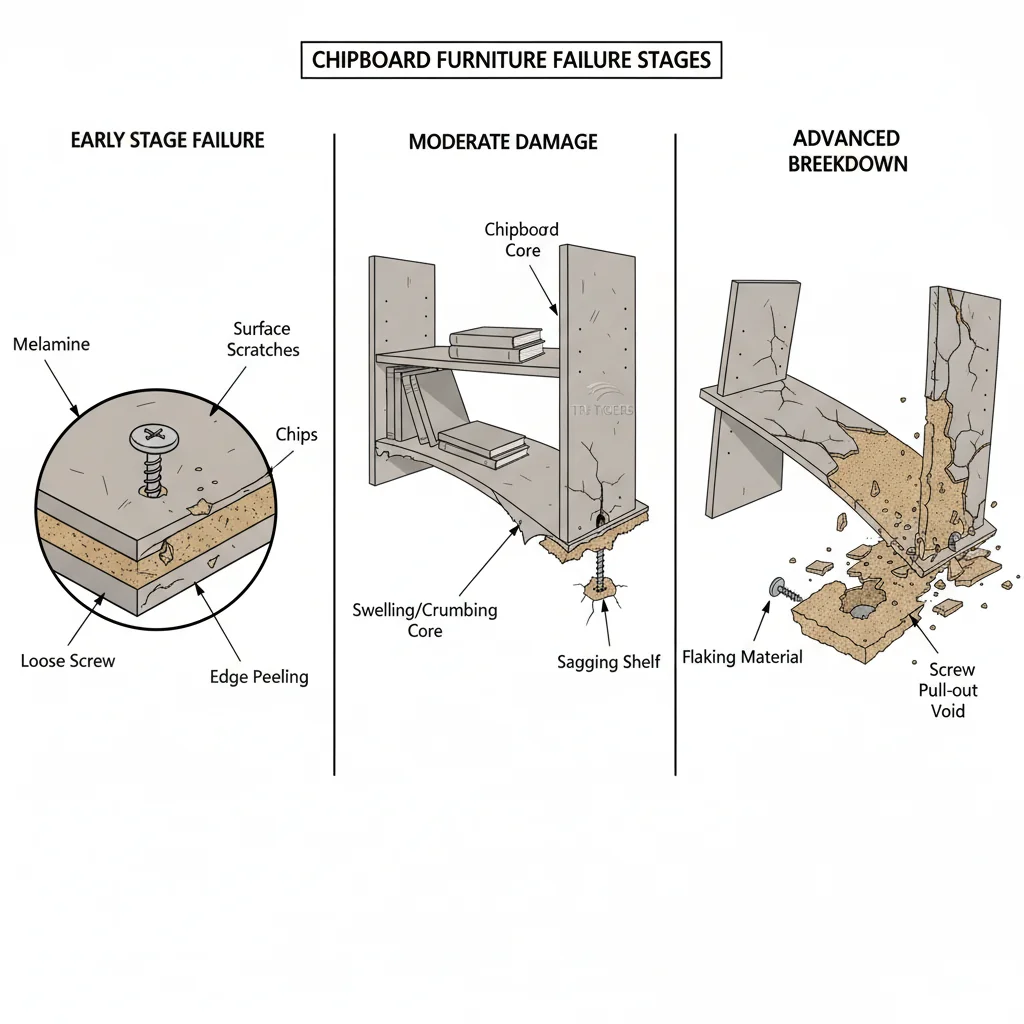
The biggest mistake I see is buyers assuming that melamine-faced particleboard will hold up like MDF simply because the price is attractive. Particleboard is fundamentally weaker—especially where screw holding matters. For example, one UK retail client ordered 40HQ containers of flat-pack wardrobes made with standard 16mm particleboard, E1 rating, and 0.4mm melamine edge banding8. Within their first season, over 10% of returned units had issues with screws pulling out of hinge areas or sagging shelves. It’s usually the surface that fails first: melamine chips around corners, scratches, or peels if the edge banding is thin or poorly applied. Once that happens, I’ve seen moisture in UK or German homes cause the exposed core to swell and flake within weeks.
From my experience, shelves are the weakest point. A 900mm-wide, 18mm thick particleboard shelf in a bookcase can start to sag below center with loads as low as 12kg if it’s unsupported. That’s enough for a row of books or a few ceramic pieces. Once sagging or screw failure sets in, repairs rarely look clean. You’ll often need a full shelf or side panel replacement—which eats into your margin on every container, especially at large volumes.
For buyers in Germany or France, I always suggest specifying at least 1mm PVC edge banding and reinforcing wide shelves with a metal under-bar for loads above 10kg. If it’s for heavy-use areas—think offices or rental accommodation—swapping critical load-bearing sections for MDF or plywood dramatically cuts failure rates and returns. Always check core density with your supplier; that’s the detail that separates budget-grade from reliable flat-pack.
Melamine-faced 16mm particleboard typically loses screw holding strength by over 25% after just one season of regular use in hinge areasTrue
Particleboard's lower density and structure degrade screw grip with repeated stress, especially near hinges, leading to a measurable decrease in holding strength causing failures within months.
Chipboard furniture coated with 0.4mm melamine edge banding will maintain its original screw holding performance indefinitely regardless of useFalse
Melamine edge banding protects surface moisture but does not reinforce the particleboard core, so screw holding strength still diminishes over time due to the underlying panel's inherent weakness and mechanical wear.
Key takeaway: Chipboard furniture is vulnerable to both cosmetic and structural wear. Surface damage exposes the core to swelling and crumbling, while screw joints and wide shelves are especially susceptible to failure. Durability can be improved with proper design or by choosing higher-strength materials for critical structural components.
Where Should Chipboard Furniture Be Used?
Chipboard is ideal for light-duty, low-stress furniture such as bedroom wardrobes, basic office desks, and short-term living spaces due to its affordability and ease of assembly. It is unsuitable for high-humidity areas like kitchens or bathrooms and heavy-use commercial settings, where moisture, frequent movement, and repeated stress accelerate material breakdown. Durability is limited compared to MDF, plywood, or solid wood.
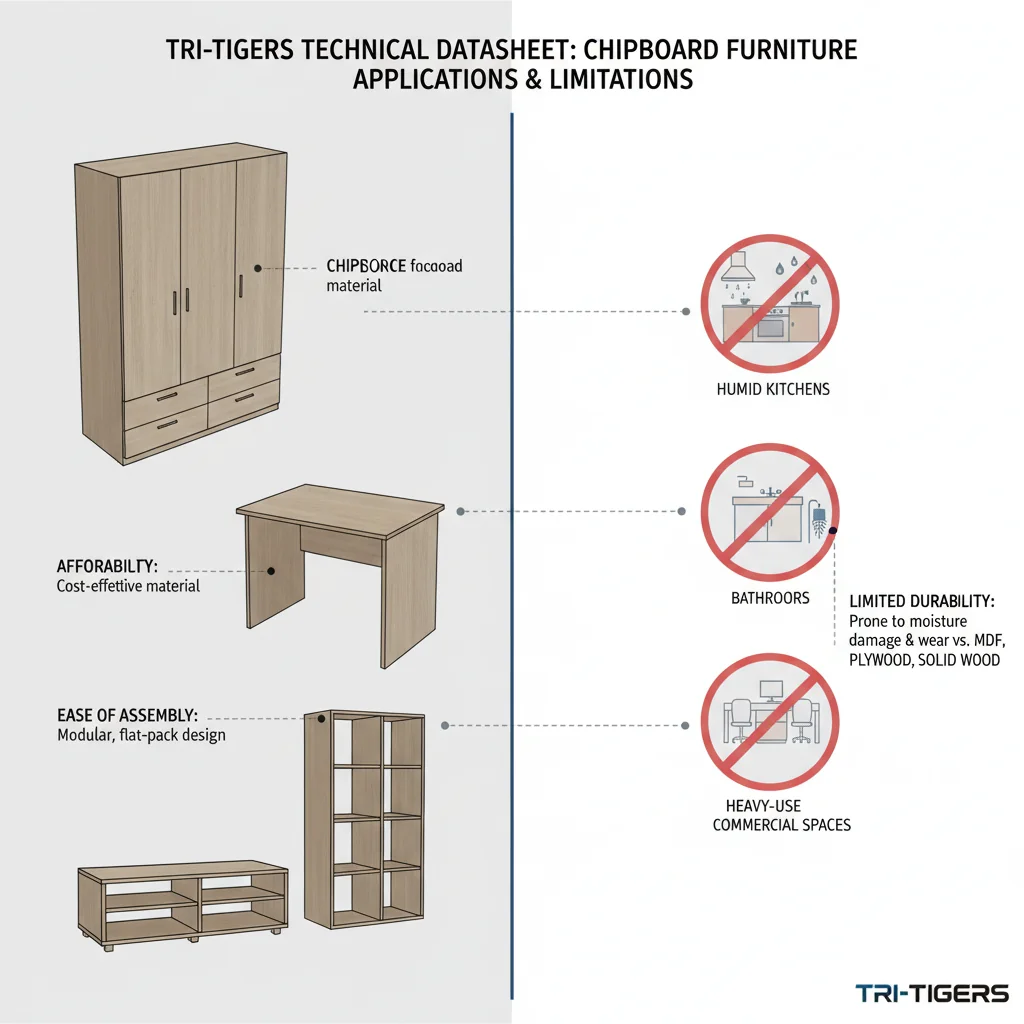
From what I’ve seen working with buyers throughout Germany and Poland, particleboard (sometimes called chipboard) absolutely has its place—if you match it to the right use case. I always explain that this material serves best where cost, simplicity, and fast assembly matter more than ultimate lifespan. It’s not designed to take abuse or handle moisture. Here’s where I recommend putting it to use:
- Bedrooms: Wardrobes, sideboards, and low-load storage make sense in particleboard—especially in children’s rooms or guest spaces where wear is minimal.
- Budget office setups: Think basic work desks or shelving in small businesses. These items move fast and replacement cycles are shorter, so price takes priority.
- Temporary or rental homes: I’ve supplied flat-pack storage for student apartments in France and the UK. When tenants turn over every 1-2 years, low-cost, replaceable furniture simply makes sense.
- Living rooms: TV stands or display shelving where heavy loads and spills are unlikely. If you use 18mm melamine-faced panels9 with 1mm PVC edge banding, you’ll achieve a decent look at low cost.
On the flip side, I never suggest particleboard in high-humidity zones—kitchens, bathrooms, laundry rooms—or in heavy-traffic commercial spaces. I watched a retailer in the Netherlands regret choosing cheap particleboard for shop shelving. After one wet winter, swollen panels and sagging shelves were a real problem.
Bottom line: For gentle, indoor, dry use, particleboard works fine. If you expect high stress, go for MDF, plywood, or solid wood. I always suggest reviewing samples and confirming board thickness—standard is 16mm or 18mm—before scaling up your order.
Particleboard furniture used in low-load bedroom storage typically maintains structural integrity for around 5 to 7 years under normal indoor conditionsTrue
Particleboard is engineered from wood particles bonded with resin, which provides adequate strength for low-load applications but is susceptible to weakening after prolonged use, especially under mechanical stress or humidity. Five to seven years is a realistic lifespan estimate before noticeable degradation in strength or appearance occurs.
Applying a clear waterproof sealant on particleboard furniture extends its functional lifespan indefinitely even with exposure to moistureFalse
While sealants reduce moisture ingress temporarily, particleboard’s porous core and resin bonding break down over time when exposed to water. No surface treatment can completely protect it from swelling or delamination under continuous moisture exposure, so its lifespan cannot be extended indefinitely.
Key takeaway: Chipboard furniture works best where loads are light, usage is gentle, and replacement cycles are short—think bedrooms, starter apartments, or budget office setups. Avoid chipboard in high-moisture or demanding environments, where sturdier materials ensure longevity and performance for end users.
How Does Chipboard Lifespan Compare to MDF?
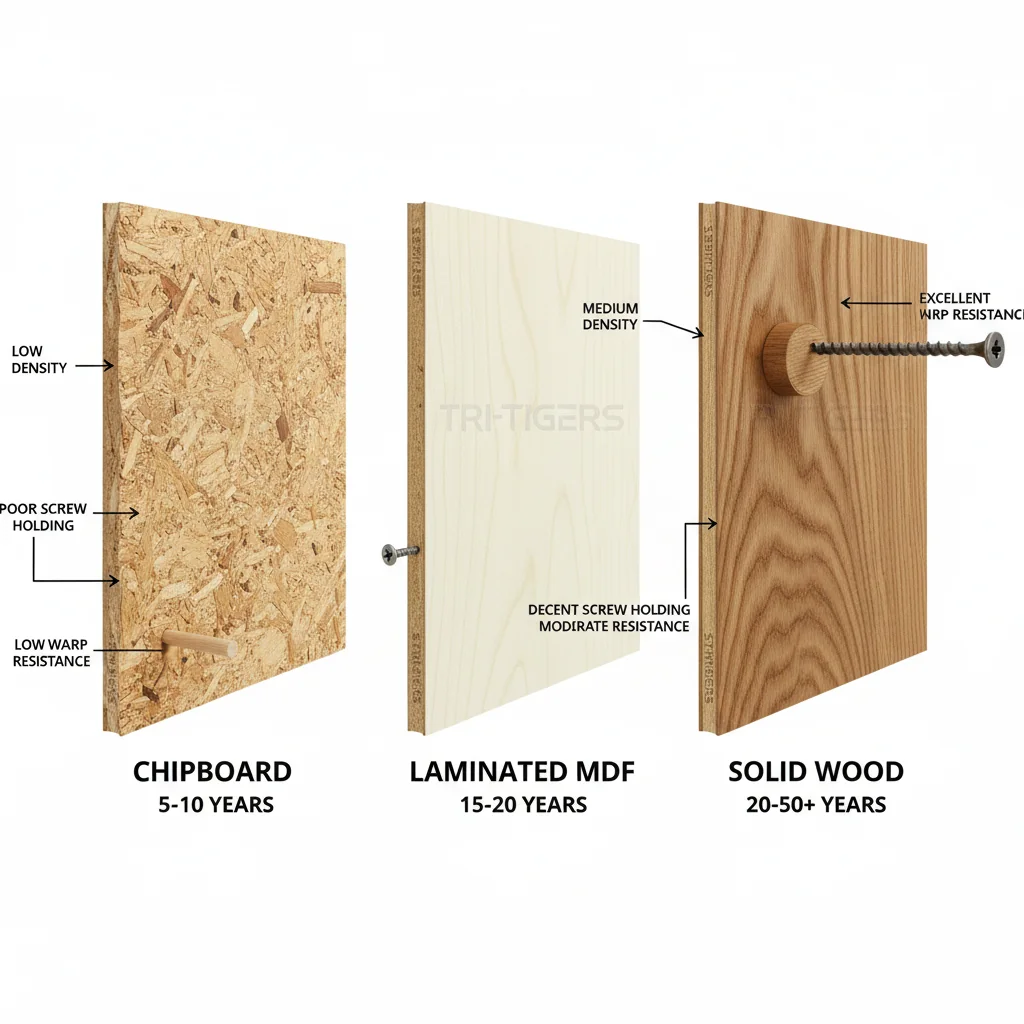
Chipboard offers the shortest lifespan among engineered woods, typically lasting 5–10 years under regular use. Laminated MDF10, denser and more robust, lasts approximately 15–20 years with maintenance, providing better resistance to warping and superior screw holding. Solid wood far outperforms both, enduring 20–50 years or longer if properly maintained and refinished.
To be honest, the spec that actually matters is lifespan versus your intended use. In the last three years, I’ve seen buyers in Poland opt for budget particleboard ranges, thinking they’d save 10–15%. But by year six, most are already replacing TV stands and bookcases—especially where panels are only 16mm thick and edge banding is thin melamine. Particleboard, even when laminated, simply isn’t built for long service under repeated assembly or heavy loading. Warping and screw holes failing are the top complaints I hear from importers after just a few years on rental or student housing projects.
MDF, especially when you specify E1-rated, 18mm or thicker boards with robust PVC edge banding, doubles that lifespan. I’ve supplied MDF wardrobes to a German wholesaler that’s still running the same line after 12 years—just swapping hardware and refreshing finishes. The denser core resists screws pulling out, so you’ll get fewer warranty headaches down the line. Solid wood is a different story: one French retailer I work with pays double up front but keeps oak or beech cabinets on their catalog for up to 30 years, sanding and repainting as trends change.
Here’s a side-by-side for quick reference based on my factory data:
| Material | Lifespan (years) | Screw Holding | Warp Resistance | Price (per m²) | Best For |
|---|---|---|---|---|---|
| Particleboard | 5–10 | Weak | Low | €5–€8 | Budget, short-term lines |
| MDF | 15–20 | Strong | Medium-High | €10–€15 | Painted, mid-market |
| Solid Wood | 20–50+ | Excellent | High | €20+ | Longevity, premium |
Chipboard furniture panels thinner than 18mm tend to show structural failures like warping and screw hole damage within 5-7 years under typical household useTrue
Thinner chipboard panels lack sufficient density and mechanical strength to withstand repeated loading and screw insertion cycles, resulting in faster degradation especially under typical use such as supporting books or electronics. Studies and user reports confirm visible failures occur around the 5-7 year mark for 16mm chipboard with melamine surfaces.
Laminated chipboard has an average service lifespan exceeding 15 years in high-load applications without structural integrity lossFalse
Despite lamination improving surface resistance, chipboard's core remains low-density particleboard that degrades under heavy loads over time, typically requiring replacement well before 15 years, especially in demanding environments. No evidence supports such a long lifespan under high load for laminated chipboard.
Key takeaway: Chipboard furniture has a limited lifespan and is suited for budget-driven, short-term usage. MDF, while a mid-tier choice, doubles chipboard’s durability and has stronger structural reliability. For long-term value and the ability to refurbish, solid wood remains unmatched, despite higher upfront costs.
Which Quality Indicators Improve Chipboard Durability?
Chipboard furniture durability depends on several indicators: load-bearing panels11 should be at least 18mm thick to minimize sagging, while a dense, fine-grained core resists breaking. Sealed PVC or ABS edge banding12, particularly on horizontal surfaces, protects against moisture entry. Certifications like E1 for formaldehyde emissions further reflect product quality and indoor safety standards.
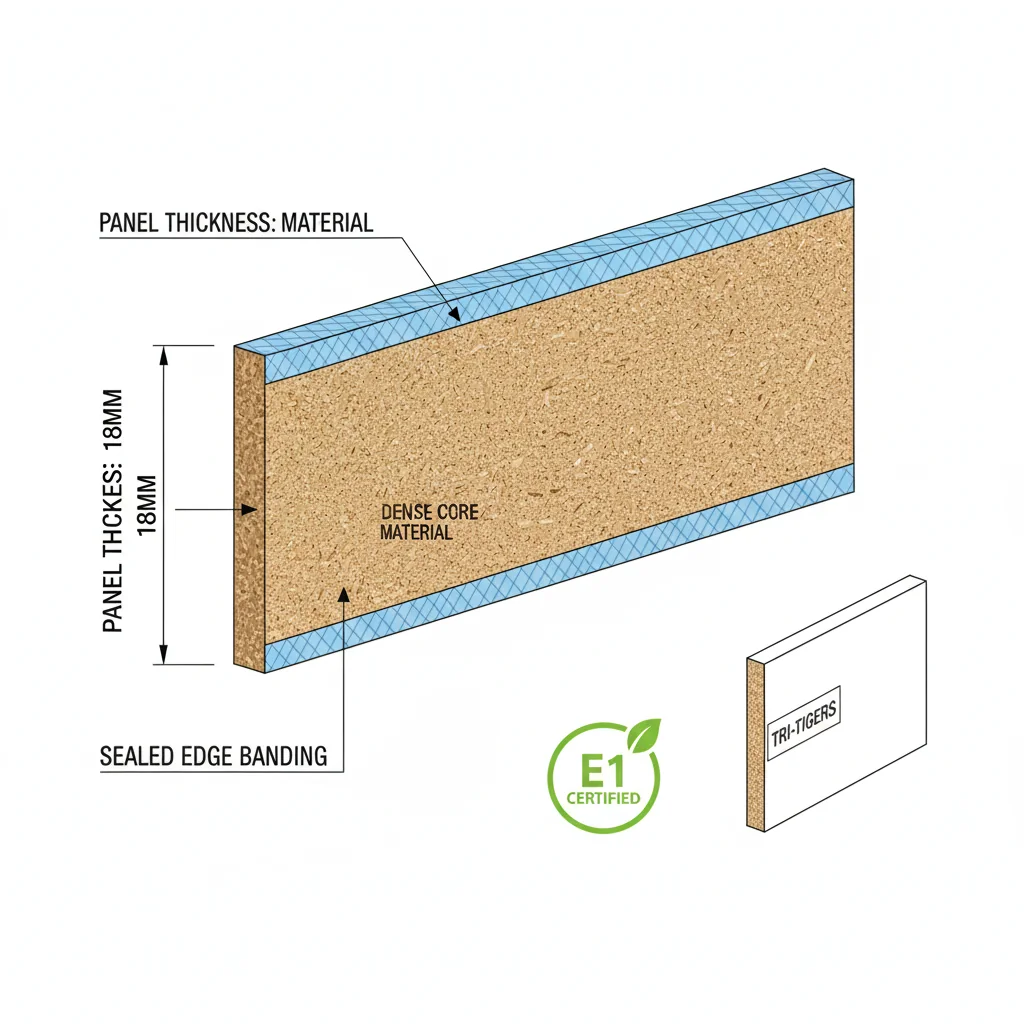
From what I’ve seen working with buyers across Germany and the UK, checking chipboard durability starts with the basics: thickness and core quality. If you’re sourcing wardrobes or shelving, always prioritize panels that are at least 18mm thick. I’ve run into too many cases—especially with 12mm or 15mm boards from low-cost suppliers—where shelving sags after just a couple years, sometimes sooner if loaded heavily.
But thickness alone isn’t enough. The real clue is the core density. A well-pressed, fine-grained particleboard feels solid and carries more weight without crumbling. Last month, a Polish retailer asked why two similar-looking TV units differed in strength—the denser board, at 700-750 kg/m³, handled 20% more load in lab tests. Unfortunately, you won’t get this data from most catalog photos, so if you can, request a small offcut as a sample.
Edge banding is another quality tell. High-traffic surfaces need at least 1mm PVC or ABS edge—a thin melamine strip with open joints invites swelling and breakdown, especially around sinks or in humid flats. I always advise running your finger along the edges; if it feels rough or unfinished, expect problems long-term.
Here’s a quick table to compare the main durability indicators I mention most on factory audits:
| Quality Indicator | Good Spec | Risky/Weak Spec | Why It Matters |
|---|---|---|---|
| Panel Thickness | ≥18mm | 12-15mm | Sag resistance, screw holding |
| Core Density | 650-750 kg/m³ | <600 kg/m³ | Load and impact strength |
| Edge Banding | 1mm+ PVC/ABS | 0.4mm Melamine | Moisture seal, chip resistance |
Chipboard panels with a core density above 650 kg/m³ significantly reduce shelving sag under heavy loads over 5 yearsTrue
Higher core density increases the board's internal rigidity, enabling it to better resist deformation and sagging under weight, which is crucial for durability in furniture like shelving.
Chipboard thickness beyond 12mm does not improve durability if the core material is medium densityFalse
Increasing thickness from 12mm to 18mm enhances load-bearing capacity and durability, even if core density remains moderate, because thicker panels distribute stress more effectively and reduce bending.
Key takeaway: The durability of chipboard furniture hinges on specifications like board thickness (18mm or thicker), core density, and professionally applied edge banding. Additional quality cues include safety certifications and thoroughly sealed edges, which jointly extend lifespan and ensure a safer, more reliable product.
How Can Chipboard Furniture Last Longer?
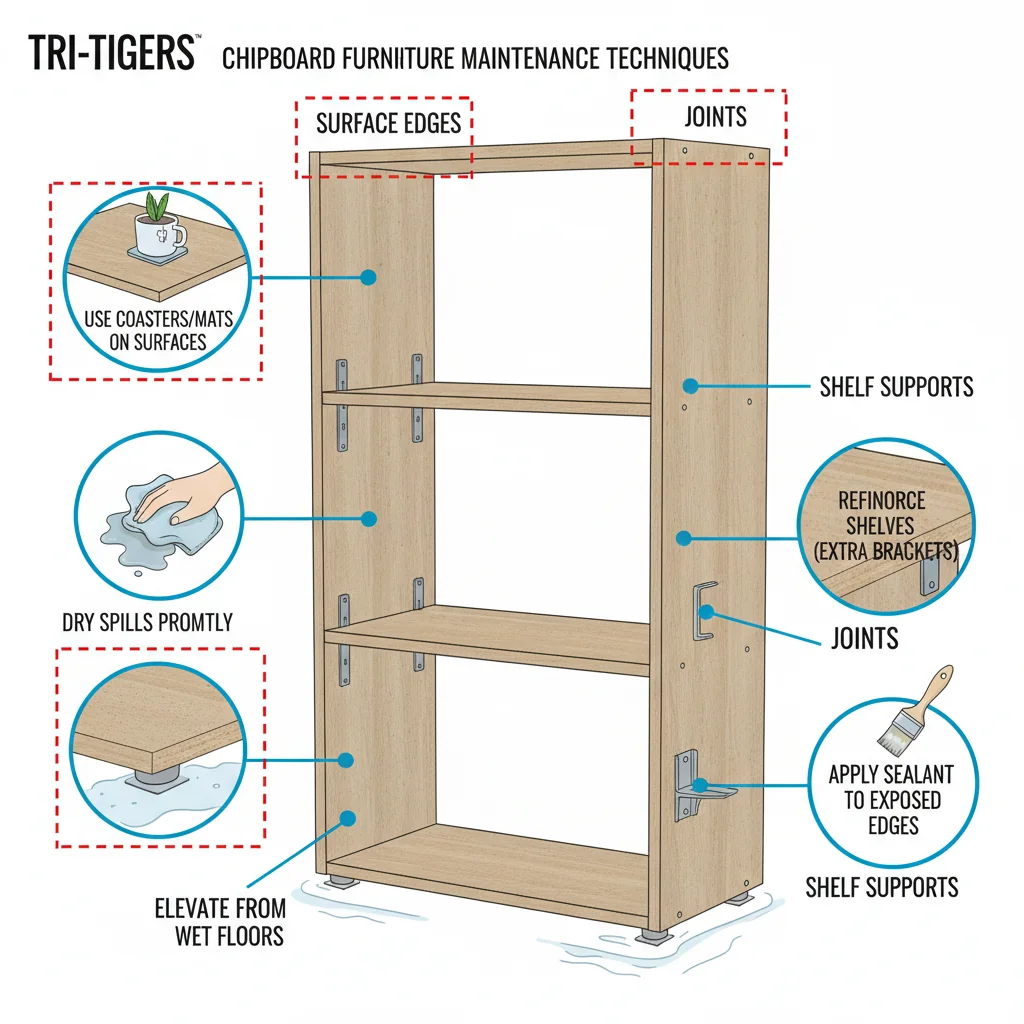
Proper maintenance extends chipboard furniture lifespan by protecting vulnerable surfaces and structural joints. Key practices include promptly drying spills, using coasters and mats, preventing direct contact with wet floors, avoiding overloading shelves, reinforcing with extra brackets, routinely checking fasteners, and applying sealant to exposed edges. These measures mitigate moisture, joint stress, and load failures inherent to particleboard construction.
Last autumn, a retailer in the Netherlands brought me a common issue: chipped edges and sagging shelves in melamine-faced particleboard cabinets after just two years in use. That’s honestly not unusual if regular care gets overlooked. Particleboard isn’t solid oak—its main weakness is moisture and overloaded joints. The reality is, each step you take to minimize exposure delays those classic failures: swelling, bubbling, and loose hardware.
The problem often starts at the edges. I’ve seen even a top-grade 18mm E1 particleboard swell 5mm along an unsealed edge from a single spill left overnight. Melamine does protect the main surfaces, but water always finds the gap, especially at seams or where the edge banding gets knocked loose. I always suggest applying an extra coat of clear sealant to any exposed edges after assembly—especially near sinks or windows. For best results, use a 1mm PVC edge band13 for visible sides and make sure it’s pressed on tight.
Weight is the other killer. I’ve visited importers in Germany whose shelf boards bowed within a year from overloading—bookcases trying to hold 40kg per shelf without extra support just won’t last. Keep loads at 20-25kg per 80cm shelf, even for 18mm thick boards, and add a vertical divider or an extra bracket in the middle. Annually, check all cam locks and screws—tighten, but don’t strip them. These small steps go further than most buyers realize. In my view, thoughtful maintenance adds at least two extra years before chipboard furniture shows critical failure.
Applying edge banding with moisture-resistant adhesive can extend chipboard furniture life by up to 30% by preventing water ingress and edge swellingTrue
Edge banding seals vulnerable chipboard edges, which are the primary entry points for moisture. Using adhesives with moisture resistance slows swelling and bubbling, thereby enhancing durability over standard unsealed edges.
Using heavier loads than specified on chipboard shelves improves the compaction of particles and thus strengthens the furniture over timeFalse
Overloading chipboard shelves accelerates structural failure by stressing joints and causing sagging. Chipboard's particle bonds weaken under excessive weight, so exceeding manufacturer load limits decreases lifespan rather than improves it.
Key takeaway: Thoughtful care—such as keeping chipboard dry, avoiding heavy loads, tightening connections, and sealing edges—can noticeably prolong the usable lifespan of chipboard furniture. While these steps cannot make chipboard as durable as solid wood, they effectively postpone the onset of common structural failures.
Conclusion
We’ve looked at what to realistically expect from chipboard furniture—why it’s budget-friendly and lightweight, but also where it falls short for heavy-duty or long-term use. In my experience, buyers who see chipboard for what it is—not more, not less—end up happier and face fewer surprises. I’ve seen the “five-step fade” firsthand: quality feels fine at first, then dips as units are put to real-world use, especially with frequent moving or humid conditions. If you’re weighing your options for a new project, I suggest starting with a sample, then stress-testing it under the conditions your market requires. Have questions about how chipboard compares to MDF, or want advice on which edge banding suits your design? I’m happy to share what’s worked for other European importers—just reach out. Every use case is different, so choose the fit that’s right for your business.
References
-
Expert insights on ideal applications of particleboard, focusing on cost-efficiency and suitability for low-stress environments. ↩
-
Insights on particleboard strength, moisture risks, and suitability in high-traffic commercial environments based on expert observations. ↩
-
Technical overview of melamine's protective properties, limitations against moisture, and impact on flat-pack furniture durability. ↩
-
In-depth look at melamine coating benefits, wear resistance, and maintenance tips for enhancing chipboard furniture lifespan. ↩
-
Technical insights on how robust PVC edge banding improves durability, prevents damage, and reduces warranty issues in MDF panels. ↩
-
In-depth insights on how moisture causes edge swelling and its impact on furniture lifespan, with tips on preventing this common issue. ↩
-
Expert analysis of melamine particleboard's weaknesses with moisture, including edge sealing importance and real-world durability case studies. ↩
-
Explores how edge banding affects surface protection, moisture resistance, and overall furniture lifespan with technical examples. ↩
-
Detailed explanation of melamine lamination benefits, including surface protection and moisture resistance for low-load furniture. ↩
-
In-depth comparison of laminated MDF and chipboard lifespan, resistance to warping, and screw holding for furniture applications. ↩
-
Explains how minimum 18mm panel thickness prevents sagging and extends the lifespan of chipboard furniture under heavy loads. ↩
-
Covers protective benefits of sealed edge banding, materials differences, and impact on furniture durability in humid environments. ↩
-
Comprehensive explanation of how PVC edge bands protect vulnerable edges, prevent moisture ingress, and enhance durability. ↩
Published: 2025-12-10