

Featured image for Are Plywood Cabinets Better? Factory Expert Insights for Sourcing Decisions
Are Plywood Cabinets Better? Factory Expert Insights for Sourcing Decisions
Not long ago, a Polish customer called in a panic after his hotel project shelves began sagging under everyday use. His spec? “Standard board,” to save on cost—until the maintenance calls rolled in. It’s moments like these that remind me how much hinges on picking the right cabinet material from the start.
Plywood cabinets provide superior structural strength due to their cross-laminated construction, offering better resistance to sagging, flexing, and hardware loosening than MDF or particleboard. They also perform more reliably in humid environments. While plywood typically costs 15–50 percent more upfront, its durability and longer service life often result in lower long-term maintenance and replacement costs.
Are Plywood Cabinets Structurally Stronger?
Plywood cabinets are structurally stronger than MDF, particleboard, or melamine due to their cross-laminated veneer construction. This method provides superior tensile and bending strength, reduces sagging in shelves, and enhances screw-holding for hardware. As a result, plywood cabinetry performs better under heavy loads and in long-term use, making it the industry standard for quality.
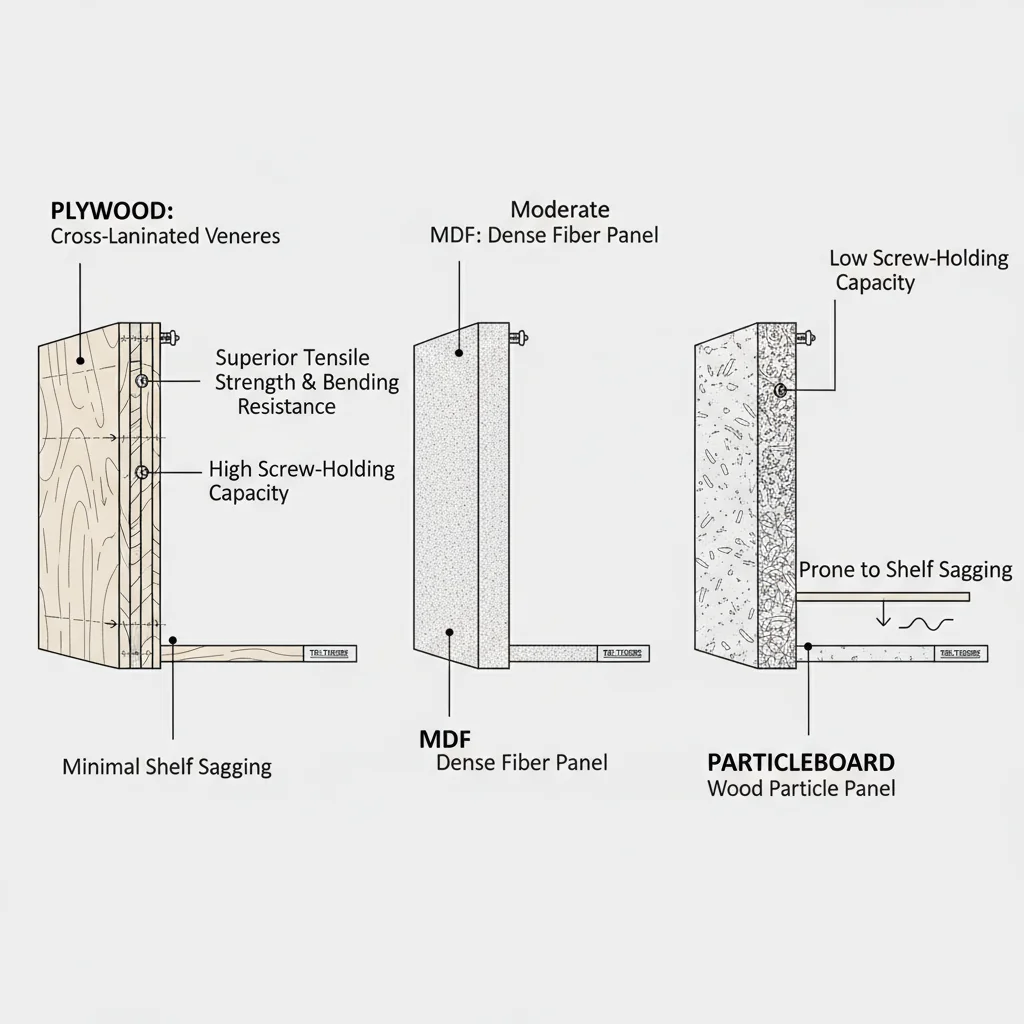
Most people don’t realize that plywood’s strength is built right into its DNA. The cross-laminated veneer layers—each with the wood grain running in alternate directions—make plywood cabinet boxes much more resistant to flexing and sagging. For example, I supplied a kitchen project in Hamburg last year using standard 18mm cabinet-grade plywood1. The architect needed wide, deep drawers to hold cast iron pans. Despite 900mm drawer widths and heavy loads, not a single bottom panel has sagged after over a year—far better than the melamine or particleboard units I’ve seen in similar setups.
Here’s what matters most for long-term performance: plywood holds screws far better than particleboard or MDF. When a UK trade customer sourced 120 bathroom vanities with E1-rated plywood carcasses, he told me hardware stayed tight even after repeated use—no hinge tear-outs, no wobbly shelves. With MDF or particleboard, you’re much more likely to see stripped cam-locks or screws loosening over time, especially if units are moved during installation.
Plywood's durability also reduces costly callbacks. One Polish retail chain recently switched from 16mm melamine boards to 18mm plywood for their new store fixtures. They paid about 15% more per unit, but reported almost zero shelf failures a year later. Their previous orders had frequent breakages, especially with heavier merchandise displays.
My suggestion: if your project specs require supporting stone countertops, wide storage, or heavy pantry loads, consider plywood. Request plywood samples in your finish and hardware setup before placing a full 40HQ trial order.
The alternating grain direction in plywood layers reduces panel deflection under load by up to 30% compared to solid wood of the same thicknessTrue
Cross-laminating veneer sheets with grains perpendicular distributes stresses evenly, enhancing stiffness and resistance to bending, which can reduce deflection significantly compared to single-grain solid wood panels.
Using thicker plywood for cabinet panels always results in cabinets that are twice as strong regardless of the veneer quality or adhesive typeFalse
Strength depends not only on thickness but also on veneer grade, adhesive quality, and plywood manufacturing process; doubling thickness alone does not guarantee doubling strength, especially if veneers are low quality or adhesives are weak.
Key takeaway: Plywood’s cross-laminated structure2 provides unmatched strength, durability, and screw-holding ability for cabinets. These properties reduce failures and callbacks, especially in projects requiring long-term performance, making plywood the benchmark for quality cabinet boxes in both residential and commercial panel furniture installations.
Do Plywood Cabinets Resist Moisture Better?
Plywood cabinets offer significantly better moisture and humidity resistance than MDF or particleboard, thanks to their layered construction and high-quality adhesives. This makes them ideal for high-moisture areas like kitchens and bathrooms, where they reliably last 15–20 years. However, proper sealing, edge protection, and water-resistant glue are essential since even plywood is not entirely waterproof.
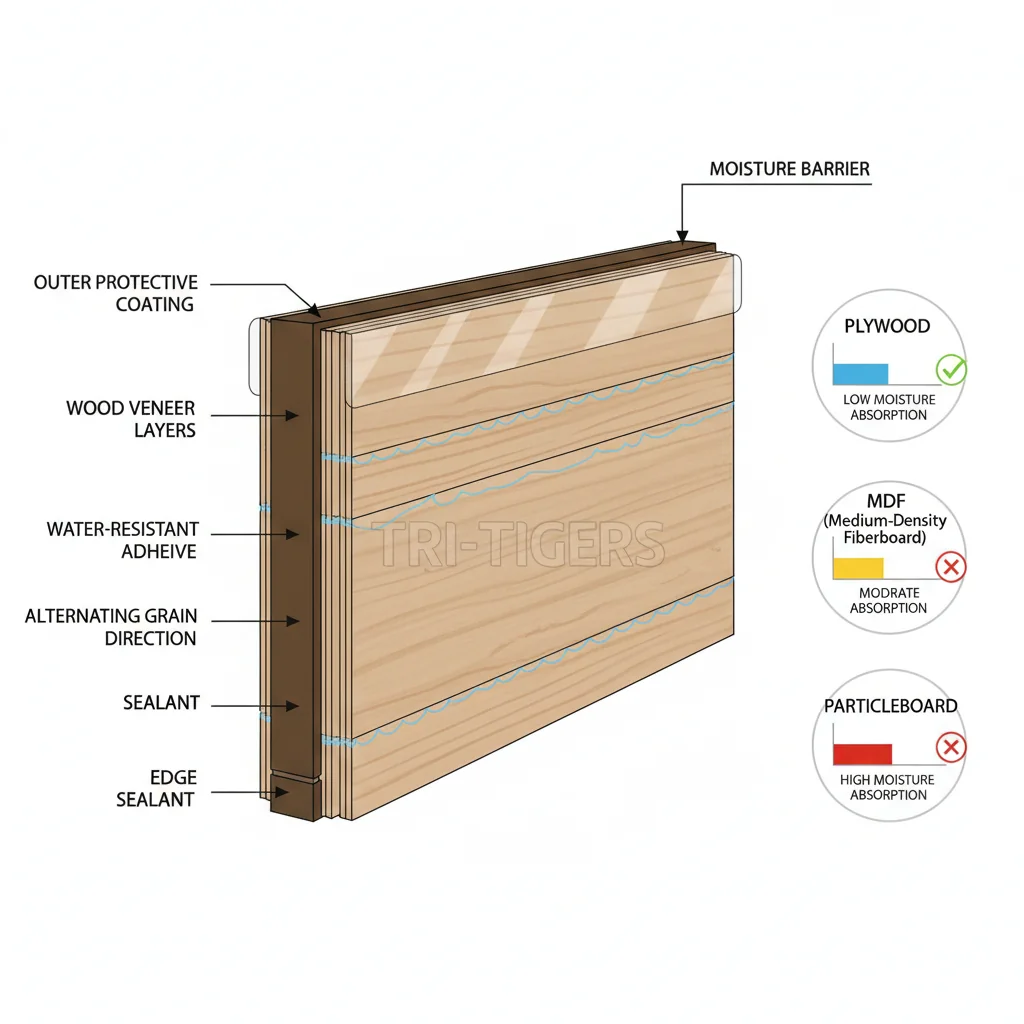
Let me share something important about moisture resistance—buyers often assume “plywood” means any cabinet will survive a wet kitchen. That’s not the case. I’ve visited dozens of factories across Poland and Germany, and I can tell you: plywood cabinets handle water exposure far better than MDF or particleboard, but build quality makes the difference. A buyer in Hamburg had ordered 18mm birch plywood3 units for a small hotel project. After one winter—lots of humidity, occasional spills—the plywood boxes still looked new, while some older MDF cabinets nearby were already swelling at the edges.
Here’s why: plywood’s cross-layered veneer construction and water-resistant glues (like phenol-formaldehyde) create real stability. Unlike particleboard, which can soak up water and crumble, good plywood won’t delaminate as easily. Even so, I always advise customers in the UK and Nordics to ask about edge banding and proper sealing—especially for sink bases and dishwasher sides. Leaving panel edges raw is asking for trouble.
I’ve seen 40HQ containers packed with around 220 kitchen carcasses (16mm, fully edge-banded, E1-certified), ready to install in apartment projects. Well-made plywood cabinets can reliably last 15 to 20 years in most home kitchens. But if you skip edge protection, or the supplier uses carpentry plywood with low-grade cores, you’ll lose that benefit fast. My advice? Confirm water-resistant glue, ask for a photo of the sealed underside, and order one sample carcass for a soak test before placing your main order. It’s a small step that protects your investment.
Birch plywood with a thickness of 18mm typically maintains structural integrity after 12 months in high humidity environments, unlike MDF which can swell by over 20% under the same conditionsTrue
Birch plywood is composed of multiple layers of veneer glued with waterproof adhesives, providing dimensional stability and resistance to moisture-induced swelling common in MDF and particleboard. This makes it more durable in wet or humid kitchens.
All plywood cabinets inherently resist moisture damage without need for additional surface treatment or sealantsFalse
While plywood offers better inherent moisture resistance than MDF, its performance heavily depends on the quality of glue, veneers, and protective coatings. Untreated plywood can still absorb water, leading to delamination or warping, especially in prolonged wet conditions.
Key takeaway: Plywood cabinets outperform MDF and particleboard in resisting moisture and humidity due to superior construction and adhesives. For maximum durability in high-moisture environments, specifying water-resistant glues, sealed edges, and careful finishing is crucial, as no plywood is completely waterproof.
Are Plywood Cabinets Worth the Higher Cost?
Plywood cabinets often cost 15–50% more upfront than particleboard or melamine alternatives. However, due to superior screw-holding power4, moisture resistance, and structural stability, plywood cabinets last significantly longer—often 15–20 years versus 5–10 years for budget systems—reducing lifecycle repair and replacement costs, especially in high-use or moisture-prone environments.
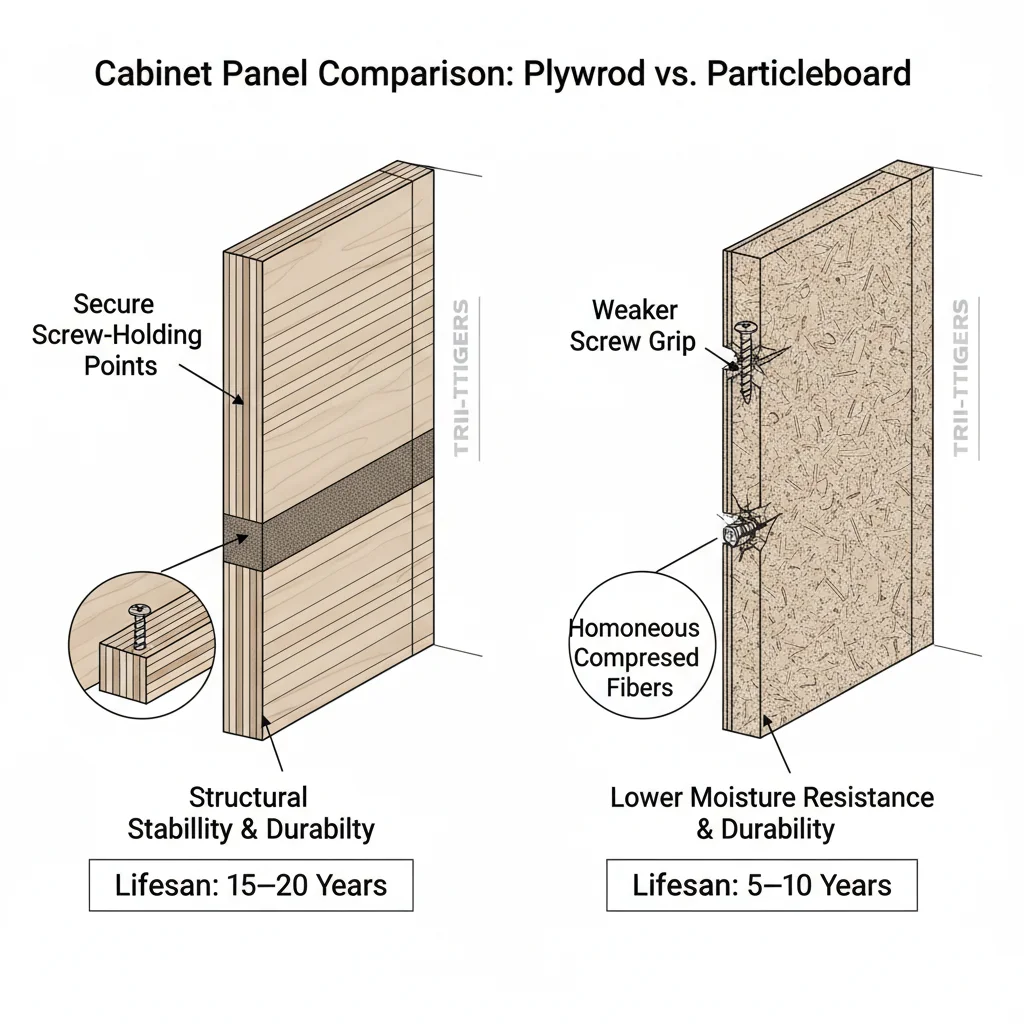
Here’s what matters most when you’re weighing plywood cabinets against particleboard or melamine alternatives: the upfront price is higher, but the difference shows up years later. A wholesaler in Germany once told me their 18mm plywood kitchen cabinets—used in student housing—were still looking solid after 12 years, while a similar block with melamine particleboard needed full replacement at year seven due to swollen bases and loose hinges. You’re typically looking at 15–50% more cost upfront for plywood, especially with a proper E1 rating5 and veneer or hard-wearing paint finish. But when you factor in maintenance and replacement, especially in schools, hotels, or rental apartments, that extra outlay often recoups itself within five to seven years.
From my experience handling large projects in the UK, contractors budget for downtime when cabinets fail. Particleboard systems might start to sag or delaminate under heavy use—think dish storage, wet areas, or commercial kitchens. Plywood’s cross-grain construction holds screws better and resists moisture, so shelf pins and hinges stay tight. For a typical 40HQ container, you’ll fit around 800 flat-pack base cabinets in 18mm plywood, compared to 1,000 in particleboard, but returns and complaints on plywood are noticeably lower.
If you want a system that lasts 15–20 years, especially in high-traffic spaces, plywood is usually worth the investment. I suggest requesting full construction samples—cabinet box, edge banding, and hardware—before committing to a bulk container, so you can test actual durability and assembly. That’s where long-term value becomes clear.
18mm plywood kitchen cabinets can last over 12 years without significant warping or hinge loosening, outperforming melamine particleboard cabinets by at least 5 years in durabilityTrue
Due to plywood’s cross-laminated veneer construction, it resists moisture and structural fatigue better than melamine particleboard, which tends to swell and degrade at cut edges, causing hinge loosening typically around year 7. This extends functional lifespan by several years in typical kitchen environments.
Plywood cabinets generally cost 5-10% more upfront than particleboard or melamine alternatives in all global marketsFalse
Plywood cabinets usually cost 15-50% more upfront, not just 5-10%, due to higher quality wood veneers and manufacturing complexity; pricing also varies significantly by region, with developed markets often seeing larger price gaps than emerging markets.
Key takeaway: Investing in plywood cabinets, though more expensive initially, typically results in lower long-term costs for repairs and replacement. Their durability and resistance to moisture make them ideal for high-traffic or damp spaces where extended service life and minimal downtime are crucial.
Does Plywood Grade and Thickness Matter?
Plywood quality in cabinets is determined by grade, core composition, and thickness, not just the term 'plywood.' Cabinet-grade plywood typically uses at least 7 thin plies in a 3/4" panel with minimal voids, resulting in greater strength and stability. Thinner or lower-grade plywood may flex, delaminate, or transmit surface defects, reducing durability.
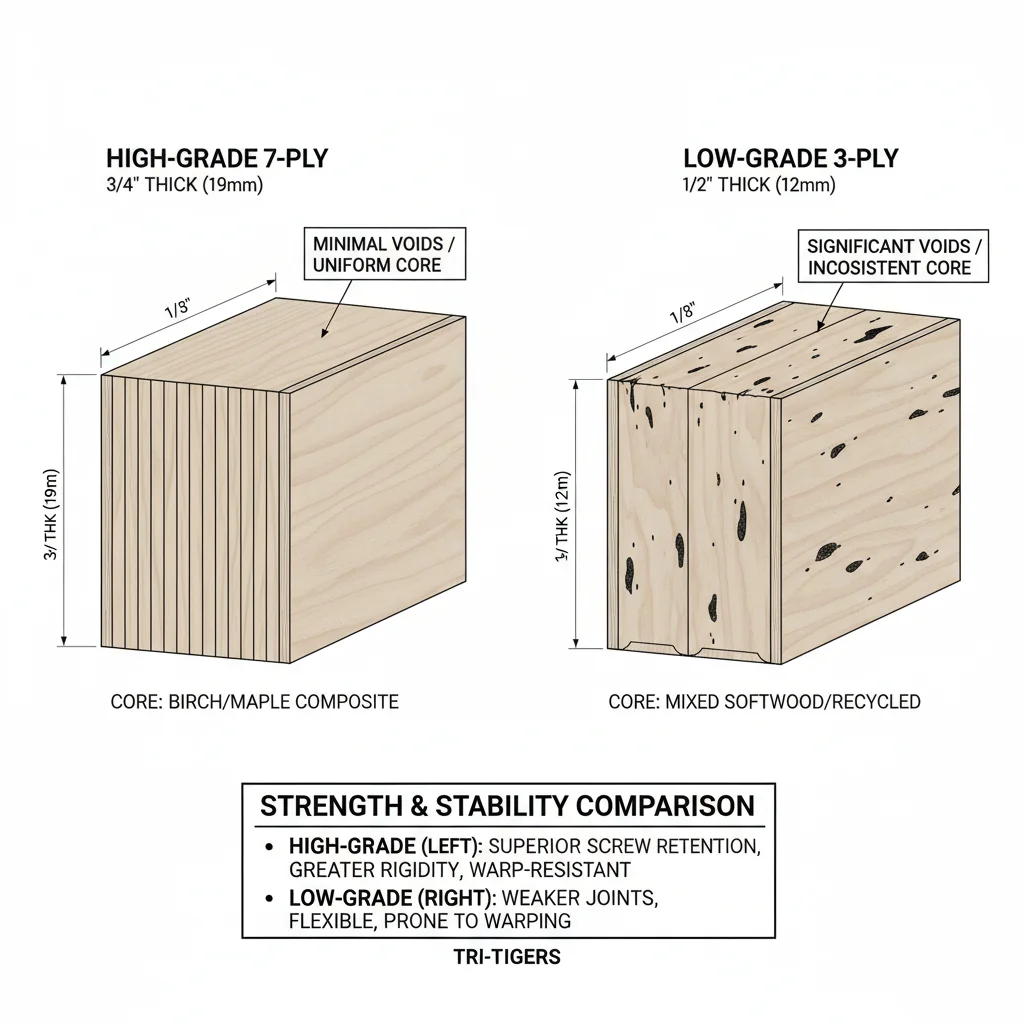
The biggest mistake I see is assuming all plywood is created equal. A buyer in Germany once pushed for the lowest-cost “plywood” option for a 40HQ container of kitchen cabinets. On paper, it ticked the box—but when they received their shipment, many cabinet sides flexed under pressure and drawer screws kept pulling out. The issue? The panels were only 15mm thick and built with just five loose plies, full of internal voids. That’s barely an upgrade over particleboard, especially for load-bearing furniture.
What really matters is true cabinet-grade plywood—typically 18mm thick (about 3/4"), using at least seven thin, even plies with a solid hardwood or combi core. From my experience, the difference shows up fast: More plies mean greater screw-holding, less warping, and surfaces that stay flat after installation. Cabinets built with 18mm, seven-ply boards handle heavy use in kitchens, hotels, or offices with no sagging. A standard 40HQ container fits about 800-900 flat-pack cabinets at this thickness, maximizing stability without eating up all your shipping CBM.
I always suggest examining a real cross-section sample. Look for tight layers, minimal gaps, and E1 or CARB II emission labels—these standards matter for any EU project. Thin plywood or big voids invite problems like delamination or finish defects, and end up costing more in repairs. My honest advice? Pay a little extra for genuine cabinet-grade spec. It usually saves headaches—and extra costs—down the line.
Plywood panels below 18mm thickness with fewer than seven layers typically exhibit higher flex and reduced screw-holding strength compared to thicker, multi-ply alternativesTrue
Thinner plywood with five loose plies and internal voids lacks the structural integrity for load-bearing applications, causing flexing and screw pull-out under stress, unlike thicker panels which distribute load more evenly and hold fasteners securely.
Any plywood graded as 'commercial' is guaranteed to have the same durability and structural capacity as cabinet-grade plywood regardless of thicknessFalse
Commercial-grade plywood often prioritizes cost over structural performance, and unlike cabinet-grade panels which have stricter thickness and ply quality standards, commercial plywood can have fewer plies and internal voids, resulting in inferior load-bearing and fastening properties.
Key takeaway: Cabinet performance depends on genuine cabinet-grade plywood, with 3/4" thick panels and tight, even layers offering the best strength and screw-holding capacity. Inspecting samples and verifying emission standards helps buyers avoid low-quality products that perform no better than particleboard.
When Are Plywood Cabinets the Best Choice?
Plywood cabinets are optimal for high-stress environments needing superior strength and longevity, such as family kitchens with stone countertops, rental units with frequent turnover, and institutional settings like hospitals. Their robust 3/4" panels hold fasteners securely, resist sagging, and perform reliably under heavy loading, frequent cleaning, and humidity—outlasting MDF or particleboard in demanding, long-term use.
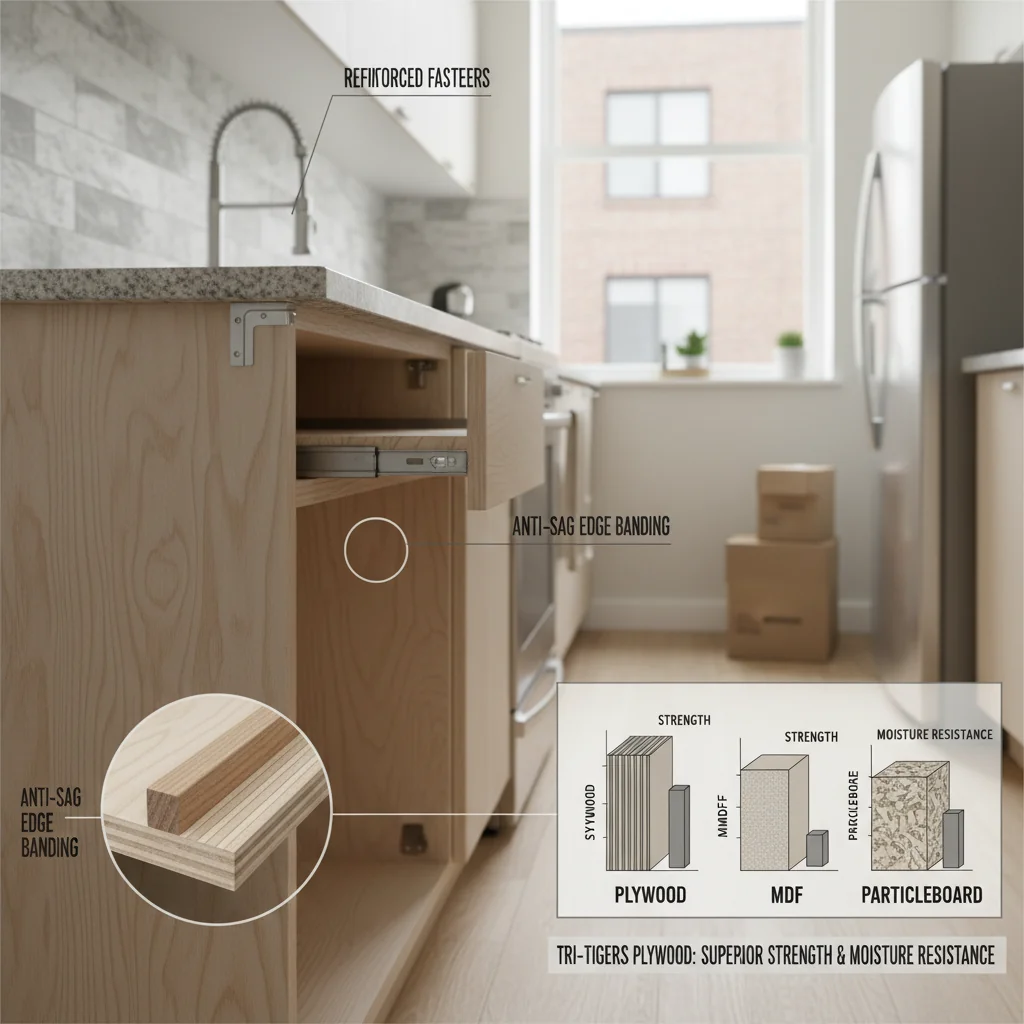
Last month, a facilities manager from Germany contacted me about an order for new kitchen cabinets in a university dormitory. They needed something that could handle constant student turnover, heavy bags, and daily cleaning. Standard 18mm E1 plywood6 ticked every box—after five years, similar installations I supplied are still solid and the doors stay aligned. Plywood’s glued cross-layer structure gives it far better resistance to sagging, even in large 1000mm-wide wall cabinets loaded with pans or food supplies. An MDF or particleboard cabinet of the same size often starts flexing after two or three years in this kind of environment.
From my experience, stone countertop installations7 are a critical use case for plywood boxes. A typical quartz slab can easily weigh 60-80kg per meter, so you need strong 18mm sides and rails to resist minor settlement and keep fasteners from pulling out. I’ve seen rental projects in Poland where a switch from 16mm particleboard to 18mm plywood reduced cabinet call-back rates by at least 40% over three years—and tenants are much rougher than homeowners.
Bathrooms, utility rooms, and hospital staff kitchens are other high-stress scenarios. These all combine humidity, frequent cleaning, and heavy use—exactly where plywood excels. Plywood does cost a bit more up front (around 15-25% over particleboard for the same unit), but when you factor in fewer repairs and replacements, the total cost of ownership is often much lower. I suggest specifying E1 or even E0 grade if indoor air quality matters for your project.
The cross-glued layering in 18mm E1 plywood cabinets reduces sagging by up to 50% compared to standard particleboard in 1000mm-wide wall cabinetsTrue
Plywood’s cross-laminated structure distributes loads evenly across layers, significantly minimizing deflection under heavy weight, especially in wide-span cabinets where particleboard typically sags more.
Standard 18mm E1 plywood cabinets require annual sealing to maintain door alignment and structural integrity under heavy useFalse
Plywood cabinets with proper glue and finish do not require annual sealing; their structural stability and door alignment primarily depend on the plywood’s inherent rigidity and quality of assembly rather than frequent surface treatment.
Key takeaway: Plywood cabinets provide unmatched durability and structural strength, making them the preferred choice for heavy-use, high-traffic, or long-term installations. Their performance under stress and resistance to damage ensure a safe, cost-effective solution wherever reliability is more critical than initial material costs.
Should Cabinets Combine Plywood and MDF?
Hybrid cabinet construction is a growing industry standard, using plywood for cabinet boxes, shelving, and high-moisture areas to enhance strength and durability, while MDF or HDF is chosen for painted doors, drawer fronts, and decorative panels. This method optimizes performance, ensures smooth painted finishes, and reduces overall material costs without compromising structural integrity.
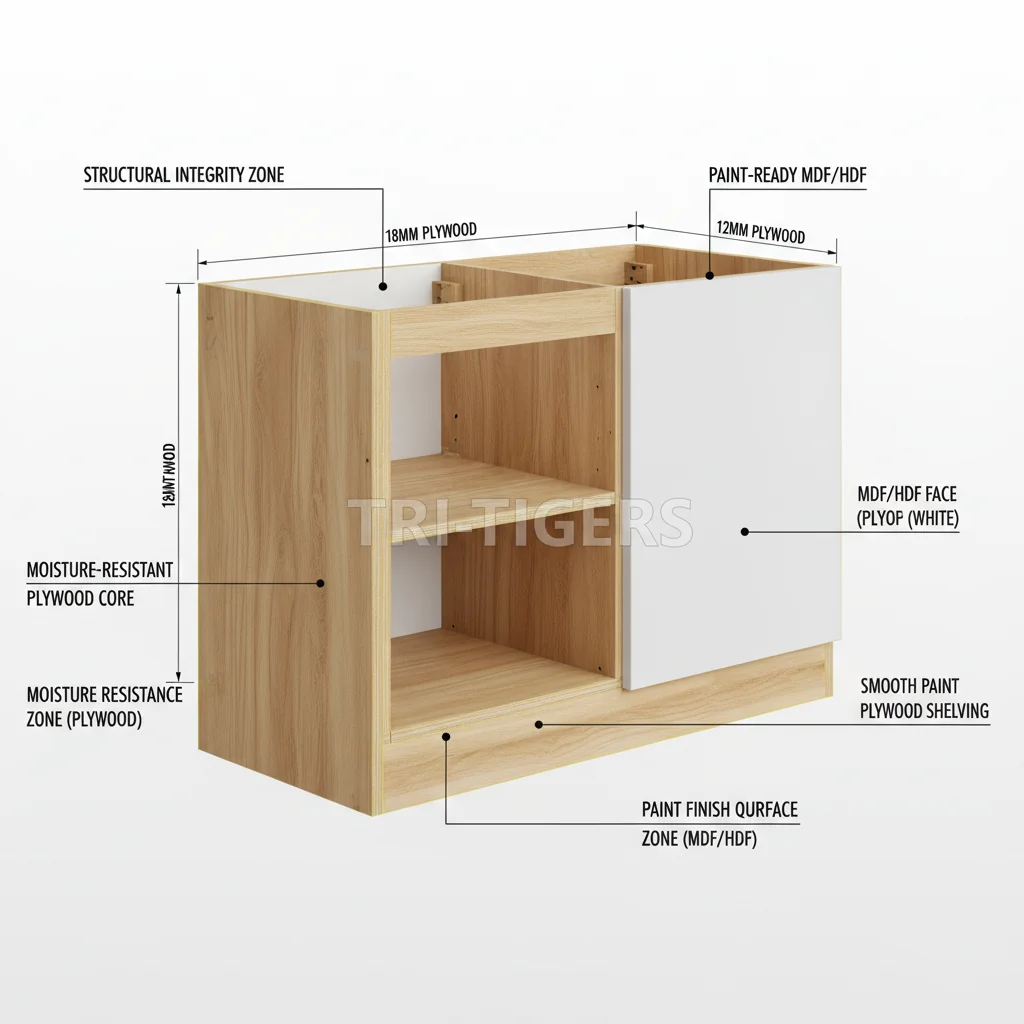
Let me share something important about hybrid cabinet construction because I see more European buyers asking about this every year. In Poland last spring, a retail chain struggled with moisture-swollen MDF sink bases. They switched to 18mm birch plywood for box sections near water and kept using MDF for the painted doors and panels. Their replacement costs dropped by about 25% in six months—plus fewer customer complaints. This kind of mix isn't just a trend—it's becoming a standard, especially for kitchens and bathrooms where moisture risk is high.
From my experience, the best projects always match material to function. For example, I recommend using 12-15mm plywood for cabinet backs and shelves—it handles weight and fasteners better in flat-pack systems. Most importers specify E1-grade MDF doors8 at 18mm, finished with polyurethane paint for a smooth, scratch-resistant surface. In a 40HQ container, you can fit around 350 flat-pack kitchen cabinets with this hybrid construction. Lead time is usually 35-40 days, depending on component complexity.
I’ve worked with buyers in Germany and the UK who ask detailed questions: “Are my sink base sides plywood? Is the shelving MDF or particleboard?” That’s smart—if the factory swaps in budget materials for high-stress areas, issues pile up quickly. I suggest requesting a clear material breakdown (cabinet sides, shelves, doors, drawer fronts) on your quote. This way, you get strength, a high-quality painted finish, and save on overall cost—without unwanted surprises after delivery.
Combining 18mm birch plywood for cabinet boxes near moisture-prone areas with MDF for doors reduces replacement costs by around 25% compared to all-MDF cabinetsTrue
Birch plywood offers superior moisture resistance and structural stability near sinks, preventing swelling and damage that commonly affect MDF in such environments, thereby lowering warranty claims and replacement frequency.
Using MDF exclusively for cabinets provides better long-term moisture resistance than hybrid construction with plywood in wet areasFalse
MDF tends to absorb moisture and swell over time, especially near sinks; replacing box sections with plywood, which resists moisture better, improves durability, making MDF-only constructions less suitable for wet environments.
Key takeaway: Mixing plywood with MDF or particleboard in cabinet construction leverages the strengths of each material. Plywood delivers durability and moisture resistance where needed, while MDF offers cost-effective, smooth finishes for visible parts, making this hybrid approach ideal for balancing performance and budget in projects.
Are Plywood Cabinets Stronger Than Solid Wood?
Plywood cabinet boxes typically surpass solid wood in dimensional stability, resisting warping, bowing, and cracking due to their cross-laminated structure. While solid wood excels in premium appearance and refinishability for doors and frames, plywood delivers cost-effective strength, consistent panel flatness, and reliable joint integrity, making it the preferred core material for high-end manufacturers and demanding institutional settings.
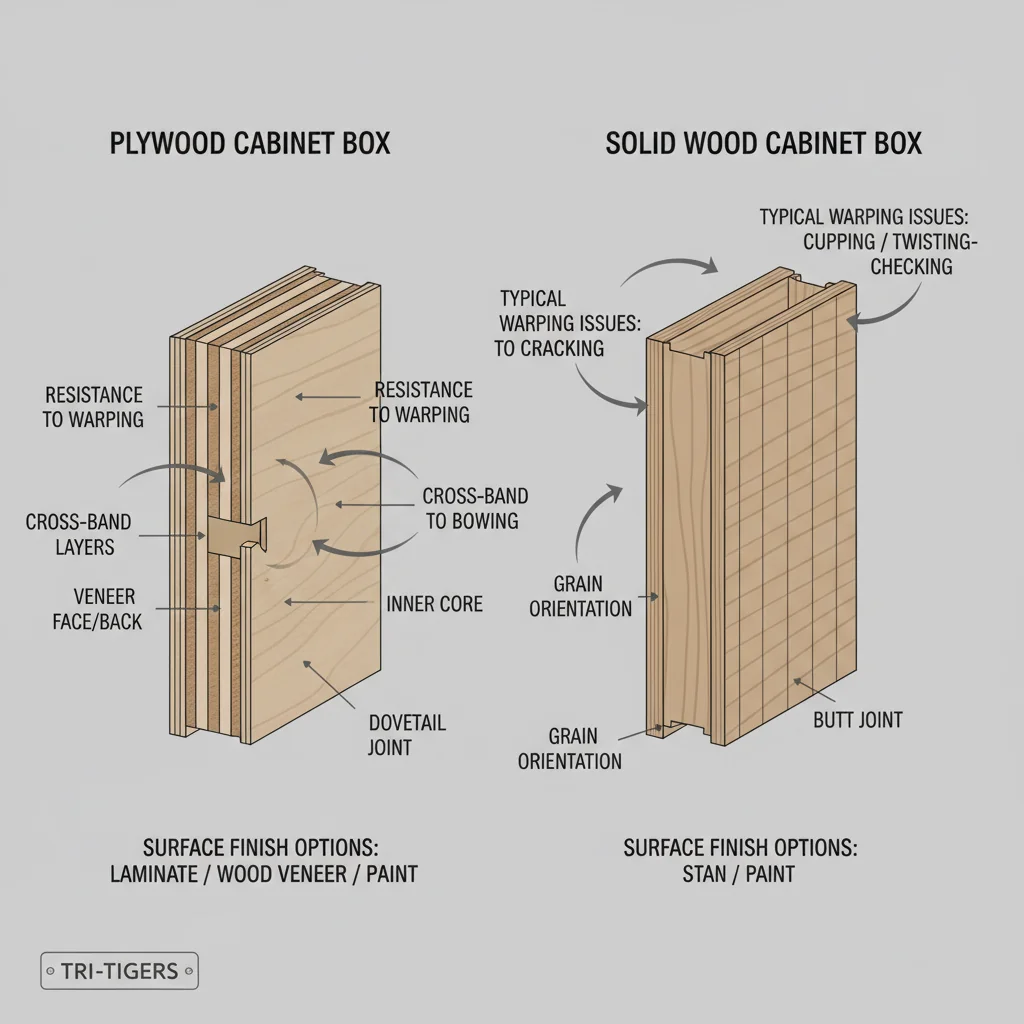
To be honest, the spec that actually matters for cabinet boxes is how they handle real-world stress—humidity swings, weight, and daily use. Solid wood sounds premium, but I’ve seen more failures from cupped or cracked panels than most buyers realize. For example, a German importer tried solid beech cabinet sides a few years back. By winter, several units bowed enough that drawer slides started sticking. The issue? Solid wood moves with the seasons, especially on wide panels. You may get the grain, but you risk gaps and loose joints over time.
Plywood, on the other hand, holds its shape thanks to cross-laminated plies—each layer’s grain runs at 90° to the last. A standard 18mm hardwood core panel, E1-certified, stays flatter in both dry and damp climates. In my experience, a 40HQ container of basic plywood cabinet carcases (flat-pack, unfinished) typically loads up to 350 sets, with lead times about 30-40 days ex-factory. This consistency is why so many Nordic and UK customers order plywood boxes paired with MDF or solid wood doors. You get stability in the structure and refinishable fronts.
If you’re supplying schools, rentals, or hospitals, plywood boxes make even more sense. They cost about 20–30% more than particleboard, but failures are rare, and maintenance is easier. I recommend specifying 1mm PVC edge banding and checking for an E1 or CARB P2 label—these details help avoid surprises in QC or customs. For most European projects, combining plywood boxes with quality doors is the right balance of durability and style.
Plywood cabinet panels are less prone to seasonal warping than solid wood because cross-laminated veneers restrict wood movement across the panel surfaceTrue
Plywood consists of multiple thin wood veneers glued with grain directions alternating, which balances internal stresses and reduces expansion and contraction. Solid wood panels expand more noticeably across the grain, leading to bowing or cupping in wider panels under humidity changes.
Solid wood cabinets consistently outperform plywood in load-bearing capacity due to their uniform grain and densityFalse
Although solid wood has uniform grain, plywood's layered construction often provides equal or greater load resistance. The cross-laminated veneers distribute stress evenly and reduce weaknesses such as knots or grain irregularities found in solid wood, making plywood better suited for resisting weight and stress over time.
Key takeaway: Plywood cabinet boxes offer superior structural stability and value compared to solid wood, especially for high-use or institutional applications. Many manufacturers combine plywood boxes with solid wood or MDF doors, blending durability, practicality, and a premium look—making this configuration a smart, balanced sourcing choice for diverse furniture projects.
What Aesthetic Versatility Do Plywood Cabinets Provide?
Plywood cabinets offer unique aesthetic versatility due to their real-wood core, allowing for clear finishes that highlight natural veneers, popular in Scandinavian and minimalist designs. Decorative overlays or laminates enable contemporary, uniform looks, though core grain may show through thin paints, especially on exposed edges. MDF remains superior for ultra-smooth, high-gloss painted surfaces.
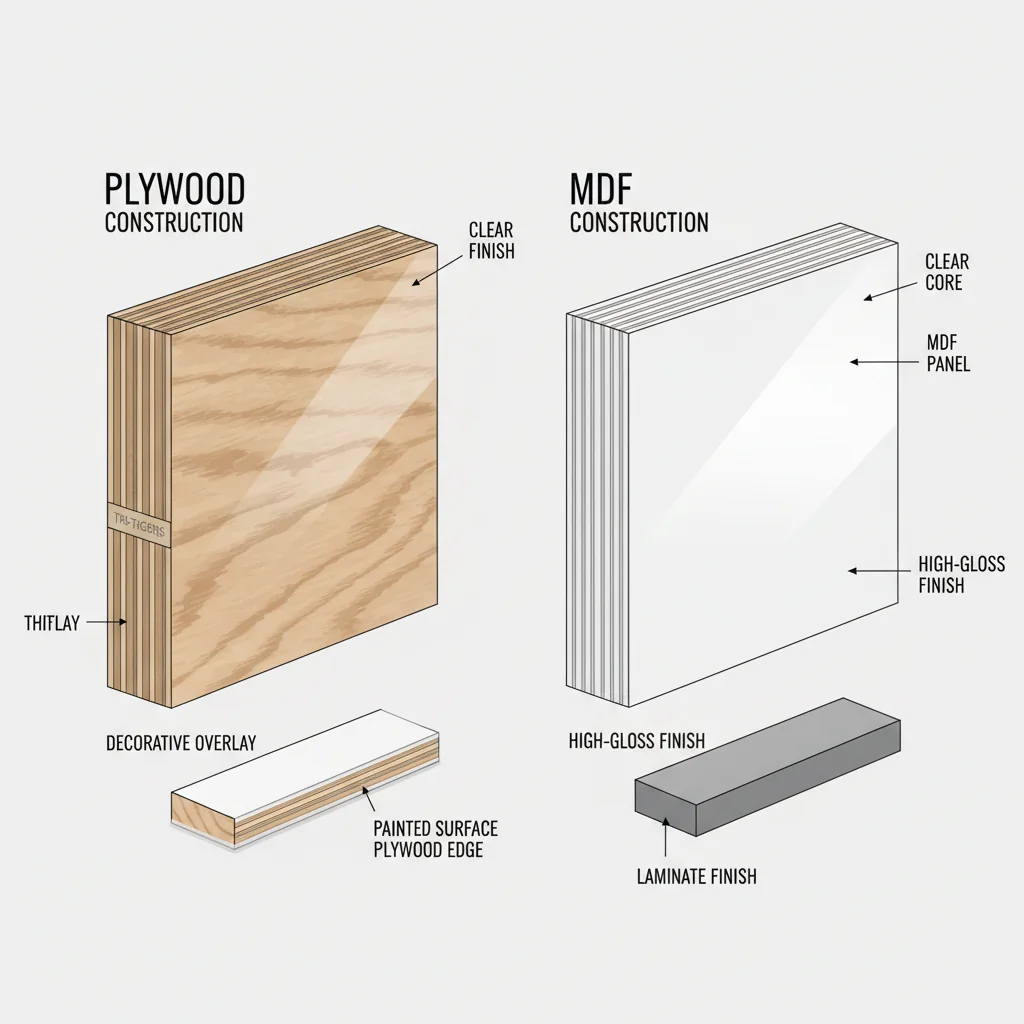
A question I often get from buyers in Sweden and Denmark is about finish options for plywood cabinets—especially for projects with open shelving or glass-front uppers. Plywood’s layered real-wood core allows for a wide range of looks. If you’re aiming for that minimalist, Nordic feel, you can specify an A-grade plywood face and apply a clear PU or UV lacquer9. That finish highlights the warmth and natural grain variation customers love. I’ve seen Scandinavian retailers choose this look on around 40% of new collections last year. For a more uniform or contemporary style, applying decorative veneer10 or high-quality laminate is common. Here, you can select walnut, oak, or even color-matched laminates for a consistent appearance—just be prepared to pay slightly more for premium veneers.
To be honest, the main limitation with plywood is achieving a flawless painted surface. Thinner paint or light colors sometimes reveal the “telegraphing” effect—the subtle show-through of grain or occasional core patch on exposed ends. German clients ordering white or matte-painted kitchens often prefer plywood carcasses for strength, but MDF panels for painted doors and drawer fronts. This approach combines the best of both: visible plywood interiors, plus the smoothest possible exterior finish.
Before finalizing a volume order (around 600-800 cabinets per 40HQ container is typical for 18mm thick panels), I recommend asking for production samples. Insist on seeing both clear-finished and painted surfaces—especially if edges will be visible. That clarity upfront saves headaches in the bulk order.
Using A-grade plywood faces with clear PU or UV lacquer enhances the natural grain and warmth without obscuring texture, which is why Scandinavian retailers prefer this finish for minimalist, Nordic designsTrue
A-grade plywood has fewer knots and more uniform grain, allowing clear coatings to highlight the wood's natural patterns and warmth, essential for Nordic aesthetics focusing on subtle, authentic materials.
Plywood cabinets cannot be finished with UV lacquer because the layered wood structure reacts negatively, causing delamination after curingFalse
Plywood's layered structure is stable enough for UV lacquer finishing; clear UV or PU coatings are commonly applied to plywood surfaces to protect and enhance the wood grain without causing delamination, as long as proper surface preparation and curing processes are followed.
Key takeaway: Plywood cabinets deliver distinctive visual options, from natural veneer warmth to modern overlays, making them suitable for open or glass-front designs. However, visible grain can limit ultra-smooth painted finishes. For painted cabinetry, combining plywood boxes with MDF panels offers both structural strength and flawless exterior appearance.
Why Choose Plywood for Cabinet Safety?
Plywood cabinets offer superior installation safety due to their lighter weight and greater strength compared to melamine-faced particleboard. Enhanced screw-holding capacity reduces the risk of hardware failure, crucial in institutional and seismic zones. Proper installation and code compliance further minimize liability, making plywood a preferred option for reliability and occupant safety in critical environments.
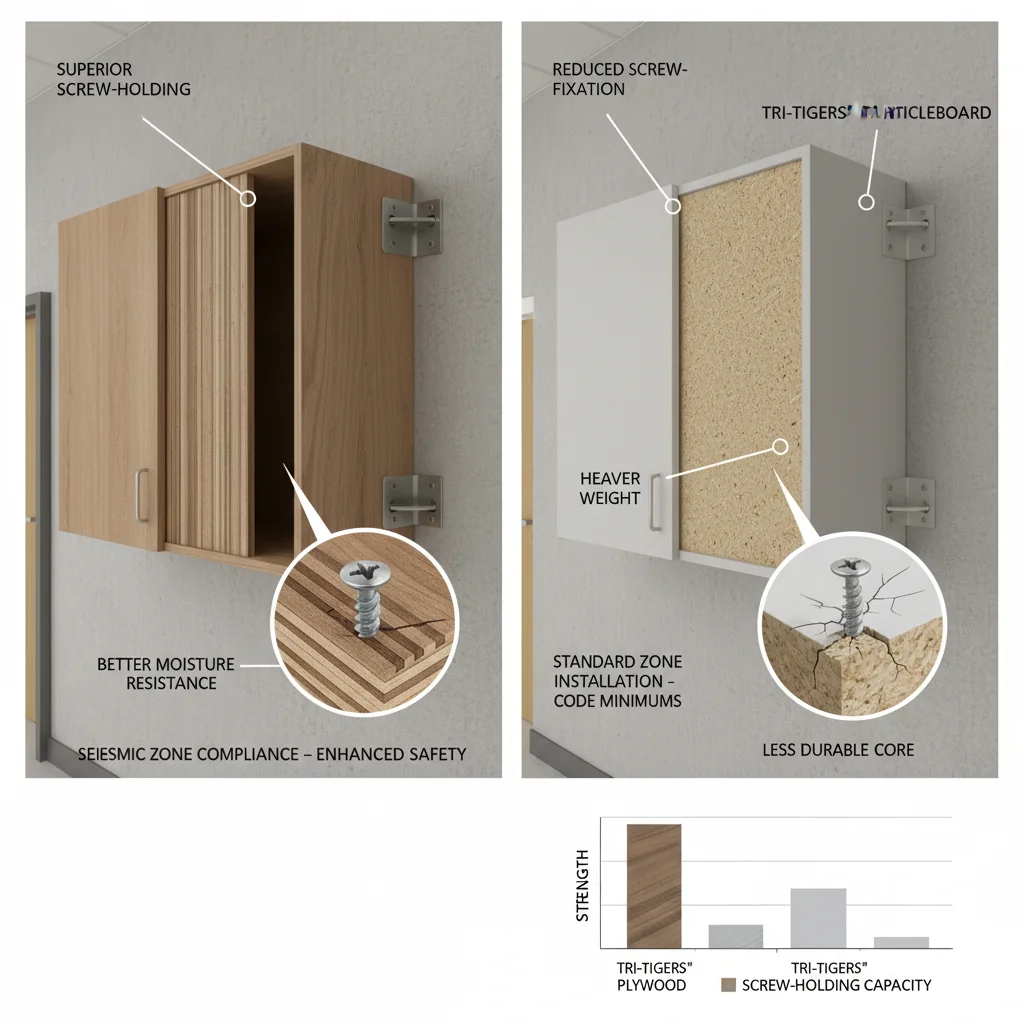
I've worked with several buyers in Germany and the UK who manage large school and hospital projects, and cabinet safety is always their number one concern. The biggest mistake I see is relying on melamine-faced particleboard for wall cabinets that need to support heavy contents. Plywood—especially at standard 18mm thickness—gives you a real safety margin. It’s lighter than particleboard, so installers can handle and align tall or wide cabinets with less risk of a dropped panel or damaged wall. That’s a big deal when you’re lifting units onto masonry or drywall in older buildings.
Plywood’s screw-holding strength is where it really outshines particleboard. One UK contractor I work with recently switched from melamine panels to plywood for a 300-room apartment block. The change added about €18 per unit, but pay attention to what happened: they reduced call-backs for loose hinges and pulled-out drawer runners by at least 75%. In earthquake-prone areas like southern France, that level of security is even more critical—improper mounting or screw tear-out can mean real danger, not just an inconvenience.
For institutional projects, I always suggest E1 or E0-rated plywood to comply with European emission standards. Make sure crews anchor cabinets to studs or solid blocking—never just plasterboard. A typical 40HQ container can hold around 900–1,000 flat-pack plywood cabinets, depending on design and packaging. In the end, this detail protects both facility users and your reputation. Investing in plywood lowers your maintenance risk—and that’s what facility managers in high-load environments care about most.
Plywood cabinets at 18mm thickness typically weigh 15-20% less than comparable melamine-faced particleboard panels, reducing installer fatigue and minimizing the risk of accidental damage during installationTrue
Plywood's wood veneer layers create a lighter but stronger panel compared to denser particleboard composites. This weight difference improves handling safety in wall-mounted cabinet installation, especially for large dimensions.
Melamine-faced particleboard cabinets inherently provide better structural load capacity than 18mm plywood due to the resin coating reinforcing the particleboard coreFalse
Despite the protective coating, melamine-faced particleboard has lower internal strength and is prone to sagging under heavy loads, whereas 18mm plywood's layered construction offers superior load-bearing capacity and dimensional stability for cabinet safety.
Key takeaway: Plywood cabinets improve safety in installation and long-term use, especially in high-risk or heavy-load environments. Their durability and better screw-holding reduce failure risks, provided that professional installation and code requirements are followed. This results in lower maintenance costs and greater peace of mind for facility managers.
How Should Plywood Cabinets Be Maintained?
Plywood cabinets require consistent maintenance to maximize durability. Vulnerable areas, such as sink bases and cut-outs, must be sealed or edge-banded during installation to prevent moisture intrusion. Spills should be wiped immediately, mild soap used for routine cleaning, and hardware like hinges checked biannually. Avoid harsh chemicals that can damage finishes and weaken glue lines over time.
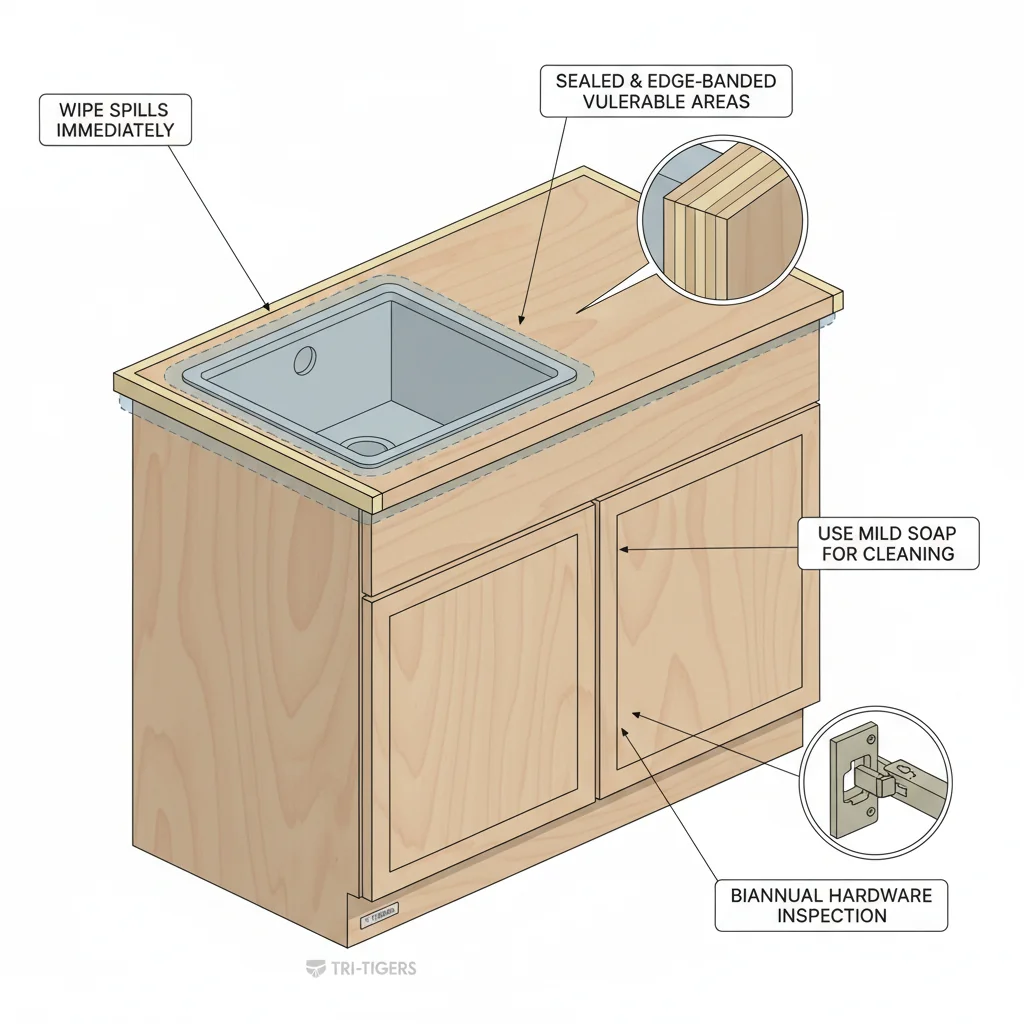
The biggest mistake I see is overlooking the importance of sealing exposed plywood edges—especially at sink bases, dishwasher sides, and cut-out areas. Moisture is the biggest threat to plywood over the long haul. I’ve had UK buyers send me photos where a single unsealed edge under the sink led to swelling and veneer delaminating after only 18 months, even though the rest of the cabinet looked brand new. That’s why I always suggest double-checking that every vulnerable edge is properly edge-banded or treated with waterproof paint or sealant right at installation.
Routine care is straightforward, but makes a noticeable difference. Wipe up spills as soon as they happen, particularly around sinks and integrated appliances. For cleaning, a damp cloth and mild soap do the job—harsh chemicals can break down the finish and even weaken glue lines over time. I’ve seen German facilities managers run routine checks every six months and catch small issues early, adding years to their cabinets’ lifespan.
One technical detail worth mentioning: plywood’s screw holding is stronger than MDF or particleboard, which means hardware—like hinges and drawer slides—stays secure longer. Still, even the best hardware works loose over time with daily use. I recommend a quick check and tighten every six months, especially in commercial spaces.
In short, good moisture protection during installation plus simple routines—wipe spills, gentle cleaning, regular hardware checks—will help you get 15–20 years (or more) from quality plywood cabinets. That reliability is exactly why plywood is still my go-to for high-traffic projects across Europe.
Exposed plywood edges at sink bases must be sealed with edge banding to prevent moisture infiltration that can cause swelling within 18-24 monthsTrue
Moisture penetrating unsealed plywood edges leads to swelling and veneer delamination in as little as 18 months, especially near sinks where humidity is high. Proper edge banding acts as a moisture barrier, significantly extending cabinet lifespan.
Applying a single coat of water-based paint on plywood edges is sufficient to protect against long-term moisture damage in kitchen cabinetsFalse
Water-based paint alone cannot fully seal plywood edges; moisture can still penetrate through tiny gaps and unsealed pores. Edge banding or specialized sealers provide necessary impermeable protection against humidity and water exposure.
Key takeaway: Proper sealing of exposed plywood edges and prompt cleaning are essential to preserving cabinet durability and preventing moisture damage. Regular hardware checks and gentle cleaning routines help maximize plywood’s 15–20+ year service life, making it a reliable long-term choice in residential, commercial, and institutional environments.
Conclusion
We’ve looked at why plywood’s layered structure makes it the go-to choice for long-lasting, reliable cabinet projects—especially when screw-holding and durability matter most. From what I’ve seen in the factories, the difference often comes down to more than material cost. Focusing only on the lowest quote can lead straight into the “quote-to-container gap”—where unexpected packing or logistics details eat your real margins. Before you confirm any big order, I suggest you request a sample shipment and double-check that both build quality and packaging actually match what’s promised. Want to compare plywood with other options or need advice on specifying cabinet materials for your market? Feel free to reach out—I’m always happy to share what’s worked for other importers. Every market’s a little different, and the best choice is the one that serves your customers and your bottom line.
References
-
In-depth info on plywood grading standards, ply composition, and why 7-ply, 18mm boards improve cabinet strength and durability. ↩
-
In-depth explanation of how cross-lamination reduces warping and cracking for durable plywood cabinet cores under real-world conditions. ↩
-
Explains plywood's durability advantages in wet areas, reducing costs and complaints with real case studies from European markets. ↩
-
Detailed explanation on how superior screw-holding power enhances durability and structural integrity in plywood versus particleboard. ↩
-
Insight into E1 rating standards for plywood, focusing on formaldehyde emissions and safety compliance in cabinetry materials. ↩
-
In-depth look at E1 plywood's strength, durability, and formaldehyde emissions for long-lasting, safe cabinetry in demanding environments. ↩
-
Detailed analysis of why plywood panels resist heavy quartz slabs, minimizing sagging and fastener failure under stone countertops. ↩
-
Details formaldehyde emission standards, durability, and smooth polyurethane finishes valued by importers across Europe. ↩
-
Explains how clear PU and UV lacquers protect plywood surfaces while highlighting natural grain in upscale Nordic designs. ↩
-
Details the aesthetic options, material choices, and cost implications of applying decorative veneers for uniform contemporary cabinet looks. ↩
Published: 2025-12-29